
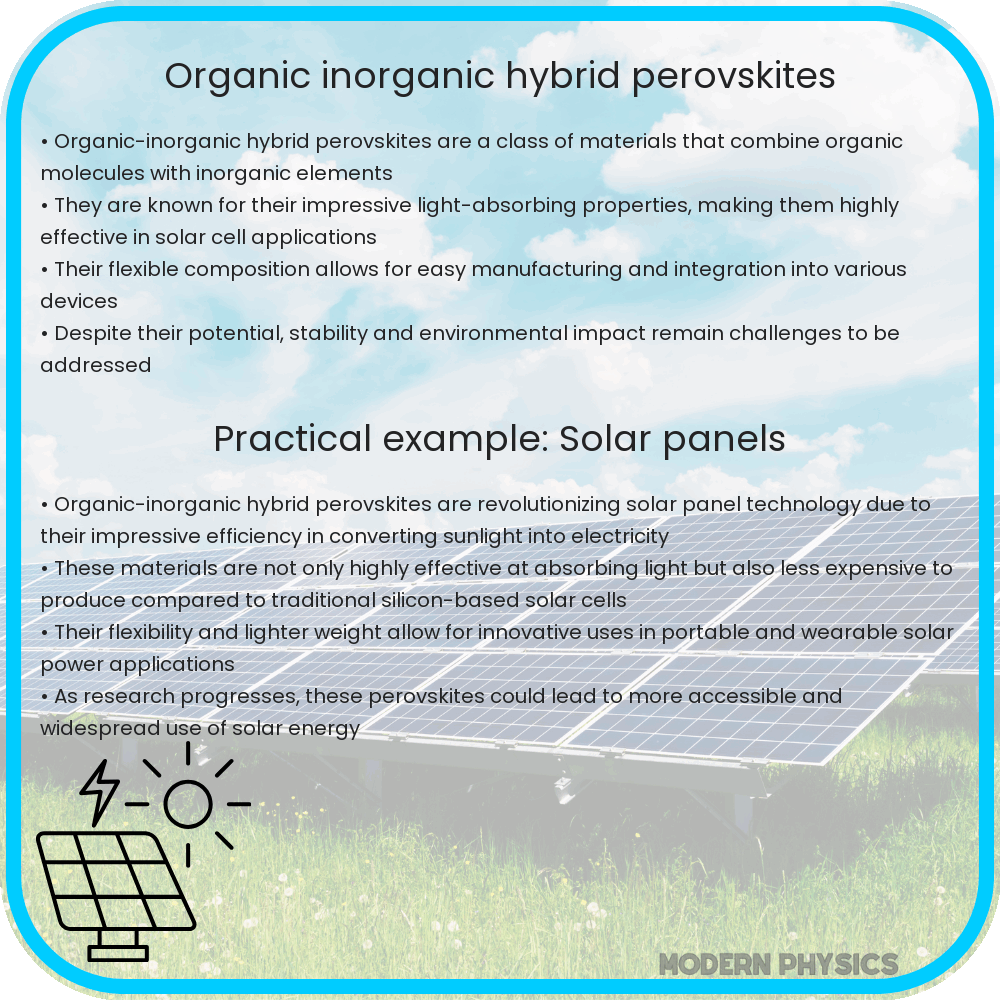
Organic-inorganic perovskites are hybrid materials with a crystal structure similar to calcium titanate, used notably in solar cells.
Introduction to Organic-Inorganic Perovskites
Organic-inorganic perovskites are an exciting class of materials that have captured the attention of researchers across fields such as solar energy, lighting, and electronics. These materials are known for their exceptional combination of efficiency, stability, and cost-effectiveness. But what exactly are they, and why are they so important? Let’s delve deeper into the intriguing world of organic-inorganic perovskites.
What are Organic-Inorganic Perovskites?
Organic-inorganic perovskites are hybrid materials that typically consist of a metal halide bonded with an organic molecule. They are named “perovskite” due to their crystal structure, which closely resembles that of the mineral calcium titanate, originally discovered in Russia and named after mineralogist Lev Perovski. The general formula for these materials is ABX3, where ‘A’ is a cation, often a methylammonium or formamidinium ion; ‘B’ is a metal cation such as lead or tin; and ‘X’ represents a halogen anion like iodide, bromide, or chloride.
Efficiency of Perovskites in Solar Cells
Perovskites have become particularly prominent due to their application in solar cells. In just over a decade, the efficiency of perovskite solar cells (PSCs) has increased from initial values of around 3.8% to over 25% in recent laboratory tests. This rapid improvement indicates a significant breakthrough compared to the more gradual increases seen in traditional photovoltaics like silicon-based cells.
- Superior Light Absorption: One of the key advantages of perovskite materials is their high absorption coefficient. This means they can absorb sunlight efficiently even when the layer is very thin, reducing material usage and cost.
- Favorable Charge Transport Properties: Perovskites possess excellent charge carrier mobility, which helps in the efficient transport of electrical charges generated by light absorption.
- Tunability: The bandgap of perovskites can be tuned by varying the composition of the material, making it possible to optimize them for different photovoltaic applications or even for tandem solar cells, which use multiple layers to capture more energy from the solar spectrum.
Challenges in Stability
Despite their high efficiency, perovskite solar cells face significant challenges in terms of stability. They are sensitive to environmental factors such as moisture, temperature, and ultraviolet light, which can degrade the materials over time.
- Moisture Sensitivity: Water molecules can penetrate the perovskite structure, leading to decomposition and the loss of operational efficiency.
- Thermal Instability: High temperatures can induce structural changes in perovskites, affecting their photovoltaic performance.
- UV Light Exposure: Continuous exposure to ultraviolet light can lead to photo-induced degradation, which compromises the long-term stability of the solar cells.
In response, researchers are exploring various strategies to improve the stability of perovskite solar cells, such as encapsulation techniques, the development of more stable perovskite compositions, and the incorporation of UV filters.
Cost Consideration
One of the most appealing aspects of perovskite solar cells is their potential low cost. The raw materials used are abundant and inexpensive, and the manufacturing processes can be adapted from existing technologies. However, achieving a low cost-production at a commercial scale while maintaining high performance and stability remains a challenge.
- Manufacturing Techniques: Techniques such as solution processing are less expensive compared to the high-vacuum processes used for traditional silicon solar cells.
- Scaling Up: While the technology holds promise for cost-effective manufacturing, scaling up production while maintaining quality and consistency is critical for commercial success.
Environmental Impact and Sustainability
Organic-inorganic perovskites not only offer advantages in performance and cost but also have the potential to be more environmentally friendly compared to traditional solar materials. However, the use of lead in many perovskite solar cells raises concerns about environmental safety and health risks. Research is ongoing to find alternative materials that can replace lead while maintaining the high efficiency and stability of perovskites.
- Lead-Free Perovskites: Scientists are exploring lead-free alternatives such as tin-based perovskites, which could potentially mitigate the environmental and health issues associated with lead.
- Recyclability: Efforts are being made to develop recyclable perovskite solar cells, which would further enhance their sustainability profile.
Future Prospects
The future of organic-inorganic perovskites looks promising with continuous research focused on overcoming the challenges of stability and environmental impact. Advancements in technology could see perovskites becoming a major player in the photovoltaic market, contributing significantly to the global shift towards renewable energy.
- Innovation in Stability: New compositions and encapsulation techniques that improve the stability of perovskite solar cells could accelerate their commercialization.
- Integration with Other Technologies: Perovskites are being studied for their potential integration with other technologies, such as silicon solar cells, to create tandem solar cells with higher overall efficiency.
Conclusion
Organic-inorganic perovskites represent a transformative development in the field of photovoltaics, offering high efficiency, low-cost options, and the potential for less environmental impact. Despite current challenges, notably in stability and the use of lead, the ongoing research and development are likely to lead to practical solutions that will pave the way for wider adoption of this technology. With their remarkable properties and transformative potential, perovskite solar cells continue to be at the forefront of solar technology innovation, holding the key to more sustainable and efficient energy systems in the future.