
Halide perovskites are advanced materials gaining attention for their high efficiency in solar cells and versatility in optoelectronics.
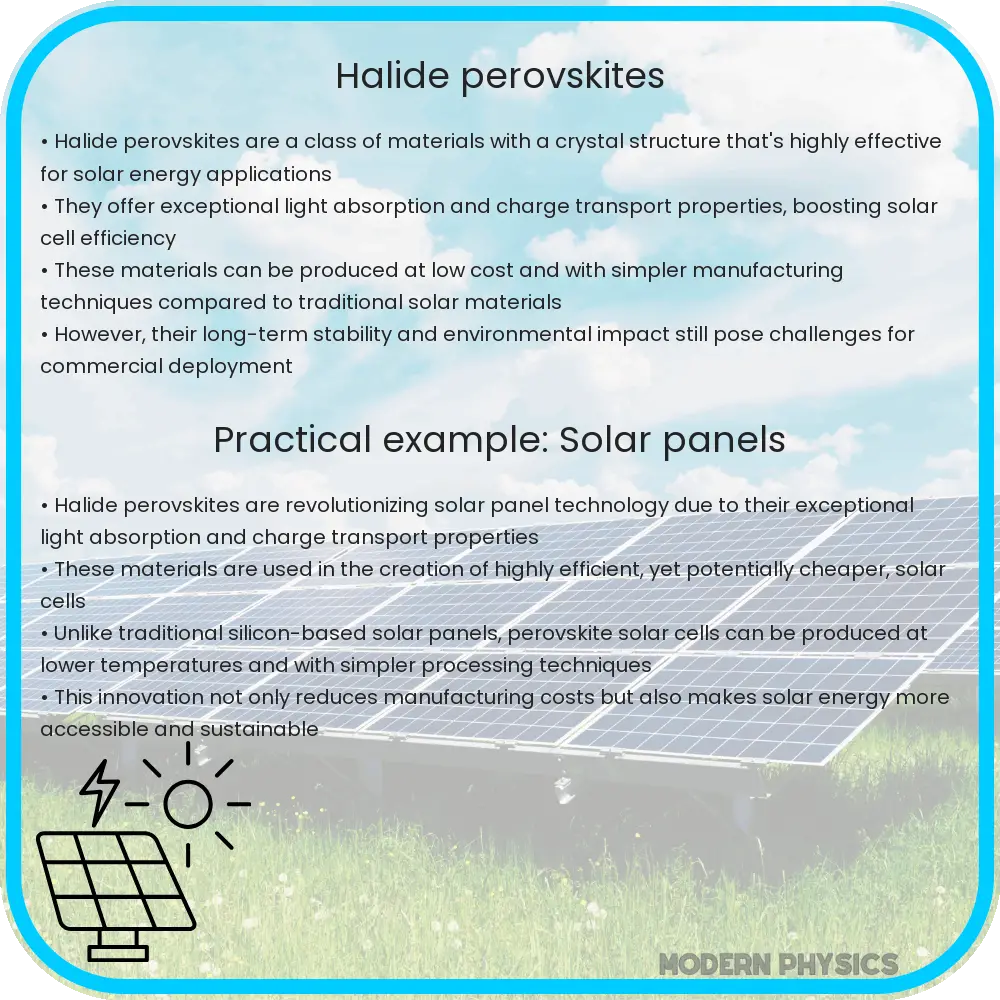
Introduction to Halide Perovskites
Halide perovskites are a class of materials that have taken the field of solar cells and optoelectronics by storm due to their exceptional electronic and optical properties. These materials are typically composed of a metal halide bonded to an organic or inorganic cation, forming a crystalline structure that can efficiently absorb and convert light into electricity. The general formula for these materials is ABX3, where ‘A’ is a cation, ‘B’ is a metal, and ‘X’ is a halide.
Efficiency of Halide Perovskites
One of the most striking aspects of halide perovskites is their impressive photovoltaic efficiency. Over the past decade, the efficiency of perovskite solar cells has skyrocketed from initial values of around 3.8% to more than 25% in recent laboratory tests. This rapid enhancement is attributed to the materials’ high absorption coefficient, direct bandgap, and long carrier diffusion lengths. These properties enable the generation and extraction of charge carriers more effectively compared to traditional materials used in solar cells.
Stability Concerns
Despite their high efficiency, halide perovskites face significant stability challenges that hinder their commercial application. These materials are sensitive to environmental factors such as humidity, temperature, and UV light, which can lead to rapid degradation. Innovations in material engineering like encapsulation and the development of stable perovskite compositions are actively being pursued to overcome these obstacles. Researchers are focusing on incorporating more durable materials into the perovskite structure and developing new fabrication techniques to enhance their stability.
Versatility and Applications
The versatility of halide perovskites extends beyond solar cells, embracing a range of other applications including light-emitting diodes (LEDs), lasers, and photodetectors. This adaptability stems from the tunable bandgaps of perovskites, allowing engineers to design devices that operate over a wide range of frequencies. Furthermore, the easy processing of perovskites, which can often be manufactured using solution-based techniques at relatively low temperatures, presents a significant advantage for commercial scalability and application in flexible or wearable electronics.
Environmental and Economic Impact
The adoption of halide perovskites in various applications could significantly impact both the environment and the economy. In terms of environmental benefits, perovskite solar cells offer a cleaner, more sustainable alternative to fossil fuels, potentially reducing carbon emissions and conserving natural resources. Economically, as the production process is less energy-intensive and more cost-effective than that of traditional silicon-based solar cells, perovskites could lead to cheaper energy solutions and stimulate job creation in new sectors of the technology industry.
Future Prospects
The future of halide perovskites appears promising, with ongoing research aimed at unlocking their full potential. Advancements in nano-engineering and the synthesis of hybrid materials may further enhance their performance and stability. Additionally, the integration of perovskite technology into existing systems and infrastructure poses a fertile ground for innovations that could revolutionize energy production, storage, and consumption. As researchers continue to tackle the challenges of stability and efficiency, we may soon see halide perovskites becoming a cornerstone of modern optoelectronic devices.
Conclusion
Halide perovskites represent a transformative development in the fields of materials science and renewable energy technology. With their high efficiency and versatility, they have the potential to play a pivotal role in advancing solar energy and other optoelectronic applications. Despite facing challenges related to environmental stability, ongoing research and technological innovations promise to improve their performance and durability. The continued exploration of perovskite materials not only fosters hope for a more sustainable future but also opens up a realm of possibilities for enhancing the efficiency and accessibility of renewable energy sources globally.