
Explore the revolutionary world of optical vortices in photonics, their role in beam shaping, precision control, and promising future applications.
Understanding Optical Vortices: Revolutionizing Beam Shaping and Control
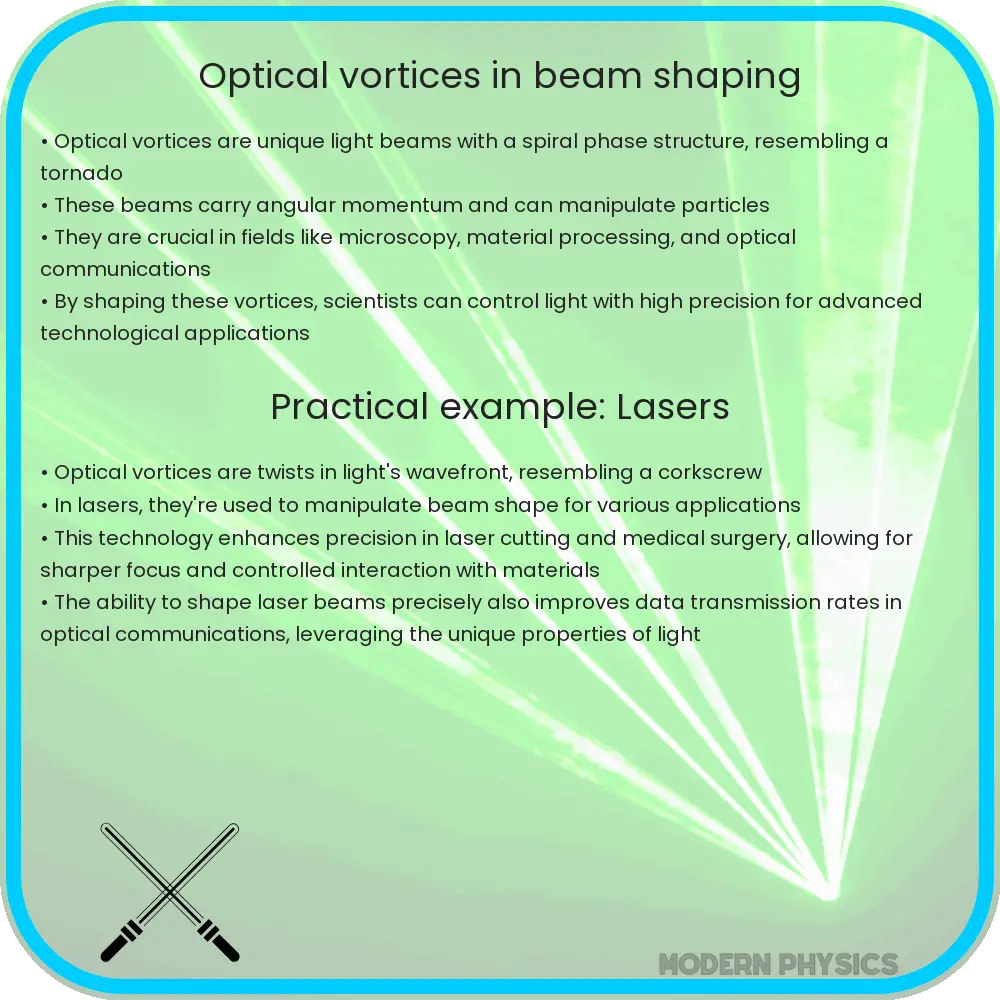
Optical vortices, a groundbreaking concept in photonics, are revolutionizing the way we manipulate light beams. These vortices, characterized by a phase singularity at their center, resemble swirling whirlpools of light. This unique structure empowers them with exceptional properties, making them pivotal in advanced beam shaping and control applications.
The Nature of Optical Vortices
At the heart of an optical vortex is a phase discontinuity, creating a spiral phase structure around a central null intensity point. This phase singularity results in a helical wavefront, distinguishing these vortices from standard Gaussian beams. Notably, optical vortices carry orbital angular momentum (OAM), a property that allows them to exert torque when interacting with matter, thereby opening new avenues in optical manipulation and precision.
Beam Shaping with Optical Vortices
One of the most significant applications of optical vortices is in beam shaping. By superimposing vortices with different topological charges, researchers can tailor the intensity and phase profile of light beams. This flexibility is crucial in creating customized beam shapes for specific applications, ranging from optical tweezers in biological research to laser machining in the industrial sector.
Enhancing Precision and Control
The ability of optical vortices to transfer their orbital angular momentum to particles presents groundbreaking possibilities in precision and control. In optical trapping and manipulation, vortices can rotate microscopic particles, enabling precise control over their orientation and movement. This is invaluable in fields like microbiology, where delicate manipulation of cells and organelles is often required.
Applications Beyond Beam Shaping
Beyond beam shaping, optical vortices have diverse applications. In telecommunications, the OAM of light offers a new dimension for data encoding, potentially increasing the bandwidth of optical fibers. In imaging, the unique phase properties of vortices enhance the resolution of microscopes, allowing for more detailed observations at the nanoscale.
As research continues, the potential of optical vortices in various fields is rapidly expanding, promising revolutionary advancements in photonics and beyond.
Is this conversation helpful so far?
Advanced Techniques in Generating and Manipulating Optical Vortices
The generation and manipulation of optical vortices have seen significant advancements, thanks to innovative techniques like computer-generated holography and spatial light modulators (SLMs). These tools allow for precise control over the phase and amplitude of light, enabling the creation of complex vortex patterns. SLMs, in particular, have become instrumental in dynamically shaping optical vortices, allowing for real-time adjustments in experiments and applications.
Challenges and Future Prospects
Despite their vast potential, optical vortices face challenges, particularly in stability and control under practical conditions. The sensitivity of vortices to environmental disturbances can lead to phase aberrations, impacting their effectiveness. Addressing these challenges requires ongoing research, particularly in the areas of adaptive optics and error correction algorithms.
Future prospects in the field of optical vortices are immensely promising. The exploration of quantum properties of vortices, for instance, could lead to breakthroughs in quantum computing and secure communications. Additionally, the integration of optical vortices with nanotechnology could open new frontiers in nanoscale manipulation and fabrication.
Conclusion
Optical vortices represent a fascinating and potent tool in the realm of photonics, offering unparalleled capabilities in beam shaping, precision, and control. Their unique properties, such as the transmission of orbital angular momentum, have opened up new possibilities in various scientific and industrial fields. From enhancing the resolution of imaging systems to enabling high-capacity data transmission in optical fibers, the applications of optical vortices are as diverse as they are impactful.
However, the full potential of optical vortices is yet to be realized. Challenges in stability and control under practical conditions remain, necessitating further research and development. As technology advances, the integration of optical vortices with emerging fields like quantum computing and nanotechnology is likely to lead to even more groundbreaking applications.
In conclusion, the journey of optical vortices from a theoretical curiosity to a practical tool in photonics exemplifies the power of scientific innovation. As we continue to unravel the complexities of these light whirlpools, their role in shaping the future of technology and science appears more significant than ever.