
Understanding the Cornu Spiral: A key graphical tool in optics used to visualize and analyze light wave interference in diffraction patterns.
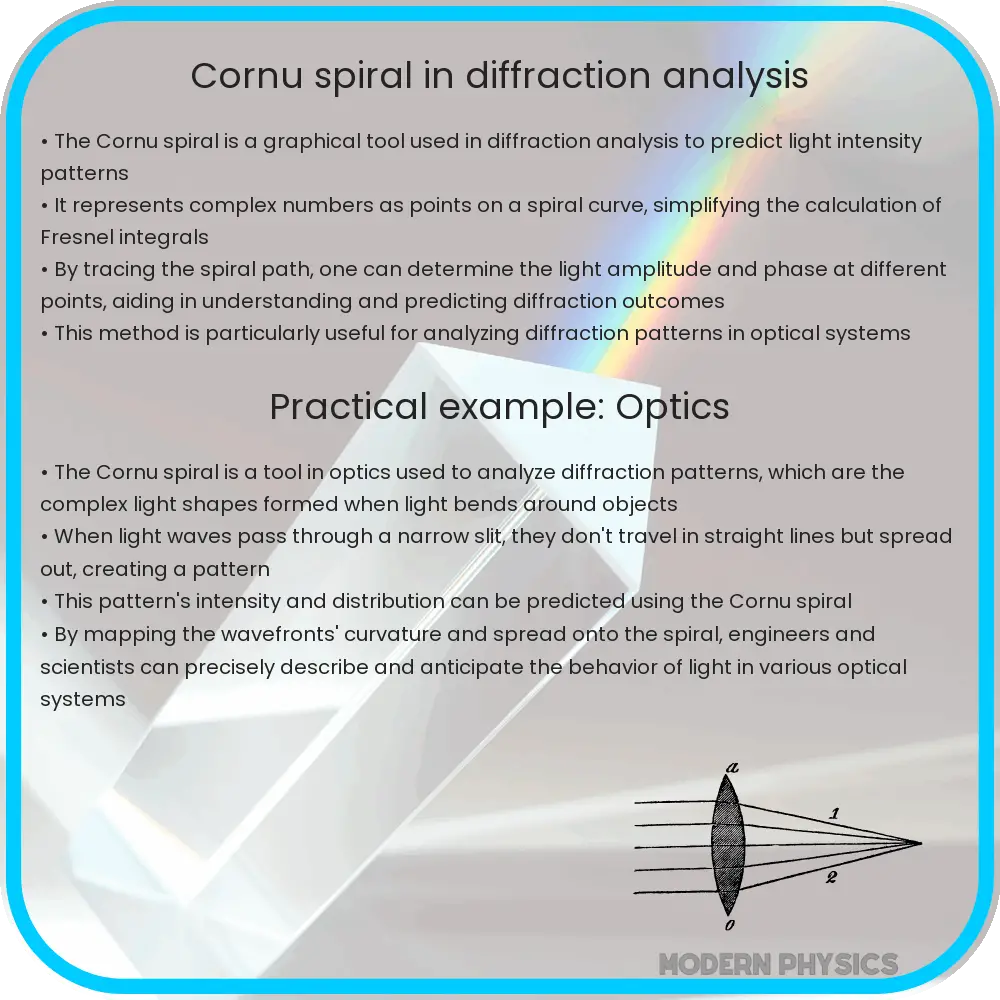
Understanding the Cornu Spiral in Diffraction
The Cornu spiral, also known as the Fresnel spiral, is a fascinating graphical tool used in optics to understand diffraction patterns. This spiral provides a powerful and intuitive visualization of how light waves interfere with each other when they encounter obstacles.
Precision in the Cornu Spiral
The Cornu spiral arises from the Fresnel integrals, which describe the complex amplitude of a wave diffracted by a straight edge. The spiral itself is a plot in the complex plane, where each point corresponds to the cumulative effect of the Fresnel integrals up to that point. The integrals are given by:
- \( C(u) = \int_0^u \cos(\frac{\pi}{2} t^2) dt \)
- \( S(u) = \int_0^u \sin(\frac{\pi}{2} t^2) dt \)
Here, \( u \) is a scaled parameter related to the distance from the center of the diffraction pattern to a point on the observation screen, and \( t \) is the integration variable. The real and imaginary parts of the optical field at any point along the spiral represent these two integrals, \( C(u) \) and \( S(u) \), respectively.
The precision of the Cornu spiral in predicting diffraction patterns lies in its ability to account for every part of the wavefront, encapsulating the continuous nature of wave propagation and interference. This allows for an accurate prediction of diffraction effects including fringe visibility, position, and intensity across various settings—from slit-based diffractions to more complex patterns like those formed by circular apertures.
Clarity in the Cornu Spiral Representation
The Cornu spiral simplifies the complex mathematics of wave interference into a visual form, making it clearer for students and researchers to understand and predict the patterns of light. Each turn of the spiral corresponds to significant points in the wavefront propagation. The endpoint of the spiral gives the net result of the diffraction at a particular point, providing a direct visual insight into the phase and amplitude of the diffracted wave.
This clarity is not just theoretical. Practical applications, such as in the alignment of optical systems and the analysis of light diffraction properties, depend heavily on accurate predictions of where and how light waves will spread. The Cornu spiral offers a straightforward path to these analyses, bridging theoretical predictions with real-world optical behavior.
Applications of the Cornu Spiral
The applicability of the Cornu spiral extends beyond the classrooms and into real-world engineering and technology fields. One prominent application is in the design and analysis of optical systems where understanding the diffraction effects is crucial. For example, in designing lenses for cameras, microscopes, or telescopes, engineers can use the Cornu spiral to predict how different lens shapes and aperture sizes will affect the focus and clarity of the final image.
Furthermore, the Cornu spiral is instrumental in the telecommunications industry, particularly in the design of fiber optic systems. Here, understanding how light bends and spreads within the fiber guides the design of more efficient and higher bandwidth systems. The detailed insights provided by the Cornu spiral into the phase and amplitude of waves help in optimizing the fiber routes and the placement of repeaters to ensure the best performance of the network.
The Cornu spiral also finds application in acoustic engineering, where similar principles of wave interference apply. Acoustic engineers use the Cornu spiral to design better auditoriums, concert halls, and other spaces where sound clarity and distribution are paramount. By predicting how sound waves will interact with surfaces and obstacles, designs can be optimized to enhance sound quality and minimize noise pollution.
In more advanced optical research, the Cornu spiral assists in the development of new imaging techniques, including those in medical imaging. The diffraction analysis facilitated by this tool helps improve the resolution and sharpness of images which are critical in medical diagnostics.
In summary, the Cornu spiral is an essential tool in optics that offers both precise predictions and clear visualizations of diffraction patterns. Its applications across various fields showcase its versatility and significance in the advancement of technology and scientific understanding.
Enhancing Education with the Cornu Spiral
The educational benefits of the Cornu spiral are profound. In academic settings, it serves not only as a tool for teaching physics and optical engineering but as a bridge in understanding complex phenomena through visual means. Learners can grasp the intricate behaviors of light waves and their interactions without delving deep into the intimidating mathematical details initially.
By introducing the Cornu spiral in visual experiments and simulations, educators can visually demonstrate the underlying physics of light diffraction. This approach not only makes learning more engaging and interactive but also deepens the understanding of theoretical concepts by linking them to observable real-world phenomena.
Future Prospects of the Cornu Spiral
The Cornu spiral continues to inspire new technologies and methods. As advancements in computational power and graphical display evolve, the potential to simulate and visualize complex wave interactions in real-time grows. Such progression could lead to more sophisticated software that incorporates Cornu spiral calculations to deliver even more detailed predictions and analysis for various scientific and engineering applications.
Moreover, ongoing research into materials with unique light interaction properties, like metamaterials, may further expand the practical applications of the Cornu spiral. Scientists can use it to explore and predict the behavior of light in new, artificially engineered environments, potentially leading to breakthrough technologies in optics and photonics.
Conclusion
The Cornu spiral represents a significant achievement in optical physics, providing an intuitive and precise method to visualize and analyze light diffraction. Its application stretches across various domains, from engineering better optical devices to enhancing telecommunications and even improving acoustical environments. As we continue to discover and harness the capabilities of light and sound, the Cornu spiral remains a fundamental tool in both education and advanced research, bridging the gap between theoretical science and practical engineering.
Embracing the Cornu spiral helps demystify complex phenomena, allowing both students and professionals to innovate and excel in their fields. Continuing to explore its applications and potential will undoubtedly lead to new insights and developments, making it a perennial asset in the quest for scientific and technological advancement.