
Explore the essentials of optical testing: accuracy, speed, geometric precision, advanced techniques, and applications in various industries.
Understanding the Essentials of Optical Testing
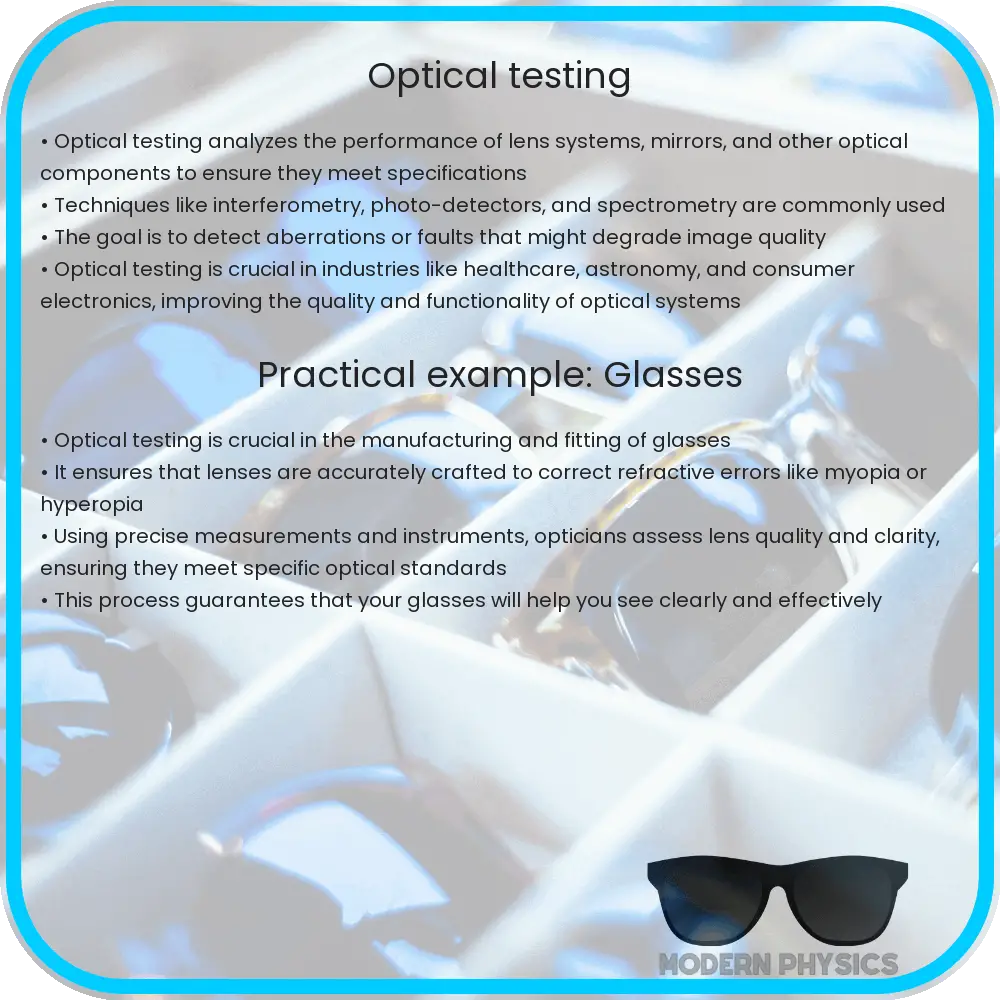
Optical testing is a critical process in the evaluation and quality assurance of various optical components and systems. This field combines the principles of optics, physics, and engineering to measure the performance, accuracy, and precision of optical elements such as lenses, mirrors, and prisms. In this article, we delve into the core aspects of optical testing, focusing on three pivotal attributes: accuracy, speed, and geometric precision.
Accuracy in Optical Testing
Accuracy is paramount in optical testing, as it determines the degree to which the test results reflect the true values. This involves assessing parameters like focal length, wavefront error, and surface quality of optical components. High accuracy in optical testing ensures that optical systems perform as expected in critical applications, ranging from microscopy to aerospace. Advanced techniques like interferometry and Shack-Hartmann wavefront sensing are often employed to achieve high levels of accuracy.
Speed: A Key Factor in Modern Optical Testing
In today’s fast-paced industrial environment, the speed of optical testing is as crucial as its accuracy. Rapid testing allows for quicker production cycles and prompt quality control, facilitating timely market entry for optical products. Techniques like computer-controlled scanning and real-time data acquisition have significantly increased the speed of optical testing, making it more efficient and cost-effective.
Geometric Precision in Optical Testing
Geometric precision in optical testing refers to the ability to measure and verify the exact shapes and dimensions of optical components. It’s essential for ensuring that the optical elements fit perfectly within an optical system and perform optimally. Techniques such as profilometry and coordinate measuring machines (CMMs) are utilized to achieve high geometric precision in optical components.
Each of these factors – accuracy, speed, and geometric precision – plays a vital role in the overall effectiveness and reliability of optical testing. By understanding and optimizing these aspects, manufacturers and researchers can ensure the highest standards for optical components and systems.
In the next section, we will explore the advanced techniques and technologies used in optical testing, along with their applications and challenges.
Is this conversation helpful so far?
Advanced Techniques and Technologies in Optical Testing
Advancements in optical testing technologies have revolutionized how we assess and ensure the quality of optical components. Techniques such as laser interferometry provide unparalleled accuracy in measuring wavefront errors and surface deformities. Another cutting-edge approach is digital holography, which allows for non-contact, three-dimensional measurements at high speeds.
Furthermore, the integration of artificial intelligence (AI) and machine learning algorithms has enabled automated defect detection and predictive maintenance, enhancing both speed and accuracy. This automation not only reduces human error but also significantly speeds up the testing process.
Applications and Challenges in Optical Testing
Optical testing finds applications in diverse sectors, from consumer electronics, where it ensures the quality of camera lenses and displays, to aerospace and defense, where it guarantees the performance of high-precision instruments like telescopes and satellite cameras. The medical field also benefits, especially in the manufacture of precision instruments used in surgeries and diagnostics.
Despite its numerous applications, optical testing faces challenges such as the need for highly skilled technicians and the high cost of advanced testing equipment. Moreover, as optical components become more sophisticated, the complexity of testing increases, necessitating continuous innovation in testing methodologies.
Conclusion
In conclusion, optical testing is a critical field that ensures the quality and performance of optical components and systems. The accuracy, speed, and geometric precision of optical testing are crucial for a wide range of applications, from everyday consumer products to specialized scientific instruments. With advancements in technology, including AI and laser interferometry, optical testing continues to evolve, offering more efficient and accurate methods. However, the field faces ongoing challenges, including the need for skilled personnel and the high cost of equipment. As we move forward, the continual development of optical testing techniques will play a key role in driving innovation across various industries, underlining its importance in our technologically driven world.