
Explore the role of principal focus in optics for precision and clarity, covering lenses, mirrors, and advanced applications in everyday life.
Understanding the Principal Focus in Optics
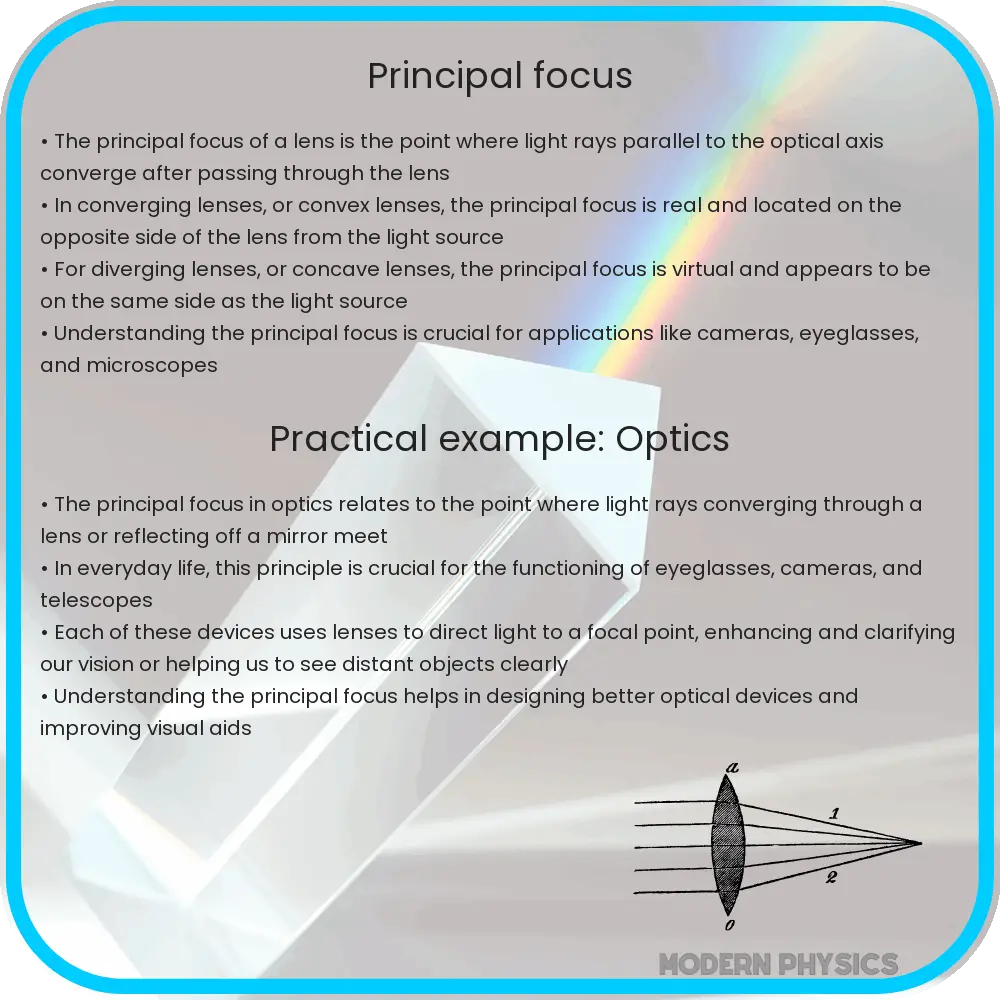
Optics, a branch of physics, intricately studies the behavior and properties of light, including its interactions with matter and the construction of instruments that utilize or detect it. The principal focus is a fundamental concept in optics that pertains to the precise point where light rays converge or appear to diverge from. This concept is pivotal in the design and function of various optical devices such as lenses and mirrors.
The Role of Precision and Clarity in Optical Systems
Precision and clarity are paramount in the field of optics. The effectiveness of optical devices, whether it’s a simple magnifying glass or a complex telescope, heavily relies on the accuracy of their design and the quality of materials used. Precision in optics ensures that light rays are accurately focused, leading to clear and undistorted images. This precision is achieved through meticulous design and manufacturing processes that account for factors like lens curvature, thickness, and refractive index.
Functional Significance of Optics in Everyday Life
The principles of optics are not just confined to scientific laboratories; they play a crucial role in our daily lives. From the glasses we wear to improve vision, to the cameras in our smartphones, the application of optical principles is widespread. Understanding the principal focus in optics helps in optimizing these devices for better performance and efficiency.
Key Components of an Optical System
An optical system typically consists of components like lenses, mirrors, and prisms. Each of these elements plays a vital role in manipulating light. Lenses, made from transparent materials like glass or plastic, are curved to converge or diverge light rays. Mirrors, on the other hand, reflect light rays, allowing for the formation of images. Prisms are used to refract (bend) light, often separating it into its constituent colors.
- Lenses: Lenses are characterized by their focal length, which is the distance between the lens and its principal focus. The focal length is determined by the curvature and the material of the lens.
- Mirrors: Mirrors can be flat, concave, or convex, each having unique properties in terms of reflecting light. The principal focus in mirrors is crucial in applications like telescopes and periscopes.
- Prisms: Prisms are used to refract light, a process dependent on the angle and the material of the prism. They are integral in devices like binoculars and spectrometers.
Understanding these components and their functions is essential in the study of optics, as they directly impact the precision and clarity of the images produced.
Is this conversation helpful so far?
Advanced Applications of Optics: Beyond the Basics
Optics transcends basic applications, venturing into advanced territories like fiber optics, astronomical telescopes, and medical imaging. In fiber optics, light is transmitted through thin glass fibers, a process relying heavily on the principles of total internal reflection. This technology is fundamental in high-speed internet and telecommunications. Astronomical telescopes, which use a combination of lenses and mirrors, illustrate the importance of principal focus in observing distant celestial bodies. In medical imaging, devices like endoscopes and optical microscopes rely on precise optical systems to provide clear and detailed images of internal body structures.
Challenges in Optical Design and Fabrication
Designing and fabricating optical components is a challenging task. It requires not only a deep understanding of optical principles but also a meticulous approach to material selection and manufacturing techniques. The refractive index, a measure of how much light bends when entering a material, is a critical factor in lens design. Additionally, optical surfaces must be free of imperfections to avoid aberrations, which can distort images. Advanced manufacturing techniques, such as computer-controlled grinding and polishing, are employed to achieve the high level of precision required in optics.
The Future of Optics: Innovations and Developments
The field of optics is continually evolving, with research and development pushing the boundaries of what is possible. Innovations like adaptive optics, which compensates for atmospheric disturbances in telescopic observations, and metamaterials, which have unique properties not found in nature, are shaping the future of optics. These advancements promise to revolutionize fields ranging from astronomy to telecommunications, offering unprecedented precision and clarity.
Conclusion
In summary, the principal focus in optics is a cornerstone concept that plays a vital role in the precision, clarity, and functionality of optical systems. From everyday objects like eyeglasses and cameras to sophisticated equipment in telecommunications and medical imaging, the principles of optics are fundamental. The challenges in optical design and fabrication demand precision and innovation, paving the way for future advancements. As technology progresses, the scope of optics expands, promising new discoveries and applications that will continue to transform our understanding of light and its myriad applications in our lives.