
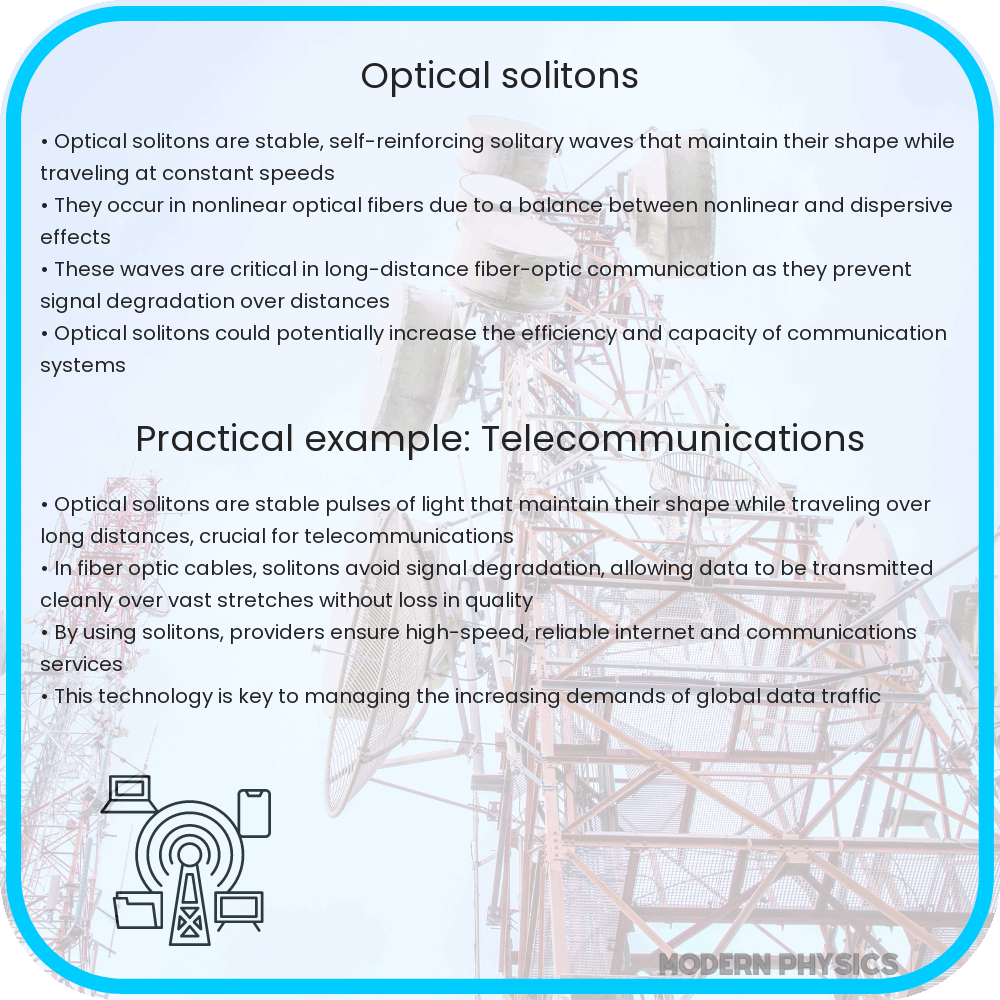
Optical solitons are pulses of light that maintain shape and speed in optical fibers due to a balance of nonlinear and dispersive effects.
Introduction to Optical Solitons
Optical solitons are fascinating phenomena that occur when pulses of light maintain their shape and speed over long distances through a transmission medium, typically an optical fiber. This stability is due to a precise balance between nonlinear and dispersive effects within the fiber. Understanding optical solitons is critical for advancements in fiber-optic communications and various other applications in the field of optics.
The Physics Behind Optical Solitons
At the core of optical soliton behavior is the interplay between group velocity dispersion (GVD) and the Kerr effect, a type of nonlinear optical effect. In typical fibers, pulses of light tend to spread out as they travel due to GVD, where different components of a pulse travel at different speeds. However, in the presence of intense light, the Kerr effect comes into play, inducing a refractive index change in the fiber that is proportional to the light intensity. This change can exactly counteract the dispersion, thus forming a soliton.
Mathematically, this balance can be described by the Nonlinear Schrödinger Equation (NLSE):
i*∂ψ/∂z + (1/2)*β2*∂2ψ/∂t2 + γ*|ψ|2ψ = 0
where ψ represents the electric field envelope, z is the propagation direction, t is time, β2 is the second-order dispersion parameter, and γ is the nonlinear parameter of the fiber.
Properties of Optical Solitons
One of the key characteristics of optical solitons is their robustness and stability over great distances, a property exploited in long-distance optical communication systems. The speed of solitons in fiber optics is primarily determined by the medium through which they propagate, and this can be adjusted for different communication needs by tweaking the fiber’s properties such as its dispersion and nonlinearity.
- Speed: The speed of solitons in optical fibers is determined by the fiber’s refractive index and geometrical characteristics. Unlike regular light pulses, solitons are not subject to dispersion-induced spreading, allowing them to maintain high speeds over long distances.
- Stability: Optical solitons owe their stability to the inherent balance between dispersion and nonlinearity. This equilibrium prevents the soliton from dispersing (spreading out) or breaking down as it travels, making them ideal for reliable data transmission over hundreds or even thousands of kilometers.
Applications of Optical Solitons
Optical solitons are not just theoretical constructs but have practical applications in various fields of technology. The most prominent application is in the realm of telecommunications, where the ability of solitons to travel long distances without losing shape or energy is invaluable. This characteristic enables the transmission of data over long stretches without the need for repeaters, significantly reducing the cost and complexity of cable networks.
- Fiber-Optic Communications: In this industry, solitons can be used to transmit information at high speeds with minimal loss in fidelity, which is crucial for backbone internet connections and intercontinental communication links.
- Optical Computing: Solitons may also play a role in the development of optical computing technologies, where they can be used to carry and process information in an all-optical system.
- Medical Imaging and Sensing: The unique properties of solitons can be utilized in advanced medical imaging techniques and sensors, potentially allowing for better resolution and deeper tissue penetration.
Challenges in Harnessing Optical Solitons
Despite their advantages, optical solitons also present certain challenges that must be addressed to harness their full potential. One significant challenge is the precise control of fiber properties, such as dispersion and nonlinearity, which must be finely tuned to maintain soliton properties. Additionally, external factors like temperature fluctuations and fiber bending can influence the behavior of solitons, potentially disrupting their stability.
- Precision in Fiber Design: Designing fibers with exact nonlinearity and dispersion parameters is crucial. This requires advanced materials engineering and precise manufacturing techniques.
- Environmental Sensitivity: Optical solitons are sensitive to environmental changes, including temperature variations and mechanical stresses, which can alter their propagation characteristics.
Future Prospects of Optical Solitons
As research continues to advance, the applications and capabilities of optical solitons are expected to expand. Innovations in fiber technology and better control methods may allow us to overcome current limitations, opening new avenues in optical communication and beyond. Researchers are also exploring the potential of solitons in quantum computing, where they could play a pivotal role in carrying quantum information over large distances.
- Enhanced Optical Communications: Future advancements could allow for even more efficient and long-range communication systems, utilizing solitons to reduce power consumption and boost data transfer rates.
- Quantum Information Systems: Solitons might be essential in developing secure, efficient quantum communication channels, which are fundamental for quantum cryptography and networking.
Conclusion
Optical solitons are not merely curiosities within the realm of physics but are a cornerstone technology in modern optical communications and have potential applications across other advanced fields. Understanding the balance between nonlinearity and dispersion has allowed scientists and engineers to utilize these stable, high-speed pulses to revolutionize how data is transmitted across vast distances. Although challenges remain, the ongoing research and development in fiber optic technologies and material science promise to enhance the capabilities of optical solitons further and possibly expand their applicability to emerging technologies such as quantum computing. By continuing to refine these complex interactions within optical fibers, the horizon expands for the next frontier of communication and computing technologies.