
Discover the precision, stability, and versatility of optical clamps and stands, essential for scientific research, industrial quality control, and photography.
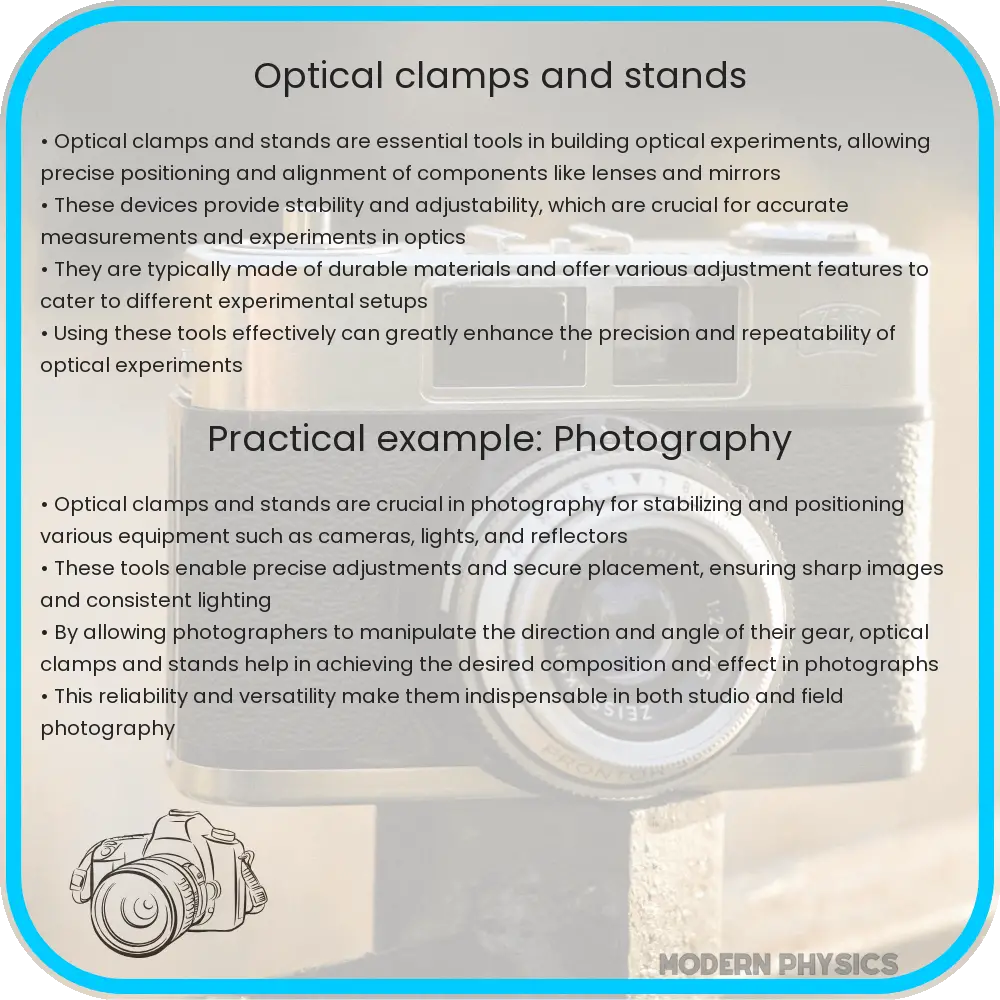
Exploring the World of Optical Clamps and Stands: Precision, Stability, and Versatility
Optical clamps and stands are indispensable tools in the realm of scientific research, engineering, and photography, offering unparalleled precision, stability, and versatility. These devices are designed to hold and position various optical components, including lenses, mirrors, and filters, with utmost accuracy. This article delves into the features, applications, and selection criteria of optical clamps and stands, highlighting their critical role in advancing experimental and industrial processes.
Key Features of Optical Clamps and Stands
Optical clamps and stands are characterized by their ability to secure optical elements in precise positions, ensuring that experimental setups or photographic compositions are both stable and adjustable. The following features distinguish these tools:
- Precision Engineering: High-quality optical clamps and stands are crafted with precision engineering, allowing for micro-adjustments that are essential in applications requiring nanometer-scale accuracy.
- Versatility: They are designed to accommodate a wide range of optical components and instruments, making them suitable for diverse applications across different fields.
- Stability: These devices provide a stable platform that minimizes vibrations and movement, crucial for experiments and applications where even the slightest disturbance can lead to significant errors.
- Material Quality: Constructed from durable materials such as stainless steel and aluminum, optical clamps and stands are built to withstand the rigors of both laboratory and field use.
Applications of Optical Clamps and Stands
Optical clamps and stands find applications in a variety of settings, from academic research laboratories to industrial manufacturing plants and photography studios. They are used in:
- Scientific Research: In physics and chemistry experiments, optical clamps and stands are used to precisely position lenses, mirrors, and prisms for experiments involving light propagation, reflection, and refraction.
- Medical and Biological Imaging: For microscopy and other imaging techniques, these tools help in securing cameras, lenses, and specimens for detailed observation.
- Industrial Quality Control: In manufacturing, they are utilized to hold components in place for inspection and measurement, ensuring products meet stringent quality standards.
- Photography and Filmmaking: Photographers and filmmakers rely on optical clamps and stands to position lights, cameras, and reflectors for optimal shot composition.
Choosing the Right Optical Clamps and Stands
Selecting the appropriate optical clamp or stand depends on the specific requirements of your application. Consider the following criteria to ensure you choose a device that meets your needs:
- Compatibility: Ensure the clamp or stand is compatible with the optical components you plan to use, including their size, weight, and mounting requirements.
- Adjustability: Look for devices that offer a wide range of adjustability options, including tilt, rotation, and height adjustments, to provide flexibility in your setup.
- Sturdiness: Opt for clamps and stands made from high-quality materials that can provide a stable base and resist wear and tear over time.
- Portability: If your work requires mobility, consider the weight and design of the clamp or stand for easy transportation and setup.
Maintenance and Care for Longevity
To ensure the longevity and performance of your optical clamps and stands, regular maintenance is essential. Keep the devices clean and free from dust and debris, which can interfere with precision. Lubricate moving parts as needed to maintain smooth operation. Store them in a dry, cool place to prevent corrosion and damage. By taking proper care of your optical clamps and stands, you can extend their life and maintain their accuracy and reliability.
Conclusion
Optical clamps and stands are foundational tools that support a wide array of scientific, industrial, and creative endeavors by providing precision, stability, and versatility. Their role in facilitating accurate positioning and measurement is crucial in experiments, quality control processes, and artistic expressions. When selecting an optical clamp or stand, it’s important to consider compatibility, adjustability, sturdiness, and portability to match your specific requirements. With proper selection, use, and maintenance, these devices can significantly enhance the precision and quality of your work, contributing to advancements in research, manufacturing, and the arts. Embrace the capabilities of optical clamps and stands to unlock new possibilities in your field, ensuring that every detail is captured with the utmost accuracy and stability.