
Explore the precision and benefits of optical pyrometers for non-contact, high-temperature measurements in industries like metallurgy and manufacturing.
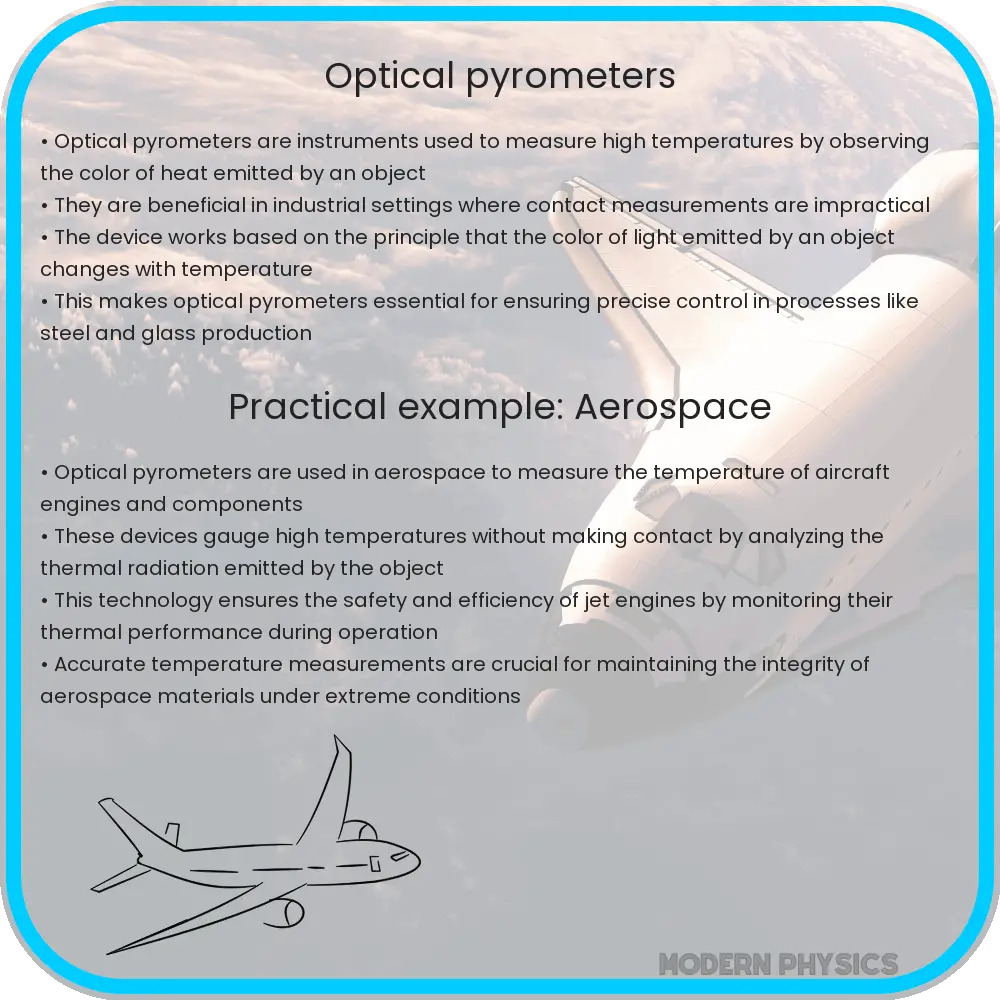
Understanding Optical Pyrometers: Precision in High-Temperature Measurement
Optical pyrometers are sophisticated devices used for measuring temperature without direct contact, offering a blend of precision, reliability, and safety, especially in high-temperature environments. This technology is indispensable in industries where temperature plays a crucial role in the quality and integrity of processes and products, such as metallurgy, glass production, and semiconductor manufacturing.
How Optical Pyrometers Work
At the core of optical pyrometer operation is the principle of black-body radiation, which posits that any object emits light at a color indicative of its temperature. By comparing the brightness of this light to a known reference, optical pyrometers can accurately gauge the temperature of an object. This non-contact method is particularly beneficial for measuring extremely high temperatures, beyond the capability of conventional thermocouples or infrared sensors, without risking damage to the instrument or the object being measured.
Advantages of Optical Pyrometers
- Precision: Optical pyrometers provide remarkably accurate temperature readings, crucial for applications requiring stringent temperature controls.
- Non-contact Measurement: Their ability to measure temperature from a distance ensures the safety of both the operator and the instrument, especially in environments with extreme temperatures or hazardous conditions.
- High Temperature Capability: These devices can measure temperatures up to 3000°C (5432°F), making them indispensable in industries working with metals, ceramics, and other materials requiring high-temperature processing.
Applications of Optical Pyrometers
Optical pyrometers find their utility in a range of industrial applications. In the steel industry, they are used to monitor the temperature of molten steel to ensure it is within the optimal range for casting or forging. Glass manufacturing benefits from the precision of optical pyrometers in controlling the temperature of molten glass, crucial for achieving desired properties and avoiding defects. In the semiconductor industry, maintaining a specific temperature during the deposition of thin films is essential for the production of high-quality electronic components, a task well-suited for optical pyrometers.
This introduction to optical pyrometers highlights their significance in achieving precision, safety, and efficiency in high-temperature industrial processes. The following section will delve into the technical specifications, selection criteria, and maintenance tips for these critical instruments, ensuring their optimal performance in diverse industrial settings.
Is this conversation helpful so far?
Understanding Optical Pyrometers
Optical pyrometers are sophisticated devices used for measuring temperature without making physical contact with the object being measured. They are particularly useful for high-temperature applications where traditional thermometers cannot be used. By analyzing the intensity of visible light emitted by a hot object, these instruments offer a non-invasive means to gauge thermal conditions accurately.
Applications and Advantages
Optical pyrometers find their use in various industrial sectors, including metallurgy, glass-making, and semiconductor manufacturing. Their ability to measure extremely high temperatures, often in the range of 700°C to 4000°C, makes them indispensable tools in environments where direct temperature measurement is impractical or dangerous.
- Precision: These devices provide precise temperature readings, essential for quality control in manufacturing processes.
- Non-Contact Measurement: The non-contact nature of optical pyrometers minimizes the risk of contaminating the material being measured and allows for the temperature measurement of moving or inaccessible objects.
- High-Temperature Capability: They can measure temperatures that are beyond the range of conventional thermometers, enabling their use in high-temperature industrial processes.
How Optical Pyrometers Work
Optical pyrometers operate on the principle that the color of the light emitted by an object changes with temperature. These devices compare the brightness of the light emitted by the target object to that of a calibrated light source within the pyrometer. This comparison is then used to calculate the temperature of the object. The fundamental principle behind their operation is Planck’s law of blackbody radiation, which describes how the intensity of electromagnetic radiation emitted by a black body (an idealized physical body that absorbs all incident electromagnetic radiation) varies with temperature.
In the next section, we will delve into the technical specifications, types of optical pyrometers, and considerations for their selection and use.
Technical Specifications and Types
When selecting an optical pyrometer, it’s important to consider its technical specifications, including temperature range, accuracy, and the field of view. The two main types of optical pyrometers are the single-color and the two-color (or ratio) pyrometers. Single-color models measure the brightness of the light at a single wavelength, while two-color models compare the brightness at two different wavelengths, which can compensate for emissivity variations and partially obscured views.
Selection and Use
Choosing the right optical pyrometer involves understanding the specific requirements of the application, such as the temperature range, the material of the object being measured, and the environmental conditions. It’s also crucial to calibrate the device regularly to ensure accuracy. Proper training for operators is essential to interpret the measurements correctly and to make adjustments for emissivity, an object’s ability to emit infrared radiation, which can affect accuracy.
Conclusion
Optical pyrometers are invaluable tools in industries requiring precise, non-contact temperature measurements at high temperatures. With their ability to provide accurate readings in challenging environments, they play a critical role in ensuring the quality and consistency of industrial processes. By understanding the principles of operation, types, and proper use of these devices, industries can significantly benefit from the technological advancements in temperature measurement. As technology evolves, the precision, usability, and applications of optical pyrometers will continue to expand, offering even greater possibilities for industrial innovation and safety.