
Explore the importance of optical limiter devices in protecting sensitive optical systems and eyes from intense light, focusing on safety and precision.
Introduction to Optical Limiter Devices
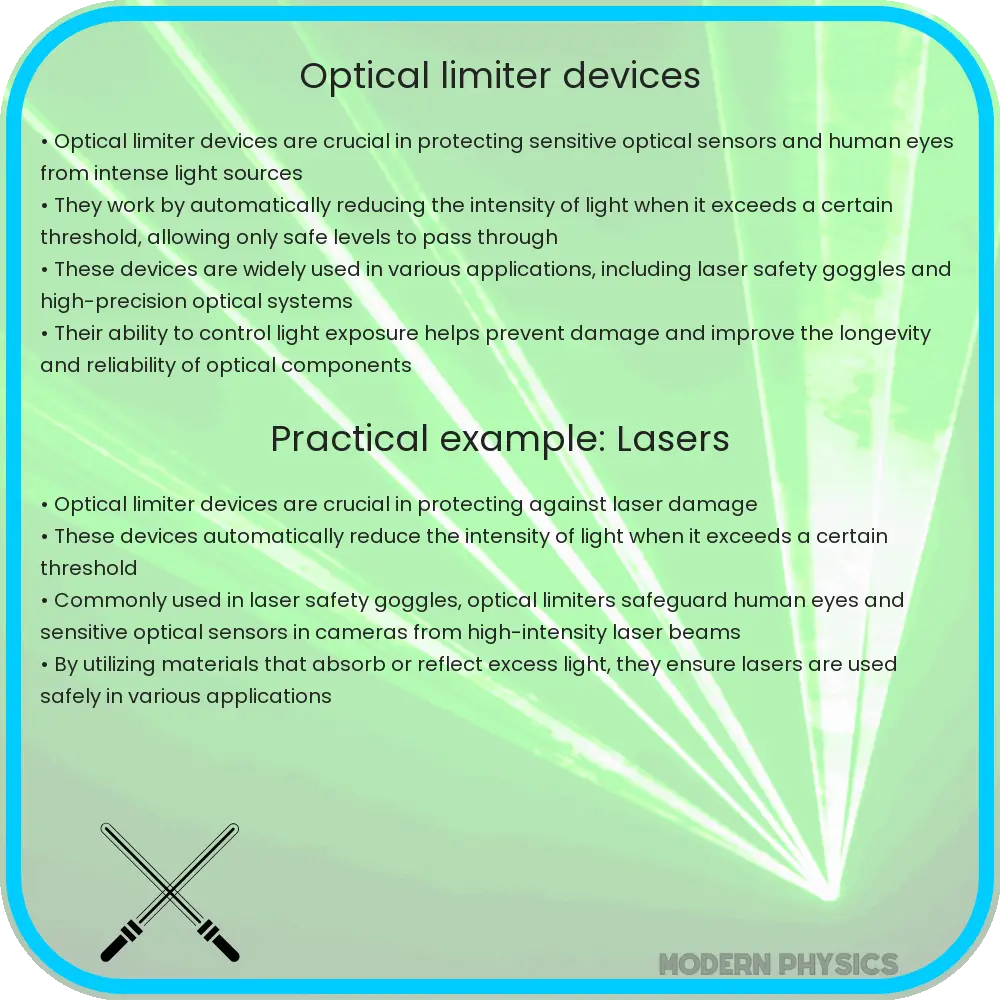
Optical limiter devices are pivotal in the realm of photonics, offering critical protection for sensitive optical sensors and human eyes from intense light sources. These devices are engineered to transmit light normally up to a certain threshold intensity, beyond which they significantly reduce the transmission to protect against potential damage. This dual nature makes them indispensable in various applications, including laser safety, optical communication, and high-precision instrumentation.
Working Principle and Safety
The core functionality of optical limiters hinges on nonlinear optical effects. When the incoming light intensity exceeds the predefined threshold, the optical properties of the limiter’s material change, thus limiting further light transmission. This instantaneous response is crucial for safeguarding against unexpected high-intensity light pulses that could otherwise cause irreversible damage.
Materials and Technologies
Advancements in materials science have been pivotal in the development of effective optical limiters. Materials such as carbon nanotubes, graphene, and organometallic compounds are frequently utilized due to their strong nonlinear optical responses. The choice of material significantly influences the limiter’s efficiency, operating wavelength range, and response time.
Precision in Application
Optical limiters are not just about safety; they also play a vital role in enhancing the precision of optical systems. By filtering out excessively bright light, these devices ensure that sensors and detectors operate within their optimal intensity ranges, thereby improving the accuracy of measurements and the quality of optical data transmission.
Future Directions
The ongoing research in optical limiter technology focuses on improving the response time, broadening the operational wavelength range, and enhancing the durability of these devices. With the advent of new materials and nanotechnology, the future of optical limiters looks promising, offering prospects for even greater protection and precision in optical applications.
Integration with Advanced Technologies
The integration of optical limiter devices with cutting-edge technologies such as quantum dots and photonic crystals is paving the way for a new generation of optical protection systems. These advancements allow for more compact, efficient, and tunable limiters, capable of operating across a wider spectrum of light wavelengths. This versatility is especially beneficial in complex optical systems that require precise control over light intensity across various frequencies.
Challenges and Solutions
Despite their significant advantages, the deployment of optical limiters faces challenges, particularly in terms of material durability and device integration. Prolonged exposure to high-intensity light can degrade the limiter materials, reducing their effectiveness over time. Researchers are actively exploring more resilient materials and protective coatings to extend the lifespan of these devices. Additionally, integrating optical limiters into existing optical systems without compromising performance requires innovative design strategies and miniaturization techniques.
Safety Regulations and Standards
As optical limiter devices become more prevalent in various industries, the development of comprehensive safety regulations and standards is crucial. These guidelines ensure that the devices are used correctly and provide adequate protection against hazardous light exposure. Standardization also facilitates the comparison of different optical limiters, aiding in the selection of the most suitable device for specific applications.
Conclusion
Optical limiter devices represent a critical intersection of safety, precision, and advanced technology in the field of photonics. Through the innovative use of nonlinear optical materials and the integration with emerging technologies, these devices offer unparalleled protection against intense light exposure while enhancing the accuracy of optical systems. Despite the challenges in material durability and device integration, ongoing research and development promise to overcome these hurdles, paving the way for more efficient, versatile, and reliable optical limiters. As the technology evolves, so too will the standards and regulations guiding their use, ensuring that optical limiters continue to serve as indispensable tools in the protection and enhancement of optical systems worldwide.