
Explore the advanced world of optical gyroscopes, their working principles, types, advantages, and wide-ranging applications in cutting-edge tech.
Understanding Optical Gyroscopes
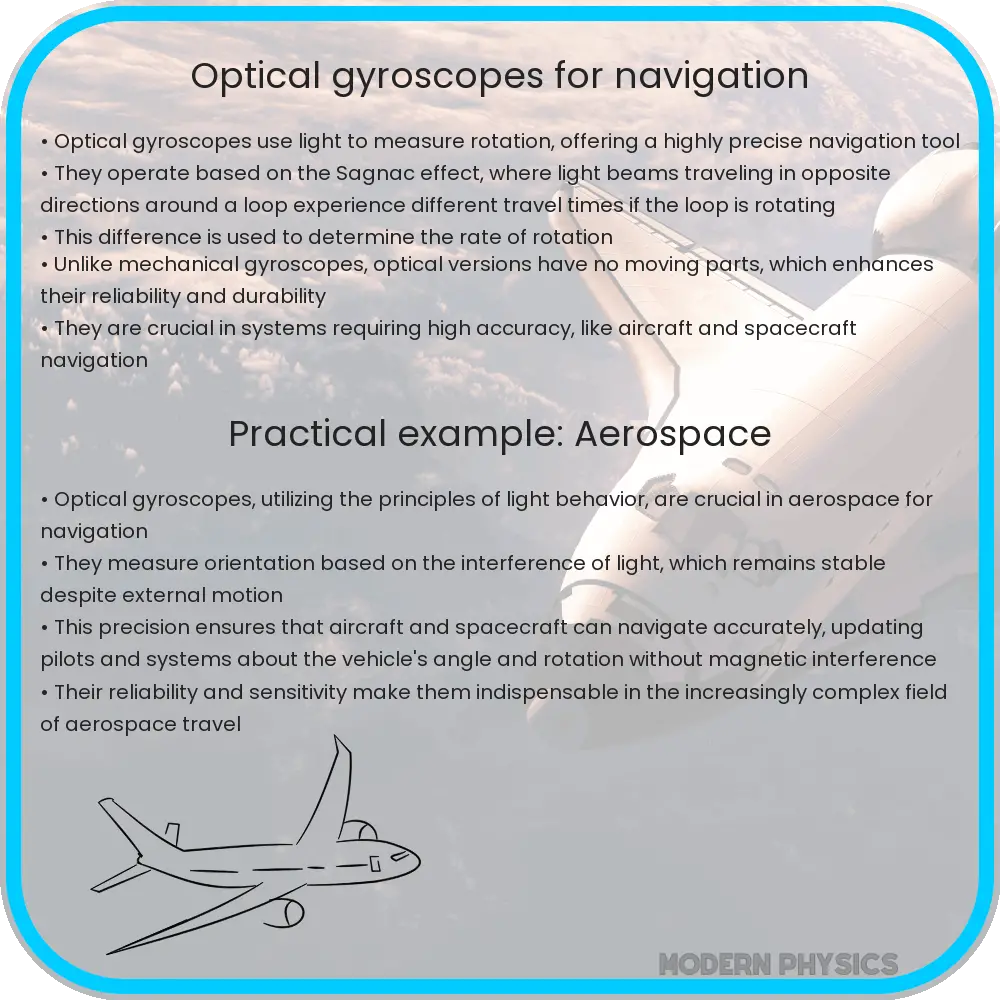
Optical gyroscopes are a cornerstone in the field of navigational technology, offering unparalleled precision and stability. Utilizing the principles of light propagation and the Sagnac effect, these devices measure rotational motion with exceptional accuracy, making them indispensable in a variety of applications, from aerospace to consumer electronics.
How Optical Gyroscopes Work
At the heart of an optical gyroscope is a phenomenon known as the Sagnac effect, which occurs when light beams travel in opposite directions around a rotating loop. The essence of this effect is that a rotation will cause a phase difference between these two beams, proportional to the rate of rotation. This phase difference can be accurately measured, providing a direct indication of angular velocity.
Types of Optical Gyroscopes
- Fiber Optic Gyroscope (FOG): FOGs use a coil of optical fiber and leverage the interference of light to detect rotation. The longer the fiber coil, the more sensitive the gyroscope.
- Ring Laser Gyroscope (RLG): RLGs employ lasers traveling in opposite directions within a closed path. Changes in the interference pattern between these lasers indicate rotational movement.
- Integrated Optical Gyroscope: These devices miniaturize the optical path onto a chip, offering advantages in terms of size, weight, and potentially cost.
Advantages of Optical Gyroscopes
Optical gyroscopes stand out for their remarkable precision and reliability. Unlike mechanical gyroscopes, they have no moving parts, which reduces wear and tear and extends their operational life. This lack of mechanical inertia allows for a rapid response to changes in orientation, essential for applications requiring real-time data, such as drone navigation and autonomous vehicles.
Moreover, the sensitivity of optical gyroscopes makes them highly effective in environments where precision is paramount. They are capable of detecting minute changes in angular velocity, making them suitable for stabilizing satellites, guiding missiles, and enhancing the accuracy of GPS systems.
Another significant advantage is their resistance to environmental factors such as temperature fluctuations and vibrations. This robustness ensures consistent performance even under harsh conditions, further solidifying their place in advanced technological applications.
Challenges and Innovations
Despite their many advantages, optical gyroscopes face challenges, particularly in terms of cost and complexity. The precision components and sophisticated manufacturing processes required for optical gyroscopes, especially for RLGs and high-grade FOGs, contribute to their higher cost compared to traditional mechanical gyroscopes. Additionally, integrating these devices into compact systems while maintaining their high performance poses engineering challenges.
In response to these challenges, ongoing research and development efforts aim to reduce the size and cost of optical gyroscopes without compromising their performance. Advances in photonic technologies and materials science are paving the way for more compact, efficient, and affordable optical gyroscope solutions. Integrated optical gyroscopes, which incorporate the gyroscope’s components onto a single chip, represent a significant leap forward, offering potential for mass production and integration into a wider range of applications.
Applications of Optical Gyroscopes
Optical gyroscopes have found their place in a broad spectrum of applications. In aerospace, they are critical for navigation and control of aircraft and spacecraft, where precision and reliability are non-negotiable. In the automotive industry, they enhance the safety and functionality of autonomous vehicles and advanced driver-assistance systems (ADAS) by providing accurate orientation and navigation data.
Additionally, optical gyroscopes are instrumental in the development of virtual reality (VR) and augmented reality (AR) technologies, offering precise head tracking to create immersive user experiences. They also play a vital role in the telecommunications industry, stabilizing and orienting antennas on moving platforms to ensure consistent communication links.
Conclusion
Optical gyroscopes represent a pinnacle of navigation technology, offering unmatched precision and stability. Their ability to accurately measure rotational motion without the limitations associated with mechanical parts makes them indispensable in critical applications across aerospace, automotive, VR/AR, and telecommunications. Despite challenges related to cost and complexity, innovations in optical gyroscope technology continue to expand their applicability, promising enhanced performance and accessibility in the future. As we move towards more autonomous and interconnected systems, the role of optical gyroscopes in enabling these advancements becomes increasingly significant, marking them as a key technology in the ongoing evolution of precise navigational solutions.