
Explore the Oldham coupling mechanism’s efficiency, flexibility, and dynamics in mechanical systems, highlighting its maintenance and advancements.
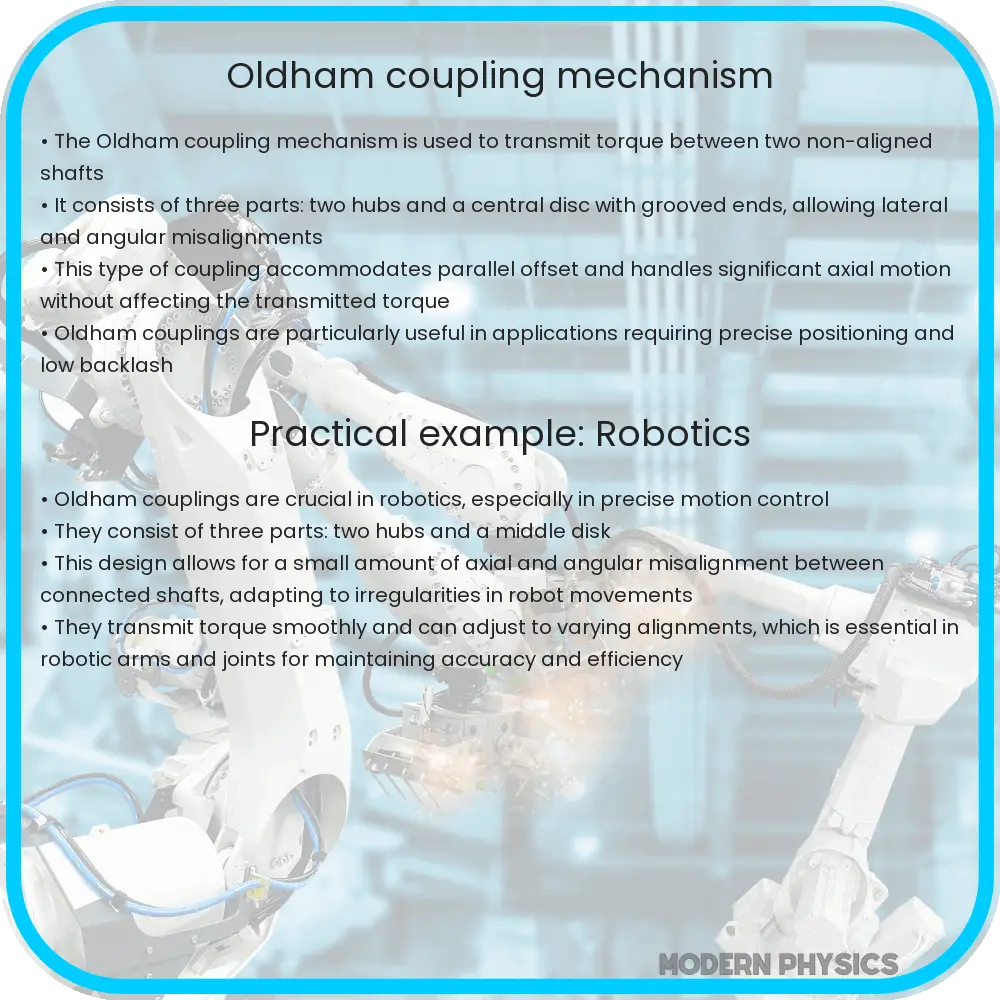
Understanding the Oldham Coupling Mechanism
The Oldham coupling mechanism, a significant component in the field of mechanical engineering, is a type of coupling used to transmit torque between two non-collinear shafts. It offers a solution for applications where misalignment is an issue. In this article, we will delve into the efficiency, flexibility, and dynamics of the Oldham coupling mechanism, highlighting its importance in various mechanical systems.
Efficiency of Oldham Coupling
Oldham couplings are renowned for their high efficiency in torque transmission. They consist of three main parts: two hubs and a central disc. The central disc, which slides between the two hubs, compensates for the misalignment. This design ensures minimal loss of energy, making the coupling almost 100% efficient under proper alignment conditions. The efficiency of an Oldham coupling, however, can be slightly reduced due to friction and wear over time.
Flexibility and Adaptability
One of the most notable features of the Oldham coupling is its flexibility. It can accommodate lateral, angular, and axial misalignments, making it an adaptable solution for various mechanical setups. The central disc can be made from different materials, such as nylon or metal, depending on the application’s requirements, offering further customization.
Dynamics and Vibration Damping
Oldham couplings play a crucial role in the dynamics of a mechanical system. They can dampen vibrations and shock loads, protecting the system from potential damage. This damping capability is particularly useful in precision applications, such as in CNC machines or in high-speed equipment. The choice of material for the central disc can significantly influence the coupling’s damping properties.
Applications in Diverse Industries
Due to their versatility, Oldham couplings find applications in a wide range of industries. From robotics to conveyor systems, they are essential in ensuring smooth operation and longevity of mechanical components. They are particularly favored in applications where precision alignment is crucial, and in systems that require regular maintenance or component replacement.
In conclusion, the Oldham coupling mechanism is a vital component in mechanical engineering, offering a blend of efficiency, flexibility, and dynamic performance. Its ability to adapt to various misalignments while maintaining high torque transmission efficiency makes it an indispensable tool in many mechanical systems.
Maintenance and Longevity of Oldham Couplings
Maintenance is a critical aspect of ensuring the longevity and performance of Oldham couplings. Regular inspection for wear and tear, especially on the central disc, is essential. The unique design of Oldham couplings allows for easy replacement of the central disc without disassembling the entire mechanism, making maintenance more straightforward and less time-consuming.
Advancements in Oldham Coupling Technology
Recent advancements in materials science and engineering have led to significant improvements in Oldham coupling designs. The use of advanced polymers and composites for the central disc has enhanced their wear resistance and reduced the need for lubrication, thereby extending the lifespan of the coupling. Additionally, precision manufacturing techniques have improved the alignment capabilities of these couplings, further enhancing their efficiency and reducing mechanical stress.
Customization and Specialized Applications
Customization is another strength of Oldham couplings. They can be tailored to specific requirements of torque, speed, and misalignment. This customizability makes them ideal for specialized applications in industries like aerospace, where exacting standards are a necessity. Moreover, miniaturized versions of Oldham couplings are increasingly used in micro-mechanical systems, where their ability to transmit torque with precision is invaluable.
Environmental Impact and Sustainability
The environmental impact of Oldham couplings is relatively minimal. The simplicity of their design and the ease of replacing only the central disc, rather than the entire coupling, contribute to waste reduction. Manufacturers are also increasingly focusing on using recyclable or sustainable materials, aligning with global environmental sustainability goals.
Conclusion
In summary, the Oldham coupling mechanism stands out as a highly efficient, flexible, and dynamic solution in the realm of mechanical engineering. Its adaptability to misalignment, ease of maintenance, and advancements in design and materials make it an essential component in a wide array of mechanical systems. The continuous evolution of Oldham couplings, driven by technological advancements and a focus on sustainability, ensures their relevance and importance in both current and future mechanical applications. This mechanism not only exemplifies engineering ingenuity but also highlights the ongoing pursuit of efficiency and reliability in mechanical design.