
Explore the efficiency, applications, and design principles of fluid coupling in industries, with insights into its future and environmental impact.
Understanding Fluid Coupling: An Overview
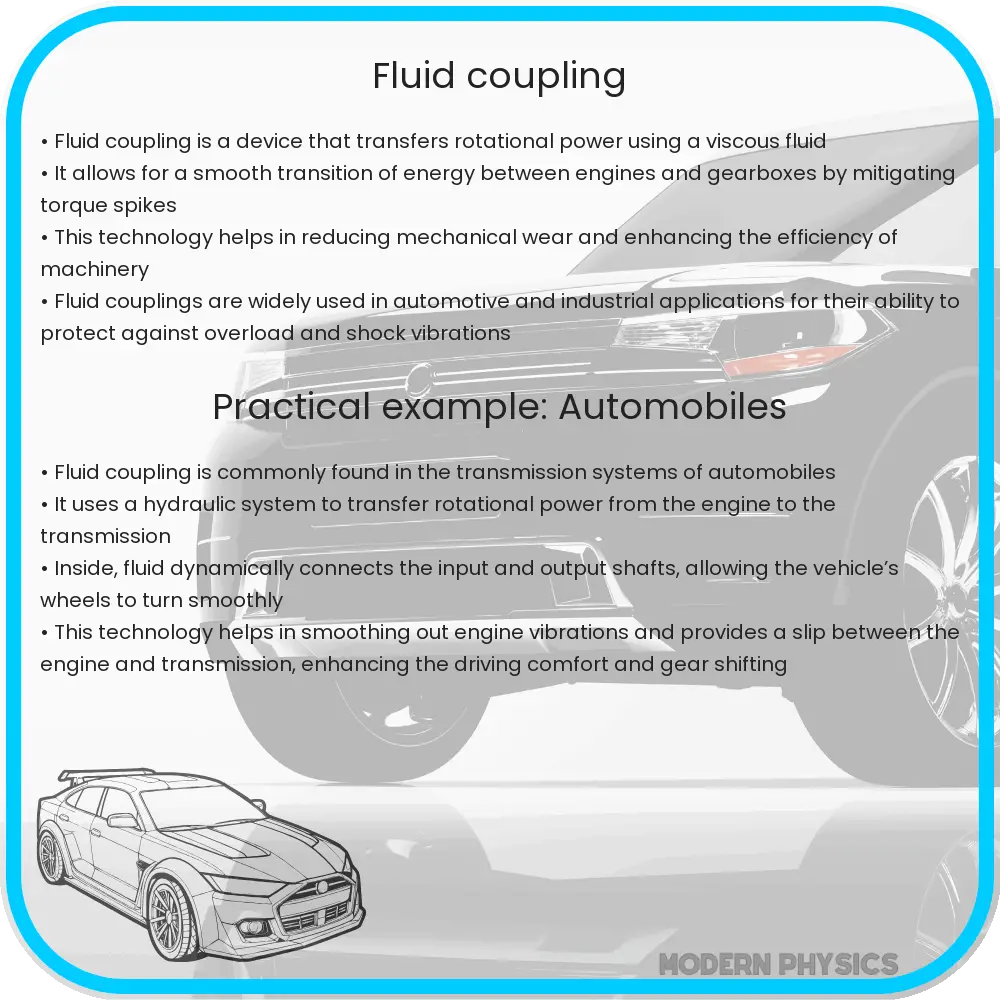
Fluid coupling, a cornerstone in the realm of mechanical engineering, is a hydrodynamic device used to transmit rotating mechanical power. It has been used extensively in automobile transmissions, industrial machinery, and various other applications. This article delves into the efficiency, applications, and design principles of fluid coupling, offering insights for both enthusiasts and professionals.
Efficiency of Fluid Couplings
At its core, fluid coupling operates on the principle of hydrokinetics, which facilitates the transfer of energy through a fluid medium, typically oil. The efficiency of fluid couplings is a critical aspect, determined by factors like fluid dynamics, coupling size, and the speed of the input and output shafts. Generally, these couplings are known for their smooth and controlled power transmission, which minimizes mechanical stress and wear.
Applications in Various Industries
Fluid couplings are pivotal in numerous industries due to their versatility and adaptability. In the automotive sector, they are integral in automatic transmissions, providing a seamless shift in gears and enhancing the driving experience. Industrial applications are vast, ranging from conveyor belt systems to complex machinery in manufacturing plants. Their ability to cushion the start-up of heavy machinery and control torque makes them indispensable in these settings.
Design Principles of Fluid Couplings
The design of fluid couplings is a sophisticated process that intertwines elements of mechanical engineering and fluid dynamics. The primary components include the impeller (pump wheel), turbine (turbine wheel), and the casing. The impeller, connected to the input shaft, propels the fluid towards the turbine, which is connected to the output shaft. This action creates a link between the input and output, transmitting power effectively. Design variations cater to specific requirements, such as adjustable speed drives, where the volume of the fluid in the coupling can be manipulated to control the torque and speed.
Understanding the nuances of fluid coupling design is pivotal for optimizing performance and durability. Factors such as the choice of fluid, the shape and size of the impeller and turbine, and the overall design of the coupling play crucial roles in its functionality. Modern advancements in computational fluid dynamics (CFD) have significantly enhanced the precision in designing these couplings, leading to improved efficiency and reliability.
Advanced Design Considerations
The evolution of fluid coupling technology has led to the development of advanced designs that offer greater control and efficiency. One such advancement is the inclusion of a delay chamber, which allows for a gradual increase in torque, thereby reducing mechanical shocks during start-up. Additionally, the use of electronically controlled valves in some designs enables precise control over the fluid flow, further enhancing the efficiency and responsiveness of the coupling.
Material Selection and Maintenance
Material selection is a critical aspect of fluid coupling design. The choice of materials must account for factors like strength, durability, and resistance to corrosion and wear. Commonly used materials include various grades of steel and aluminum alloys. Proper maintenance, such as regular fluid checks and replacements, is essential for the longevity and optimal performance of fluid couplings.
Environmental Considerations
In the current era of environmental consciousness, the impact of fluid couplings on the environment is an important consideration. The use of eco-friendly and biodegradable fluids, along with designs that minimize leakage and fluid disposal issues, is becoming increasingly prevalent. This shift not only helps in reducing environmental impact but also complies with stringent environmental regulations.
Future Prospects
The future of fluid coupling technology is promising, with ongoing research focusing on enhancing efficiency and reducing environmental impact. Innovations like integrating smart sensors for real-time performance monitoring and adopting advanced materials for improved durability are on the horizon. These developments are expected to expand the applications of fluid couplings further, making them more adaptable and efficient in various industries.
Conclusion
Fluid coupling stands as a testament to the ingenuity of mechanical engineering, providing efficient, reliable, and smooth power transmission solutions across diverse applications. Its evolution, driven by advancements in design, materials, and environmental considerations, continues to play a pivotal role in the development of more sophisticated and sustainable industrial machinery. As technology progresses, fluid coupling will undoubtedly adapt and evolve, cementing its place as an indispensable component in the machinery of today and tomorrow.