
Explore the intriguing world of nucleon structure functions in QCD, covering insights from DIS experiments, challenges, and future prospects.
Understanding Nucleon Structure Functions in Quantum Chromodynamics (QCD)
The exploration of nucleon structure functions is a fascinating aspect of Quantum Chromodynamics (QCD), the fundamental theory describing the strong interaction in the realm of particle physics. These structure functions provide deep insights into the internal composition and dynamics of nucleons – protons and neutrons – which are the building blocks of atomic nuclei.
What are Nucleon Structure Functions?
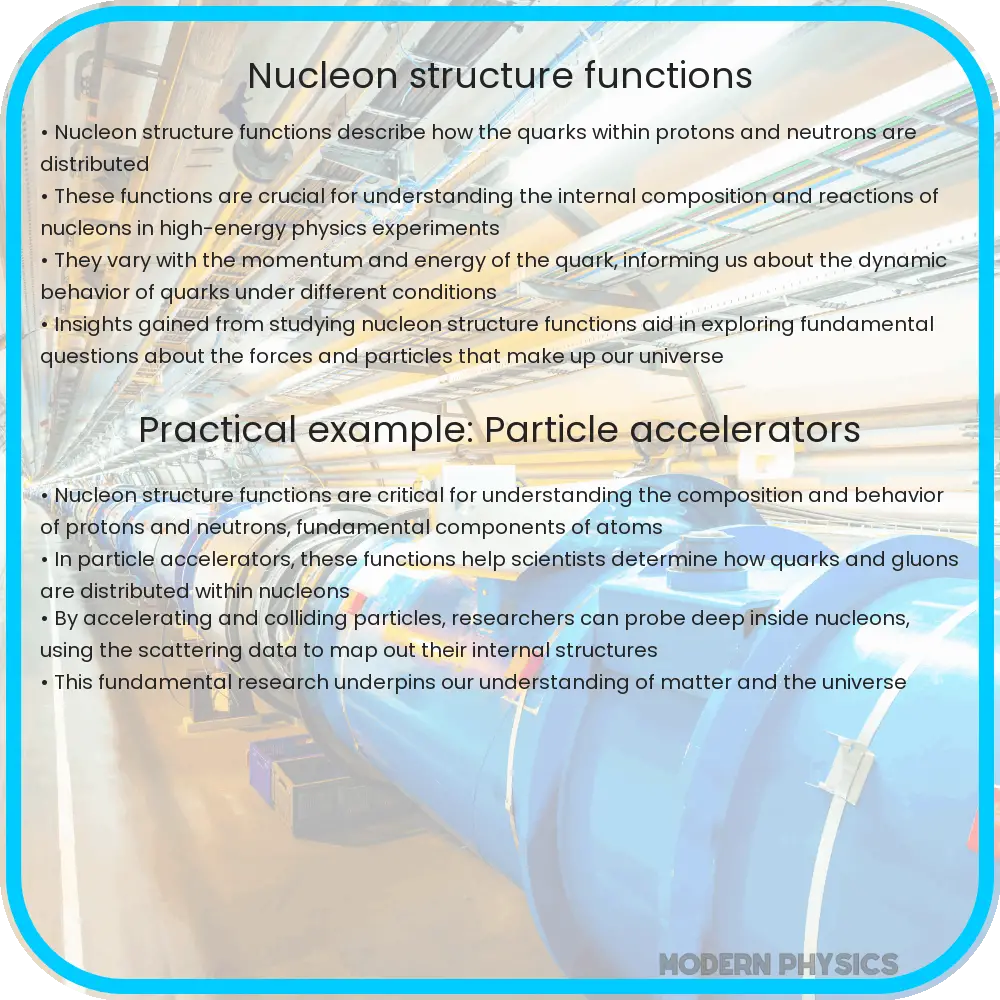
Nucleon structure functions are mathematical expressions that quantify how the momentum and spin of a nucleon are distributed among its constituent quarks and gluons. They play a crucial role in understanding high-energy processes such as deep inelastic scattering (DIS), where electrons or other leptons scatter off nucleons, probing their internal structure.
Deep Inelastic Scattering (DIS) and QCD
DIS experiments are instrumental in exploring nucleon structure. When a high-energy lepton collides with a nucleon, it interacts with the quarks inside the nucleon via the exchange of virtual photons. The pattern and energy distribution of the scattered lepton provide information about the quarks’ distribution and momentum inside the nucleon, which are encapsulated in the structure functions. These experiments have been pivotal in confirming the QCD theory, revealing that nucleons are made of quarks held together by gluons – the force carriers of the strong interaction.
Importance of QCD in Analyzing Nucleon Structure
QCD plays a vital role in analyzing and interpreting the data from DIS experiments. The theory’s complex equations, rooted in the non-Abelian nature of the strong force, describe how quarks and gluons interact inside nucleons. QCD predicts phenomena like asymptotic freedom, where quarks behave as free particles at extremely short distances, and confinement, where they are bound tightly at larger distances. These predictions are crucial for understanding the observed results in DIS experiments and extracting precise information about nucleon structure functions.
Advanced computational methods, such as lattice QCD, also allow physicists to calculate nucleon structure functions from first principles. These calculations provide a direct link between experimental data and the fundamental theory of the strong force.
Challenges and Advancements in Understanding Nucleon Structure
Despite significant progress, fully understanding nucleon structure remains a challenging frontier in particle physics. One key challenge is the intricate interplay between quarks and gluons due to QCD’s non-perturbative nature at low energies. This complexity necessitates sophisticated theoretical models and computational techniques to accurately predict nucleon structure functions. Furthermore, experimental limitations in probing the extremely small distances within nucleons pose additional hurdles.
Recent Developments and Future Prospects
Recent advancements in experimental techniques, such as the use of more powerful particle accelerators and sophisticated detectors, have allowed for more precise measurements of nucleon structure functions. These developments, coupled with improvements in theoretical models and computational methods like lattice QCD, are providing new insights into the nucleon’s internal dynamics.
Looking ahead, upcoming experiments at facilities like the Electron-Ion Collider (EIC) are expected to provide even more detailed data on nucleon structure. These experiments will help address unanswered questions, such as the role of gluons and the sea quarks (quark-antiquark pairs) in the nucleon’s spin and momentum distribution.
Conclusion
In conclusion, the study of nucleon structure functions is a vital aspect of understanding the fundamental forces and particles in our universe. Through the lens of Quantum Chromodynamics, researchers have made significant strides in unraveling the complex inner world of nucleons. While challenges remain due to the intricate nature of the strong force and the minuscule scales involved, ongoing technological and theoretical advancements continue to push the boundaries of our knowledge. The future of this field is promising, with upcoming experiments and computational techniques poised to offer deeper insights into the quantum world, enhancing our understanding of the fundamental building blocks of matter.