
Explore the role of Deep Inelastic Scattering in quantum physics, revealing the inner workings of particles and advancing our understanding of QCD.
Understanding Deep Inelastic Scattering Apparatus
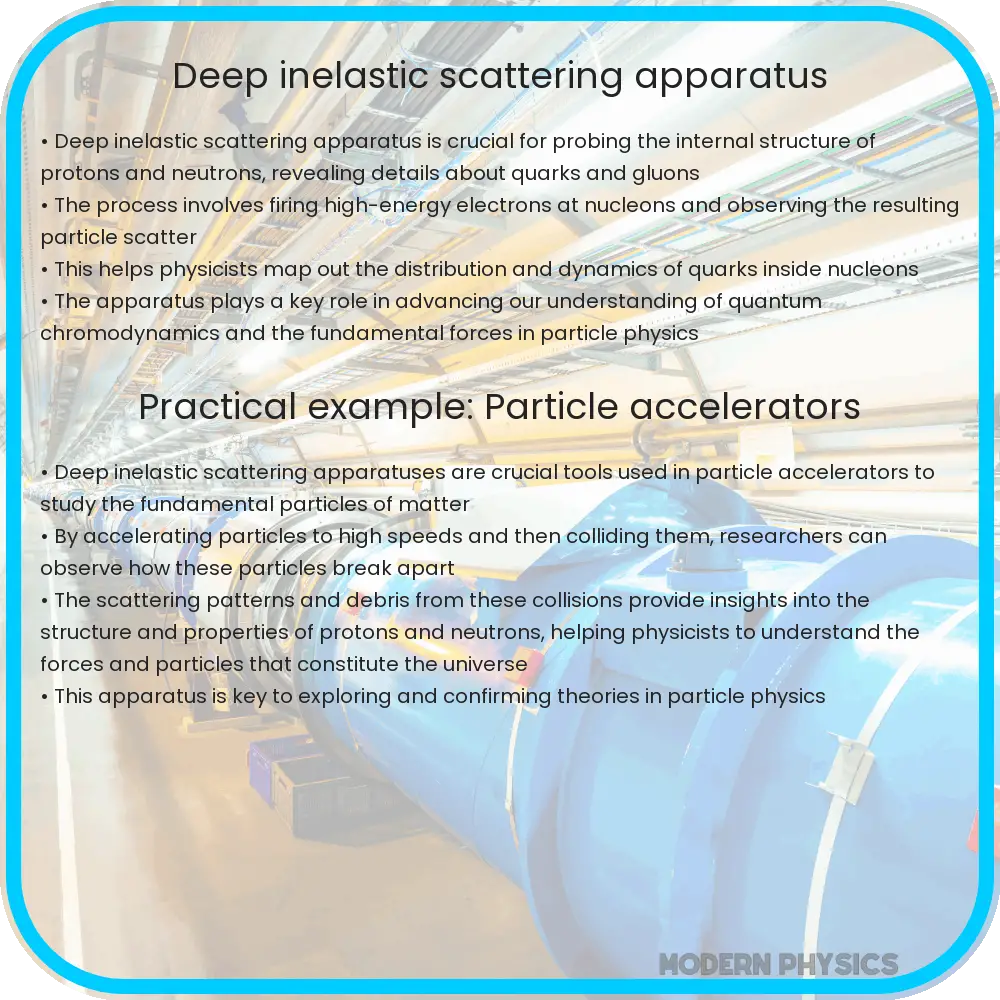
Deep Inelastic Scattering (DIS) is a critical process in particle physics, offering profound insights into the quantum world. It involves the collision of high-energy particles, such as electrons, with nucleons (protons and neutrons) in atomic nuclei. This interaction is pivotal in probing the internal structure of nucleons, shedding light on the distribution and behavior of quarks and gluons – the fundamental constituents of matter.
The heart of DIS research lies in sophisticated apparatuses designed to facilitate and analyze these high-energy collisions. These apparatuses are equipped with various detectors and components, each playing a pivotal role in the measurement and interpretation of collision events.
The Components of DIS Apparatus
A typical DIS apparatus comprises several key components:
- Beam Source: A high-energy particle accelerator generates a beam of electrons or other leptons. These particles are accelerated to near-light speeds, attaining the high energies necessary for DIS.
- Target: The target material contains nucleons with which the incoming particles will interact. This material is often a solid or liquid, chosen for its nuclear properties.
- Detectors: Surrounding the target are various detectors, each designed to capture different aspects of the collision aftermath. These include tracking detectors to trace particle paths, calorimeters to measure energy, and Cherenkov detectors for velocity determination.
Quantum Probing through DIS
DIS is not just about observing collisions; it’s about probing the quantum realm. By analyzing the scattering patterns and energy distributions in these high-energy collisions, physicists can infer the internal structure of nucleons. The distribution of quarks and gluons, along with their momentum and spin, becomes accessible through precision measurements.
For instance, the scattering angle and energy loss of the incoming lepton in DIS provide critical information. The kinematic variables, such as the Bjorken scaling variable (x) and the square of the four-momentum transfer (Q2), are essential for understanding the interaction dynamics at a quantum level.
Modern DIS apparatuses are marvels of precision and technological advancement. They integrate cutting-edge technology in particle acceleration, detection, and data analysis. The precision offered by these instruments allows physicists to test and refine theoretical models in quantum chromodynamics (QCD), the theory describing the strong force that binds quarks and gluons within nucleons.
As we delve deeper into the intricacies of quantum mechanics and particle physics, DIS apparatuses stand at the forefront of scientific discovery, offering a window into the very fabric of the universe.
Insights Gained from Deep Inelastic Scattering
The insights gleaned from deep inelastic scattering experiments have been monumental in advancing our understanding of particle physics. One of the key achievements is the experimental verification of the quark model. By probing the innards of nucleons, DIS has provided concrete evidence for the existence of quarks, previously a theoretical construct. Furthermore, these experiments have shed light on the distribution and dynamics of these quarks and gluons within the nucleons, a field known as parton distribution functions (PDFs).
Another significant contribution of DIS is the exploration of the strong force, or the color force, which is mediated by gluons. The interactions observed in DIS experiments have been critical in testing and validating aspects of Quantum Chromodynamics (QCD), the theory that describes the strong interaction. This includes observations such as asymptotic freedom, where quarks behave as free particles at high energies, a cornerstone prediction of QCD.
Challenges and Future Directions
Despite its successes, deep inelastic scattering experiments also present formidable challenges. One of the major challenges is the sheer complexity of the data. The collisions generate a plethora of particles and interactions that require sophisticated algorithms and computational resources to analyze. Additionally, as we probe deeper into the subatomic realm, the energy requirements for these experiments increase, necessitating more powerful accelerators and more sensitive detectors.
Looking forward, the future of DIS is tied to advancements in particle accelerator technology and detector sensitivity. Projects like the Electron-Ion Collider (EIC) aim to provide deeper insights into the structure of nucleons and the nature of the strong force. These future experiments will not only test the limits of our current understanding but also potentially unveil new physics beyond the Standard Model.
Conclusion
In conclusion, deep inelastic scattering apparatuses are pivotal in the quest to unravel the mysteries of the quantum world. They provide a unique window into the subatomic realm, allowing physicists to probe the fundamental constituents of matter and the forces that govern their interactions. The precision and insights offered by DIS experiments have been instrumental in shaping our understanding of quantum chromodynamics and the structure of matter. As technology advances, DIS will continue to be a cornerstone in the exploration of particle physics, paving the way for new discoveries and a deeper comprehension of the universe’s fundamental laws.