
Explore the role and advancements of nuclear parton distribution functions in particle astrophysics, their impact on cosmic ray studies, and neutrino physics.
Understanding Nuclear Parton Distribution
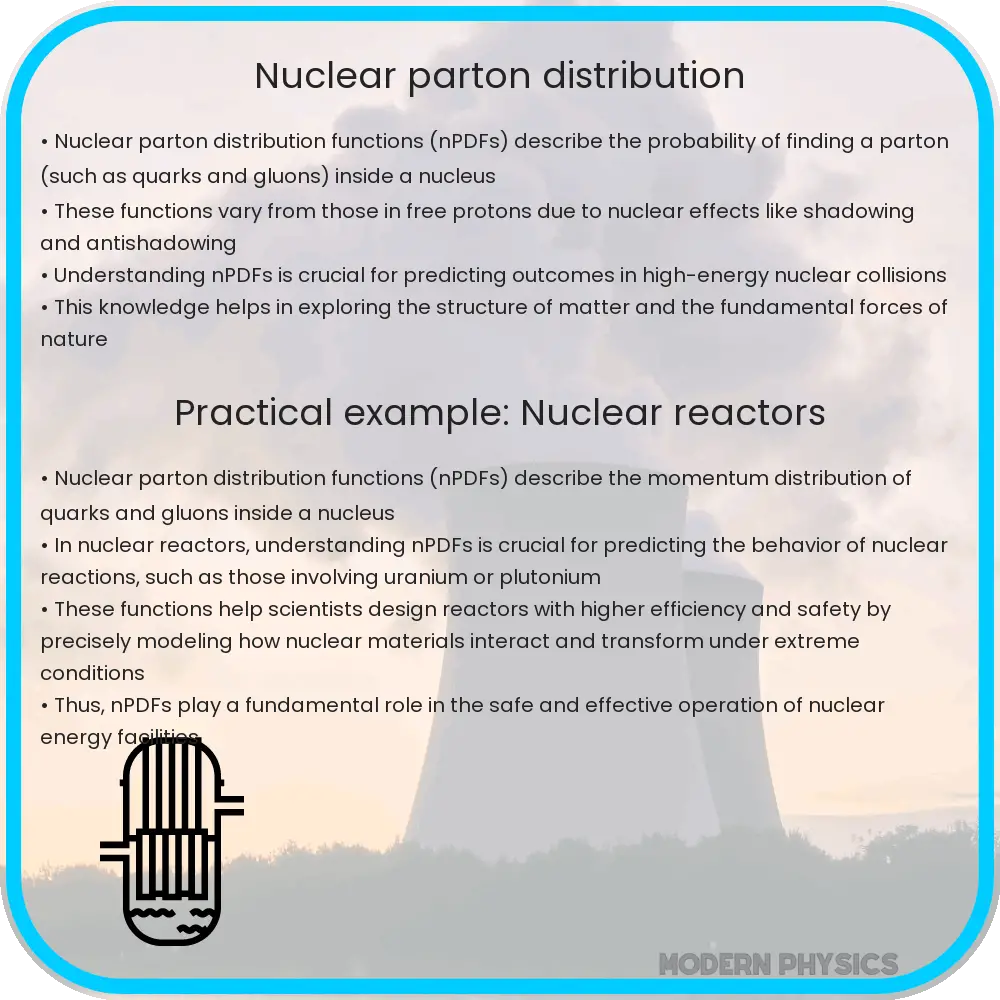
The study of nuclear parton distribution functions (nPDFs) is a critical area in particle astrophysics, providing profound insights into the internal structure of nucleons (protons and neutrons) within a nucleus. This research is pivotal for understanding the strong force, one of the four fundamental forces of nature, which holds the atomic nucleus together. nPDFs describe the momentum distribution of the quarks and gluons (collectively known as partons) inside the nucleons when they are part of a larger nucleus.
Impact on Particle Physics and Beyond
The investigation of nPDFs has significant implications not only in particle physics but also in other fields such as nuclear physics and cosmology. By comparing the parton distribution in free nucleons with those in bound states, scientists can explore modifications due to nuclear effects. This includes phenomena like shadowing, anti-shadowing, and the EMC effect, which alter the distribution of partons and hence, the physical properties of nuclear matter. Understanding these changes is crucial for interpreting high-energy nuclear collision experiments, such as those conducted at the Large Hadron Collider (LHC) and Relativistic Heavy Ion Collider (RHIC).
Advances in the Field
Recent advancements in the study of nPDFs have been facilitated by innovative theoretical frameworks and cutting-edge experimental techniques. Sophisticated models and computational tools have been developed to predict nPDFs with greater accuracy. Experiments using deep inelastic scattering (DIS) and hadron colliders have provided essential data, helping to refine these models. Moreover, advancements in machine learning are being leveraged to analyze vast datasets, enabling a deeper understanding of the complex interactions governing parton distribution within nuclei.
- Shadowing: This refers to the reduction in the number of partons at low x (a variable representing the fraction of the nucleon’s momentum carried by a parton), observed in nuclei compared to free nucleons.
- EMC Effect: Named after the European Muon Collaboration, this effect describes the modifications in the quark distribution functions due to the nuclear environment.
- Anti-shadowing: This is the increase in parton distribution at medium ranges of x, contrasting with shadowing.
Understanding Nuclear Parton Distributions
Nuclear parton distribution functions (nPDFs) are fundamental in the field of particle astrophysics and high-energy physics, providing essential insights into the structure of nucleons (protons and neutrons) within atomic nuclei. Unlike the parton distribution functions (PDFs) for free protons, nPDFs account for the modifications of the quark and gluon distributions when they are bound within nuclei. These modifications are crucial for understanding phenomena such as the EMC effect and nuclear shadowing, which have significant implications for high-energy nuclear collisions and the interpretation of deep inelastic scattering experiments.
Impact on Particle Astrophysics
The study of nPDFs has profound impacts on particle astrophysics, particularly in understanding cosmic rays and neutrino physics. Cosmic rays, high-energy particles from outer space, interact with the Earth’s atmosphere, producing showers of secondary particles. By understanding the nuclear parton distributions, scientists can better predict these interactions and the resulting particle showers, leading to improved models of cosmic ray propagation and impact. Furthermore, nPDFs are crucial in the analysis of neutrino oscillations and interactions, which are pivotal in probing the fundamental properties of neutrinos and the underlying principles of the universe.
Advances in Nuclear Parton Distribution Research
Recent advances in the study of nuclear parton distributions have been driven by both theoretical developments and experimental breakthroughs. Theoretical models have become more sophisticated, incorporating quantum chromodynamics (QCD) and non-linear effects to better describe the dynamics of partons in nuclei. Experimentally, new data from collider experiments like the Large Hadron Collider (LHC) and Relativistic Heavy Ion Collider (RHIC) have provided unprecedented insights into the structure of bound nucleons. These developments have led to more precise nPDFs, enabling more accurate predictions for high-energy nuclear collisions and deep inelastic scattering processes.
Conclusion
The exploration of nuclear parton distribution functions is a vital area of research in particle astrophysics, providing essential insights into the structure of matter at the most fundamental level. The advancements in theoretical models and experimental techniques have significantly improved our understanding of nucleon behavior in nuclear environments. As research continues, nPDFs will remain central to unraveling the mysteries of high-energy particle interactions, cosmic ray physics, and the overall structure of the universe. The ongoing collaboration between theorists and experimentalists promises further breakthroughs, contributing to our comprehension of the cosmos and the fundamental forces that govern it.