
Hadronic structure functions are fundamental tools in exploring the depths of Quantum Chromodynamics (QCD), the theory that describes the strong interaction, one of the four fundamental forces in nature.
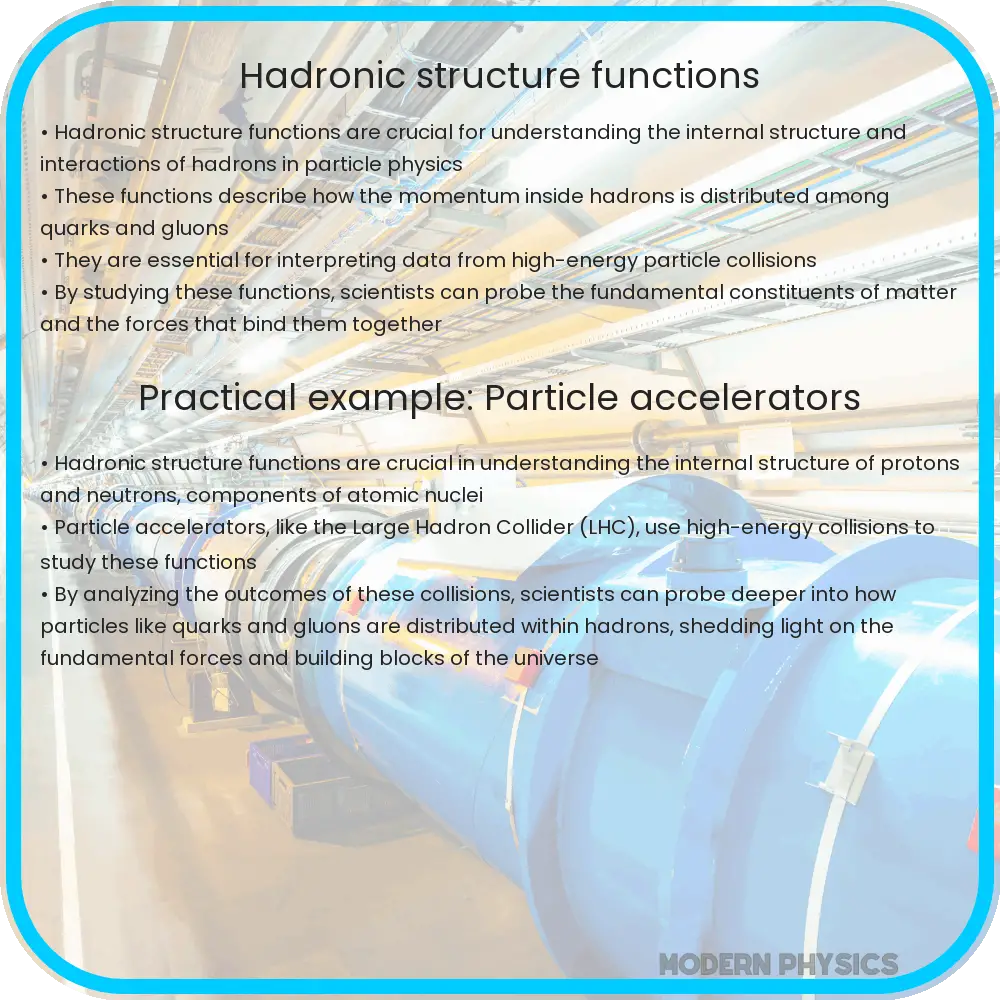
Understanding Hadronic Structure Functions: A Window into QCD and Parton Dynamics
Hadronic structure functions are fundamental tools in exploring the depths of Quantum Chromodynamics (QCD), the theory that describes the strong interaction, one of the four fundamental forces in nature. These functions provide insights into the dynamics of partons—the quarks and gluons that make up hadrons, such as protons and neutrons. This exploration is not only crucial for understanding the microscopic world of particle physics but also has implications for the broader understanding of the universe.
The study of hadronic structure functions primarily takes place through deep inelastic scattering experiments, where high-energy electrons are scattered off nucleons. This scattering process reveals the internal structure of hadrons, allowing physicists to probe the distribution and dynamics of quarks and gluons. A key feature observed is the phenomenon of scaling, which suggests that the structure functions depend only on certain dimensionless variables, pointing to the underlying simplicity in the complex world of hadrons.
QCD and the Role of Gluons in Hadrons
QCD, a part of the Standard Model of particle physics, posits that quarks are held together by gluons, the carriers of the strong force. Gluons are unique as they carry the color charge and can interact with themselves, leading to a rich structure within hadrons. Understanding how gluons contribute to the mass and spin of hadrons is a central question in QCD. The gluon’s contribution is encapsulated in the gluon distribution function, a key component of the hadronic structure functions.
As energy increases, the role of gluons becomes more pronounced. At high energies, gluons can split into quark-antiquark pairs or other gluons, leading to a complex sea of partons inside hadrons. This dynamic nature is described by the Dokshitzer-Gribov-Lipatov-Altarelli-Parisi (DGLAP) equations, which model the evolution of parton distribution functions with the energy scale.
Scaling and its Violations
One of the most intriguing aspects of hadronic structure functions is the concept of scaling. Initially, experiments suggested that structure functions were independent of the energy of the interaction, known as Bjorken scaling. This scaling hinted at a point-like structure for partons. However, further experiments revealed violations of this scaling, aligning with QCD predictions that parton distributions change with energy due to gluon emissions and absorptions. This scaling violation is crucial for testing the validity of QCD and understanding the parton dynamics at different energy scales.
Deep Inelastic Scattering and the Proton Spin Puzzle
Deep inelastic scattering experiments have been pivotal in unraveling the internal structure of hadrons. By examining the scattering of electrons off protons at different angles and energies, scientists have gained insights into how quarks and gluons are distributed within. A significant outcome of these studies is the ‘proton spin puzzle’, a term that refers to the surprising discovery that the spins of quarks account for only a small fraction of the total spin of the proton. This has led to extensive research into the role of gluons and orbital angular momentum in contributing to the proton’s spin.
Technological Advances and Future Prospects
Advancements in accelerator and detector technology have allowed for more precise measurements of hadronic structure functions. The Large Hadron Collider (LHC) and other facilities continue to push the boundaries of high-energy physics, exploring phenomena at unprecedented energy scales. Future experiments, like the Electron-Ion Collider (EIC), are expected to provide even deeper insights into the structure of hadrons and the nature of the strong force.
The study of hadronic structure functions is not just limited to understanding fundamental particles but also extends to cosmology and astrophysics. For instance, the behavior of quarks and gluons at high densities is relevant for understanding the conditions inside neutron stars.
Conclusion
Hadronic structure functions serve as a crucial bridge between theoretical predictions of Quantum Chromodynamics and experimental observations. They offer a unique perspective into the complex world of partons, revealing the dynamic interplay of quarks and gluons that constitute the fabric of hadrons. Through deep inelastic scattering experiments and the evolution of parton distribution functions, scientists have been able to test the predictions of QCD, understand the violation of scaling, and explore the contributions of gluons to the properties of hadrons. The ongoing research in this field, propelled by technological advancements and theoretical developments, continues to deepen our understanding of the fundamental forces and particles that govern the universe. The insights gained from studying hadronic structure functions not only enrich the field of particle physics but also have far-reaching implications in our quest to comprehend the cosmos.