
Uncover the complexities of the Nonlinear Zeeman Effect, where high magnetic fields cause deviations from simple spectral line splitting, revealing intricate quantum behaviors.
Understanding the Nonlinear Zeeman Effect
The Zeeman Effect is a fascinating phenomenon in physics where magnetic fields influence the energy levels of atomic and subatomic particles. Initially observed by Pieter Zeeman, this effect contributes crucial insights into the quantum structure of atoms and helps in the study of atomic spectra. What begins as a simple splitting of spectral lines due to external magnetic fields reveals far more complex interactions in the variant known as the Nonlinear Zeeman Effect.
Basics of the Zeeman Effect
To set the stage, the traditional (or linear) Zeeman Effect describes how a spectral line corresponding to electronic transitions within an atom splits into various components under the influence of a magnetic field. This splitting occurs because the magnetic field affects the magnetic dipole moment of the electron. Classical understanding tells us that these splittings should be regular and proportional to the strength of the magnetic field, conforming to the relationship:
ΔE = μB B g M,
where ΔE is the change in energy, μB is the Bohr magneton, B is the magnetic field strength, g is the Landé g-factor, a dimensionless quantity, and M is the magnetic quantum number associated with the angular momentum of the state.
The Transition to Nonlinear Zeeman Effect
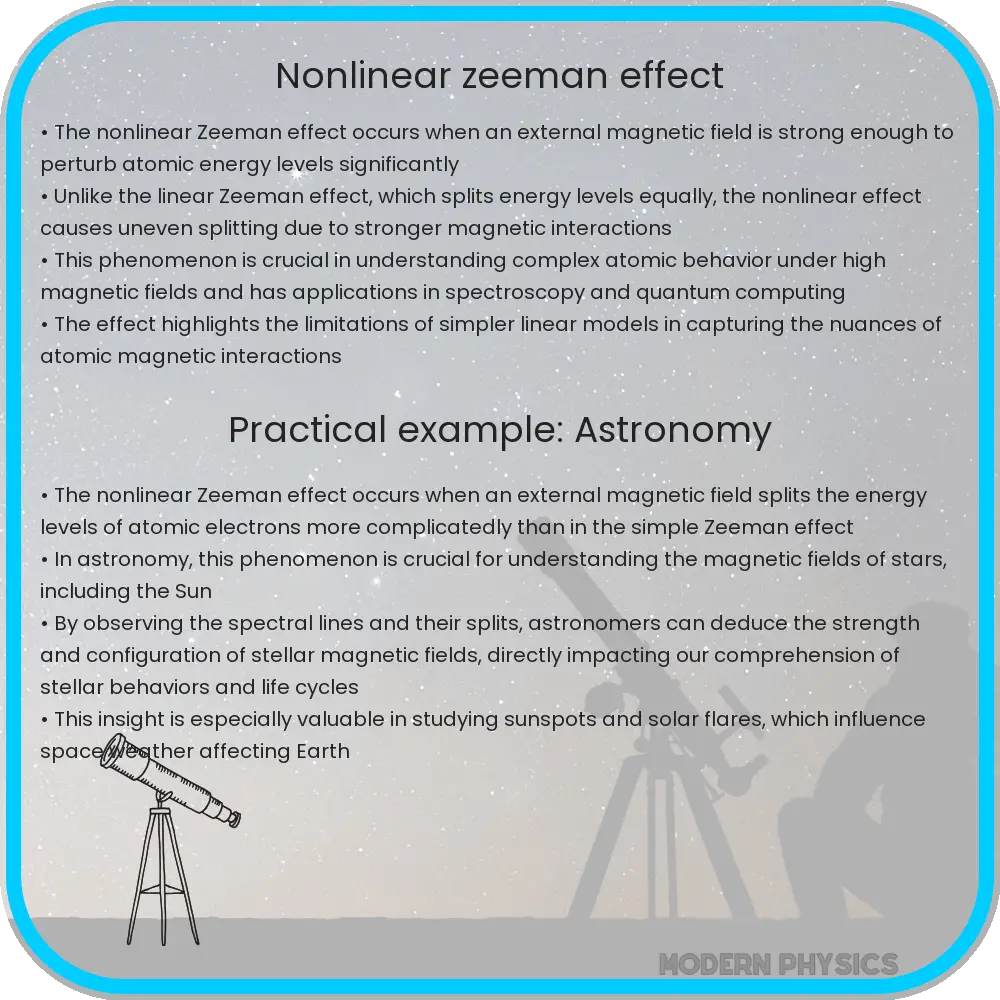
When the applied magnetic field is relatively weak, this energy splitting maintains a linear relationship with the field’s strength. However, as the magnetic field’s intensity increases, deviations from this simple linearity begin to occur, marking the onset of the Nonlinear Zeeman Effect. This nonlinear behavior primarily arises from the perturbations in higher magnetic quantum numbers and the interaction between different spin states.
- The strong magnetic fields start influencing not just the original Zeeman splittings but also cause interactions between different orbital and spin angular momenta (J, L, S).
- Such conditions lead to alterations in the g-factors for different energy levels, resulting in a complex pattern of spectral line splittings.
- The equation governing these splittings becomes dependent on higher powers of the magnetic field, and additional terms need to be considered:
ΔE ≈ g0μBB + g1μBB2 + g2μBB3 + …,
Here, g0, g1, g2, etc., represent factors that modify the energy differences due to nonlinear dependencies on the magnetic field strength.
Implications and Applications
The Nonlinear Zeeman Effect not only deepens our understanding of fundamental magnetic interactions in quantum mechanics but also has practical implications. For example, these insights help improve the accuracy of spectroscopic techniques in various scientific applications, ranging from plasma diagnostics to astrophysical studies. Moreover, understanding this nonlinear behavior is crucial for precision measurements in atomic clocks and quantum computing elements where high magnetic fields may be used.
The shift from a linear to a nonlinear interpretation of the Zeeman splitting epitomizes the transition from classical to quantum thinking in physics. As we delve deeper into nonlinear effects, we uncover more about the intricate balance of forces at the subatomic level.
Experimental Observations of Nonlinear Zeeman Effect
Historically, the detection and measurement of the Nonlinear Zeeman Effect have relied heavily on high-resolution spectroscopy. Advanced techniques, such as laser-induced fluorescence spectroscopy and Doppler-free spectroscopy, have enabled physicists to observe the minute details of spectral line splitting under strong magnetic fields. These experimental setups are crucial in validating the theoretical predictions related to the Zeeman Effect.
- Using polarized light and varying magnetic field strengths, researchers can meticulously trace the changes in energy levels and correlate them with changes in the magnetic environment.
- Data from these experiments help refine the models and constants used in quantum mechanical calculations, such as the g-factors and magnetic quantum numbers.
Educational and Research Value
The study of the Zeeman Effect, particularly its nonlinear aspects, offers valuable educational insights into quantum mechanics and electromagnetism. It serves as an exemplary case of how theoretical physics gets applied in practical scenarios. Furthermore, research into the Nonlinear Zeeman Effect paves the way for more sophisticated quantum mechanical models and can push the boundaries of what is currently known about particle physics.
- In university curricula, this effect is often used to demonstrate quantum splitting and magnetic effects on atomic particles—concepts at the core of modern physics.
- For researchers, continuing to explore this effect could lead to developments in technology based on quantum principles, such as quantum sensors and next-generation magnetic resonance imaging (MRI) systems.
Conclusion
The Nonlinear Zeeman Effect richly illustrates the complexity and beauty of the interactions within atomic and subatomic particles under the influence of strong magnetic fields. From its initial discovery to current technological and theoretical advances, this effect remains a cornerstone of quantum mechanics and magnetic effects in physics. Its implications stretch far beyond the laboratory, influencing the development of technologies in fields such as medical imaging, quantum computing, and spectral analysis. As we refine our understanding and capabilities to measure these tiny quantum phenomena, the potential for new applications and improved technologies seems boundless. The Nonlinear Zeeman Effect not only enriches our knowledge of the natural world but also underscores the interconnectedness of scientific disciplines and their collective impact on technology and innovation.
By embracing both classical concepts and quantum advancements, enthusiasts and experts in physics continue to explore and unravel the complexities of the universe, marked by phenomena like the Nonlinear Zeeman Effect.