
Learn about Multi-Photon Ionization (MPI), a quantum phenomenon where atoms or molecules absorb multiple photons resulting in ionization, used in fields like spectroscopy and medical imaging.
Introduction to Multi-Photon Ionization Dynamics
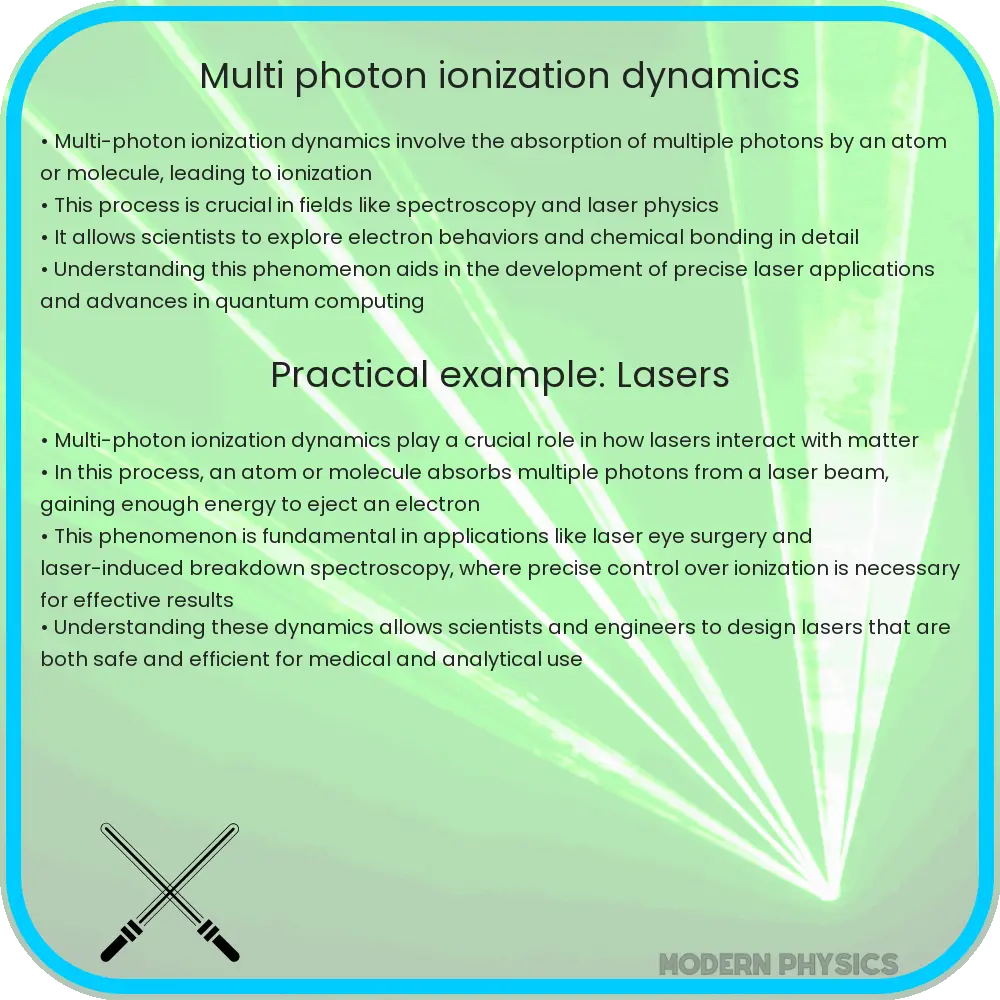
Multi-photon ionization (MPI) is a process where multiple photons are absorbed by an atom or a molecule, resulting in ionization – the ejection of one or more electrons. This fascinating quantum phenomenon occurs under the influence of intense electromagnetic fields typically produced by lasers. Understanding MPI is essential for various applications in physics and chemistry, including spectroscopy, microscopy, and even in the medical field.
Basics of Multi-Photon Ionization
In single-photon ionization, an electron is ejected from an atom or molecule when it absorbs a single photon possessing enough energy to overcome the binding energy of the electron, i.e., the ionization energy. In contrast, multi-photon ionization involves the absorption of multiple photons, each contributing a fraction of the energy needed to free the electron. The total energy absorbed from all the photons collectively enables the electron to escape from its atomic or molecular bound state.
The likelihood of MPI occurring depends on the intensity of the light source and the duration of its interaction with the matter. High-intensity, short-pulse lasers are typically used to initiate these interactions effectively. The process is non-linear, meaning that the probability of ionization per photon does not increase linearly with the number of photons.
Mechanisms of MPI
There are two primary mechanisms through which multi-photon ionization can occur:
- Sequential Absorption: This mechanism involves the step-by-step absorption of photons where each photon moves the electron to a higher energy state until it has enough energy to escape.
- Simultaneous Absorption: In this mechanism, all the required photons are absorbed simultaneously in one quantum event, resulting in immediate electron ejection.
Applications of Multi-Photon Ionization
Multi-photon ionization dynamics have diverse and crucial applications. Some of these include:
- Spectroscopy: MPI is used in multi-photon excitation spectroscopy to study the electronic structures of molecules. This method provides valuable insights in fields such as environmental science and materials research.
- Microscopy: Multi-photon microscopy allows for imaging deep within biological tissues. The technique uses near-infrared light, minimizing damage and absorption by the sample, resulting in clearer, deeper images.
- Medical Applications: In the medical field, MPI is explored for its potential in precise laser surgeries and photodynamic therapies, where it can be used to target and destroy pathological cells.
The versatility of multi-photon ionization makes it a powerful tool in both research and applied sciences, making a deep understanding of its dynamics crucial for technological advancements.
Recent Advances in MPI Technology
Advancements in laser technology have significantly influenced the development and applications of MPI. The creation of ultra-short pulse lasers, capable of delivering high-intensity bursts over femtoseconds (10-15 seconds), has opened new avenues in how MPI can be utilized efficiently and effectively in both experimental and practical applications.
These improvements not only enhance the precision of MPI but also reduce unwanted thermal effects, which is especially important in delicate applications such as biological imaging and the treatment of sensitive materials.
Challenges and Future Prospects
Despite the significant advances and applications, multi-photon ionization faces several challenges that need to be addressed. One major hurdle is the requirement for extremely high-intensity laser sources, which can be expensive and difficult to handle. Moreover, controlling the exact spatial and temporal distribution of the photons to ensure efficient ionization without damaging the surrounding materials remains a technical challenge.
Future research in MPI is likely to focus on improving the control and efficiency of photon sources, and expanding the understanding of complex ionization processes in different materials. This could lead to breakthroughs in quantum computing, where MPI techniques might be used for manipulating quantum bits with high precision.
Conclusion
Multi-photon ionization is a profound and versatile quantum mechanical process that plays a pivotal role in advancing numerous scientific fields. By providing a deeper understanding of electron dynamics in atoms and molecules, MPI enhances the capabilities of spectroscopy, microscopy, and various medical technologies. The continuous evolution of laser technologies not only broadens the scope of MPI’s applications but also tackles existing challenges, paving the way for innovative solutions in science and engineering.
As we progress, the integration of advanced computational models with experimental research will be crucial in unlocking further potential of MPI. This will enable scientists and engineers to design more sophisticated and effective applications, ultimately contributing to significant technological advancements and a deeper understanding of the microscopic world.