
Explore the essentials of Non-Equilibrium Ion Transport, its efficiency, predictive models, and advanced applications in technology and science.
Understanding Non-Equilibrium Ion Transport: Key Principles and Applications
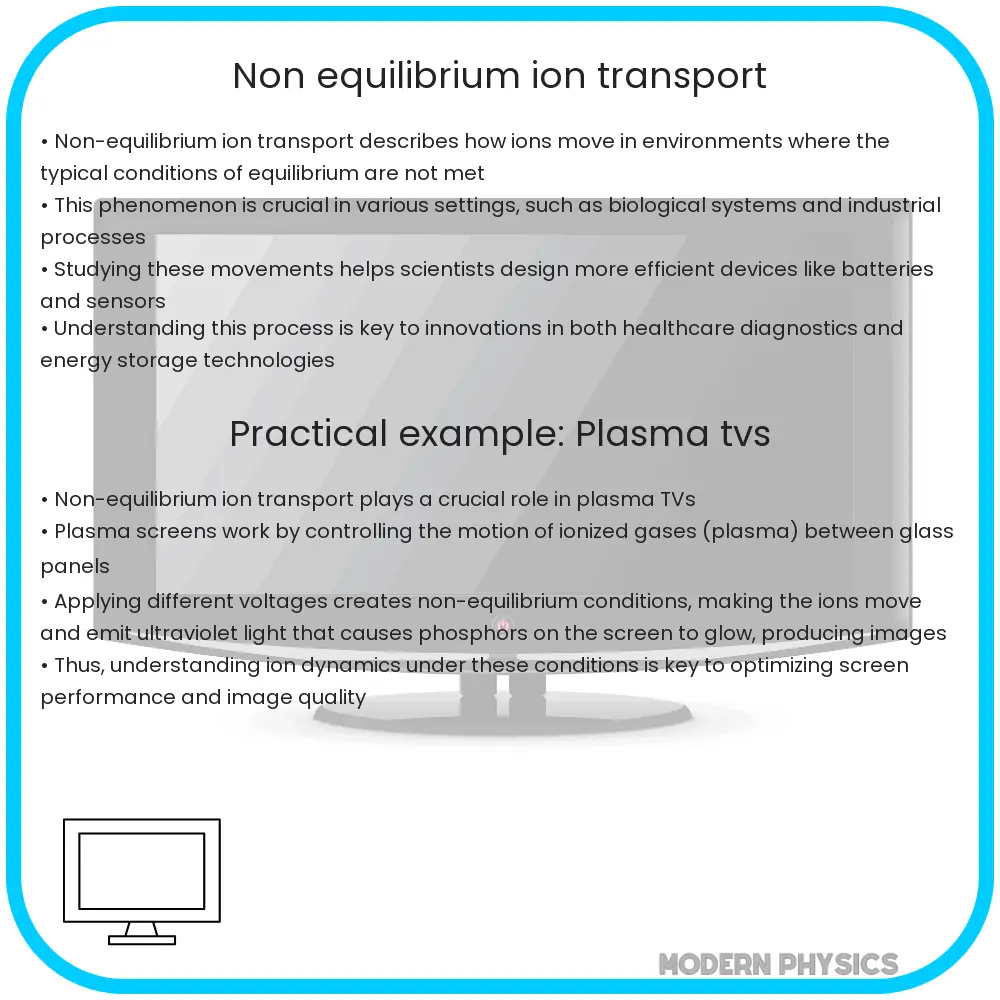
Non-Equilibrium Ion Transport is a fundamental concept in various scientific fields, particularly in chemistry and physics. It involves the movement of ions in a medium (like a liquid or gas) under conditions that are not in thermodynamic equilibrium. This phenomenon is crucial in understanding and developing various technological and industrial processes.
Basics of Non-Equilibrium Ion Transport
The core of non-equilibrium ion transport lies in ions moving under the influence of external forces, such as electric fields, concentration gradients, or temperature differences. Unlike equilibrium conditions, where ions distribute uniformly and the net movement ceases, non-equilibrium conditions perpetuate ion movement. This movement is described by the Nernst-Planck equation, which combines the effects of diffusion, electromigration, and convection.
Efficiency in Ion Transport
Efficiency in non-equilibrium ion transport is vital for various applications, including battery technology, electrochemical cells, and biological systems. Improving efficiency involves optimizing the conditions that affect ion movement, such as the strength of the electric field, the concentration gradient, and the properties of the medium through which ions move.
Predictive Models in Ion Transport
Predictive modeling plays a crucial role in understanding and controlling non-equilibrium ion transport. These models help in predicting the behavior of ions under different conditions, which is essential for designing efficient systems. Advanced computational methods, like molecular dynamics simulations and machine learning algorithms, are increasingly used to develop these predictive models.
Advanced Applications
Non-equilibrium ion transport finds its application in several advanced technological fields. In energy storage systems like lithium-ion batteries, it’s essential for understanding and improving the efficiency of ion exchange between electrodes. In the field of biophysics, it helps in understanding the transport of ions across cell membranes, crucial for nerve impulse transmission and muscular contraction. Additionally, in environmental science, it aids in the study of ion transport in soils and aquatic systems, essential for understanding pollutant behavior and nutrient cycling.
Understanding and harnessing non-equilibrium ion transport opens doors to numerous innovations in science and technology. Its principles are fundamental to the development of more efficient energy storage systems, advanced biomedical devices, and sustainable environmental solutions.
Advancements in Non-Equilibrium Ion Transport
Recent advancements in the field of non-equilibrium ion transport have been groundbreaking. Researchers are exploring novel materials and methods to enhance ion transport efficiency. For example, the use of nanostructured materials in batteries and fuel cells has shown significant improvements in ion transport, leading to higher energy densities and faster charging times. Additionally, advancements in membrane technology have revolutionized water purification and desalination processes, where ion transport plays a crucial role.
Challenges in Non-Equilibrium Ion Transport
Despite its vast applications and advancements, non-equilibrium ion transport faces several challenges. One major challenge is the control and optimization of ion transport in complex systems, like biological membranes or heterogeneous catalytic systems. Moreover, there is an ongoing need to develop more accurate and efficient computational models that can predict ion transport behavior in these complex systems.
Future Directions
The future of non-equilibrium ion transport lies in integrating multidisciplinary approaches for better understanding and application. Collaboration between chemists, physicists, biologists, and engineers is crucial for developing innovative solutions. There is also a growing interest in sustainable and environmentally friendly approaches in ion transport-related technologies. For instance, research is being directed towards developing bio-based or recyclable materials for ion transport in energy storage devices.
Conclusion
Non-Equilibrium Ion Transport is a dynamic and evolving field with immense potential for scientific and technological breakthroughs. Its applications span across critical areas like energy storage, environmental science, and biotechnology. As we continue to unravel the complexities of ion movement under non-equilibrium conditions, we pave the way for more efficient, predictive, and advanced technologies. The ongoing research and interdisciplinary efforts promise not only to enhance our understanding of this fundamental phenomenon but also to contribute significantly to solving some of the most pressing challenges of our time.