
Explore the intriguing world of electrokinetic phenomena in fluids, covering charge interactions, fluid flow, heat transfer, and practical applications.
Understanding Electrokinetic Phenomena in Fluids
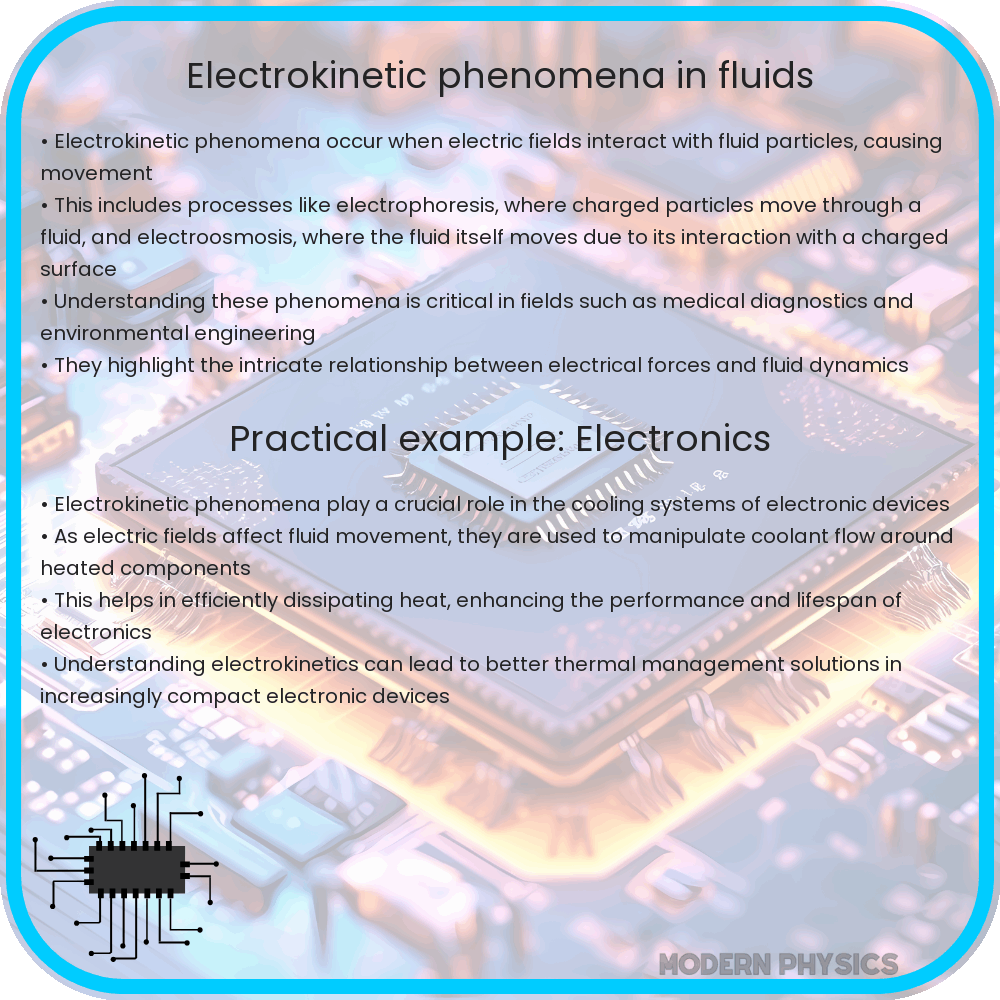
Electrokinetic phenomena represent a fascinating intersection between electricity and fluid mechanics, profoundly influencing fields like microfluidics, colloidal chemistry, and wastewater treatment. At its core, electrokinetics involves the study of fluid motion produced by an applied electric field, primarily in colloidal suspensions or in porous media. This article delves into the key aspects of electrokinetic phenomena, highlighting the principles of charge, flow, and heat transfer.
Charge Interactions in Electrokinetics
In colloidal systems, particles are often charged, either naturally or through chemical modification. When these particles are suspended in a fluid, a unique double-layer structure forms. This structure, known as the electrical double layer (EDL), comprises a layer of charged particles and a counter layer of oppositely charged ions. The interaction of these layers under an electric field leads to several electrokinetic effects.
Electroosmosis: Fluid Motion through Capillaries
One of the primary electrokinetic phenomena is electroosmosis, which refers to the motion of a liquid through a capillary or porous medium in response to an electric field. This movement is governed by the interaction between the electric field and the electrical double layer within the capillaries. The governing equation for electroosmotic flow (EOF) can be expressed as:
EOF = εε0ζμE/η
where ε is the dielectric constant of the medium, ε0 is the vacuum permittivity, ζ is the zeta potential, μE is the electric mobility, and η is the dynamic viscosity of the fluid.
Electrophoresis: Movement of Charged Particles
Electrophoresis describes the motion of charged particles relative to a stationary fluid under an electric field. This phenomenon is crucial in separating and analyzing biomolecules like DNA and proteins. The electrophoretic mobility (μE) is a key parameter here, defined as the velocity of the particle per unit electric field strength.
Streaming Potential: Flow-Induced Voltage
When a pressure-driven flow occurs through a capillary or porous plug containing an EDL, it generates an electric potential known as streaming potential. This potential is proportional to the pressure difference and inversely proportional to the ionic strength of the fluid. The streaming potential equation is:
Streaming Potential = -ΔPζ/σ
where ΔP is the pressure difference, ζ is the zeta potential, and σ is the electrical conductivity of the fluid.
Heat Transfer in Electrokinetic Systems
Heat transfer in electrokinetic systems is a complex process influenced by Joule heating, electroosmotic flow, and conductive heat transfer. Joule heating, caused by the electric current passing through the fluid, can significantly affect temperature distribution and hence the efficiency of processes like electrophoresis.
This interplay between electric fields, fluid flow, and heat transfer in electrokinetic systems offers immense potential in various applications, from lab-on-a-chip devices to enhanced oil recovery methods. Understanding these principles is vital for the advancement of technologies leveraging electrokinetic phenomena.
Applications and Advancements in Electrokinetics
Electrokinetic phenomena are not just theoretical constructs; they have practical applications in a wide range of fields. The principles of charge interaction, fluid flow, and heat transfer in electrokinetic systems are particularly pivotal in areas such as microfluidics, environmental engineering, and biomedical applications.
Microfluidics and Lab-on-a-Chip Devices
In microfluidics, electrokinetics provides a way to manipulate small volumes of fluids. Lab-on-a-chip devices exploit electrokinetic effects like electroosmosis and electrophoresis to control fluid movement and molecular separation on a microscale. These devices have significant implications in medical diagnostics, drug delivery, and biochemical assays.
Wastewater Treatment and Environmental Remediation
Electrokinetics plays a crucial role in environmental engineering, especially in soil and water remediation. Techniques like electrocoagulation and electroflotation leverage electrokinetic principles to remove pollutants from wastewater. Similarly, in soil remediation, electrokinetic processes help in the extraction of heavy metals and organic contaminants from contaminated soils.
Biomedical Applications
In the biomedical field, electrokinetics facilitates cell manipulation and sorting, critical for applications like cancer research and stem cell therapy. Electroporation, a process where an electric field creates pores in cell membranes, is a key technique in gene therapy and drug delivery.
Challenges and Future Directions
Despite its diverse applications, electrokinetic phenomena face challenges, particularly in scalability and energy efficiency. Future research is directed towards optimizing electrokinetic processes for industrial-scale applications and minimizing energy consumption. Innovations in materials and computational modeling are also expected to enhance the efficiency and applicability of electrokinetic systems.
Conclusion
Electrokinetic phenomena represent a vital intersection of physical science principles, offering unique insights into the behavior of fluids under electric fields. From advancing microfluidic technologies to contributing to environmental sustainability, the implications of understanding and harnessing these phenomena are profound. As research continues to address the existing challenges, the future of electrokinetics holds promising potential for groundbreaking applications across various scientific and engineering disciplines. The ongoing exploration of electrokinetics not only enriches our understanding of fluid dynamics and electromagnetism but also paves the way for innovations that could transform numerous technological and industrial sectors.