
Explore the intriguing world of Non-Centrosymmetric Superconductors, their unique properties, challenges, and potential in quantum technology.
Introduction to Non-Centrosymmetric Superconductors
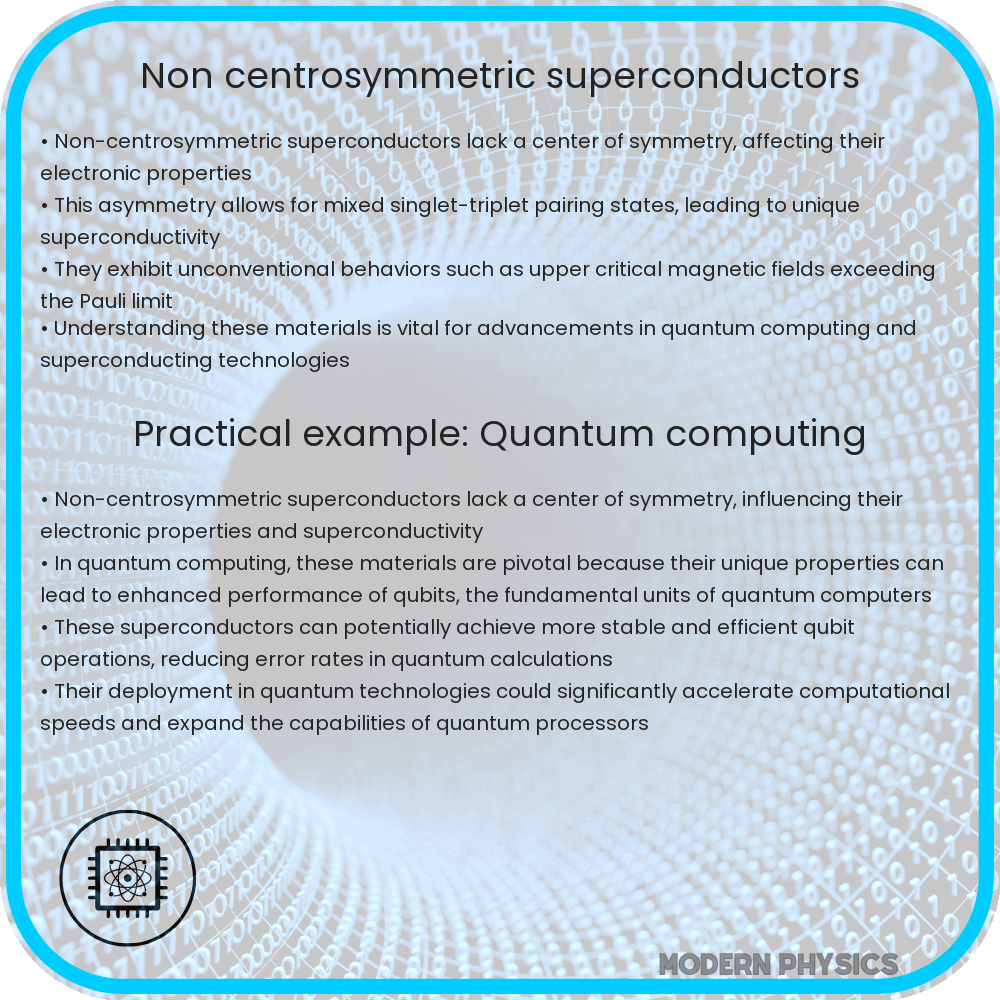
Non-Centrosymmetric Superconductors (NCSs) represent a fascinating and innovative class within the field of superconductivity. These materials, characterized by their lack of a center of symmetry in their crystal structure, have garnered significant attention for their unusual properties and potential applications in quantum technology. Unlike traditional superconductors, NCSs exhibit unique and robust quantum phenomena due to the asymmetric electric field distribution within their lattice structure.
Unusual Properties of NCSs
One of the most intriguing aspects of NCSs is the mixed singlet-triplet pairing state they can exhibit. This results from the strong spin-orbit coupling induced by the non-centrosymmetric crystal structure. In conventional superconductors, Cooper pairs are formed by two electrons with opposite spins, leading to a singlet state. However, in NCSs, the lack of inversion symmetry allows for the admixture of singlet and triplet states, leading to unconventional superconductivity.
This unique pairing mechanism gives rise to several unusual properties. For example, NCSs can exhibit an upper critical field much higher than what is predicted by the conventional BCS theory. Moreover, they can demonstrate a range of non-standard behaviors under magnetic fields, such as the helical or mixed phase states, which are of great interest in the study of quantum phenomena and technology.
Robustness and Applications
The robustness of non-centrosymmetric superconductors against impurities makes them particularly appealing for practical applications. Traditional superconductors can be significantly disrupted by impurities and defects; however, NCSs maintain their superconducting properties due to their unconventional pairing mechanisms. This robustness extends their potential use in environments where conventional superconductors might fail.
Furthermore, the unique properties of NCSs hold promise for various applications in the realm of quantum computing and spintronics. Their ability to maintain superconductivity under high magnetic fields and to exhibit topological superconducting states makes them ideal candidates for the development of qubits and other quantum devices. Additionally, the mixed singlet-triplet pairing offers new avenues for spintronic applications, where the manipulation of spin currents is essential.
Challenges and Future Directions
Despite their promising features, non-centrosymmetric superconductors face several challenges that must be addressed to fully exploit their potential. One of the primary obstacles is the difficulty in synthesizing these materials with the desired purity and structural properties. Precise control over the material’s crystal structure is crucial for achieving the unique superconducting properties that NCSs can offer. Additionally, understanding the complex relationship between the lack of inversion symmetry and the resulting superconducting properties requires advanced theoretical and experimental approaches.
Another challenge lies in the detailed investigation of the mixed singlet-triplet pairing mechanism. While this feature is at the heart of the unique properties of NCSs, it also complicates their theoretical description and experimental analysis. Advanced spectroscopic techniques and theoretical models are needed to unravel the complexities of this pairing state and its effects on the superconducting properties.
Furthermore, for practical applications, it is essential to develop techniques for integrating NCSs into devices and systems. This includes fabricating junctions, wires, and other components that can operate effectively at the low temperatures required for superconductivity. Addressing these engineering challenges is crucial for the successful implementation of NCSs in quantum computing, spintronics, and other advanced technologies.
Conclusion
Non-centrosymmetric superconductors offer a rich playground for exploring unconventional superconductivity and hold significant promise for future technological applications. Their unique properties, such as mixed singlet-triplet pairing and robustness against impurities, make them attractive candidates for applications in quantum computing and spintronics. However, the full realization of their potential requires overcoming current challenges in material synthesis, theoretical understanding, and device integration. As research in this field continues to advance, NCSs may play a critical role in the development of future quantum technologies and devices, marking a significant step forward in our understanding and application of superconducting materials.