
Explore the world of chiral superconductivity, its unique non-centrosymmetric properties, exotic pairing, and potential applications in advanced technology.
Understanding Chiral Superconductivity
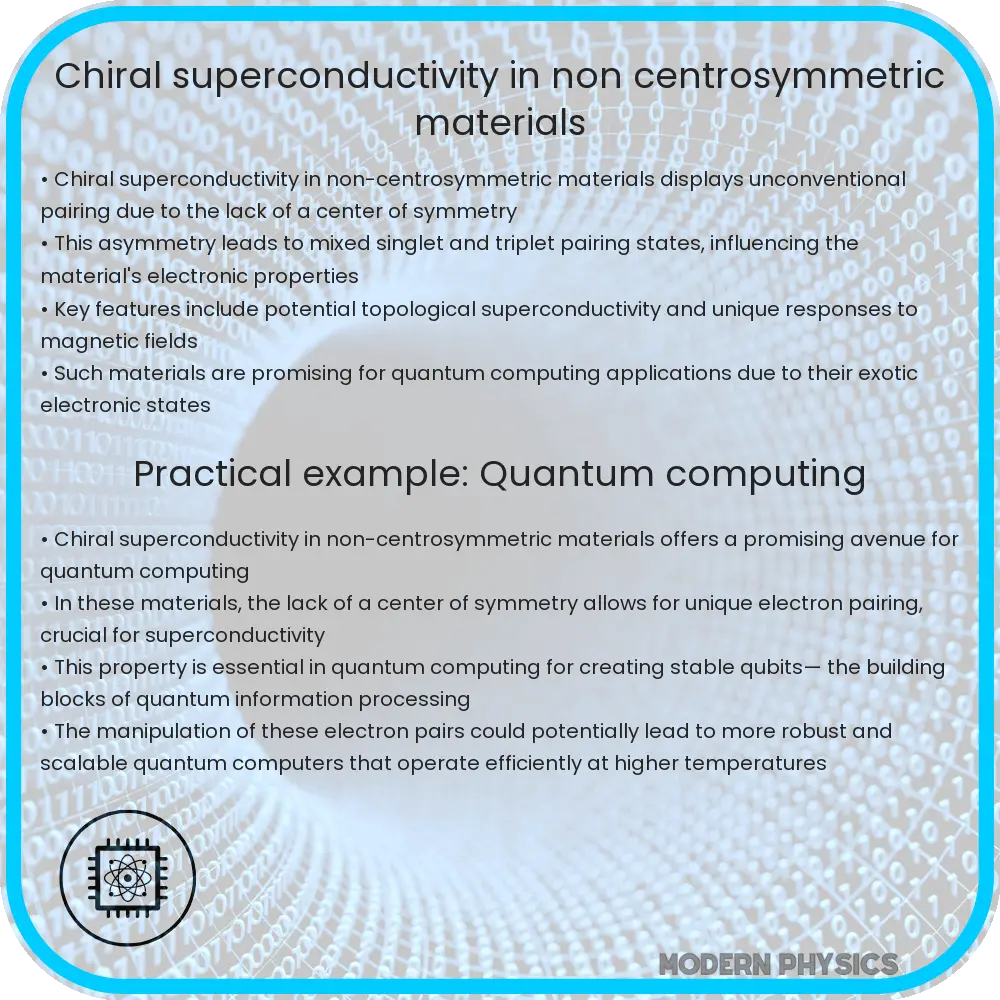
Chiral superconductivity represents a fascinating and complex phase of matter, exhibiting unique properties that defy conventional superconducting behavior. Unlike traditional superconductors that exhibit symmetry in their electron pairing, chiral superconductors break this mold, leading to non-centrosymmetric structures. This phenomenon has garnered significant interest due to its potential for revolutionary applications in quantum computing, magnetic sensors, and other advanced technologies.
Non-Centrosymmetric Superconductors
At the heart of chiral superconductivity lies the lack of inversion symmetry, known as non-centrosymmetry. In non-centrosymmetric superconductors, the crystal structure lacks a center of inversion, leading to asymmetric electronic properties. This asymmetry allows for the mixing of spin-singlet and spin-triplet pairing states, a characteristic unattainable in centrosymmetric materials. The result is an exotic state of matter that hosts a mixture of different superconducting states, providing a platform for unique electronic phenomena such as mixed-parity superconductivity and unconventional magnetic responses.
Exotic Pairing Mechanisms
The exotic pairing mechanisms in chiral superconductors are central to their unique properties. In these materials, electrons pair up in a non-traditional manner, not just based on their opposite momenta and spins, as in conventional superconductors, but also incorporating complex angular momentum states. This results in the formation of Cooper pairs with non-zero angular momentum, leading to chiral superconductivity where the order parameter has a distinct handedness or chirality. Such pairing mechanisms are key to understanding the unconventional behaviors observed in these superconductors, including topological edge states and the potential for hosting Majorana fermions.
Advanced Applications and Research
The intriguing properties of chiral superconductors open the door to numerous advanced applications. In the realm of quantum computing, for instance, the unique quantum states present in chiral superconductors, such as Majorana fermions, could provide a platform for fault-tolerant quantum computing. Additionally, the sensitivity of these materials to magnetic fields and their unconventional superconducting states offer promising avenues for the development of highly sensitive magnetic sensors and novel electronic devices.
Challenges and Future Directions
Despite their promising potential, chiral superconductors face several challenges that need to be addressed. One of the primary issues is the difficulty in synthesizing high-quality non-centrosymmetric materials with the desired superconducting properties. Additionally, the precise manipulation and characterization of the chiral superconducting state require advanced techniques that are still under development. Researchers are also tasked with understanding the complex interplay between spin-orbit coupling, electron pairing mechanisms, and external factors like magnetic fields and pressure.
Furthermore, the theoretical framework for chiral superconductivity is still evolving. Current models provide a basis for understanding the exotic behaviors observed, but they may not fully capture all aspects of the phenomena. As such, continued theoretical and experimental research is crucial for advancing our understanding and for harnessing the full potential of these materials.
Conclusion
Chiral superconductivity represents a frontier in condensed matter physics, offering a blend of fundamental scientific intrigue and potential technological revolution. The unique properties of non-centrosymmetric superconductors, characterized by their exotic pairing mechanisms and lack of inversion symmetry, open new avenues for applications in quantum computing, sensing technologies, and beyond. However, the path forward is paved with challenges, including material synthesis, theoretical understanding, and device integration.
As research progresses, the future of chiral superconductivity looks promising, with the potential to unlock new quantum states and enable advanced electronic devices. The ongoing synergy between theoretical predictions, material science, and experimental techniques will be pivotal in overcoming the current challenges and in realizing the full potential of these exotic materials. In the quest for understanding and utilizing the quantum mechanical underpinnings of our universe, chiral superconductivity stands as a beacon of potential, guiding the way towards novel quantum phenomena and technologies.