
Explore the impact of Noether’s Theorem in quantum mechanics, linking symmetries to conservation laws and shaping modern physics theories.
Noether’s Theorem and Its Significance in Quantum Mechanics
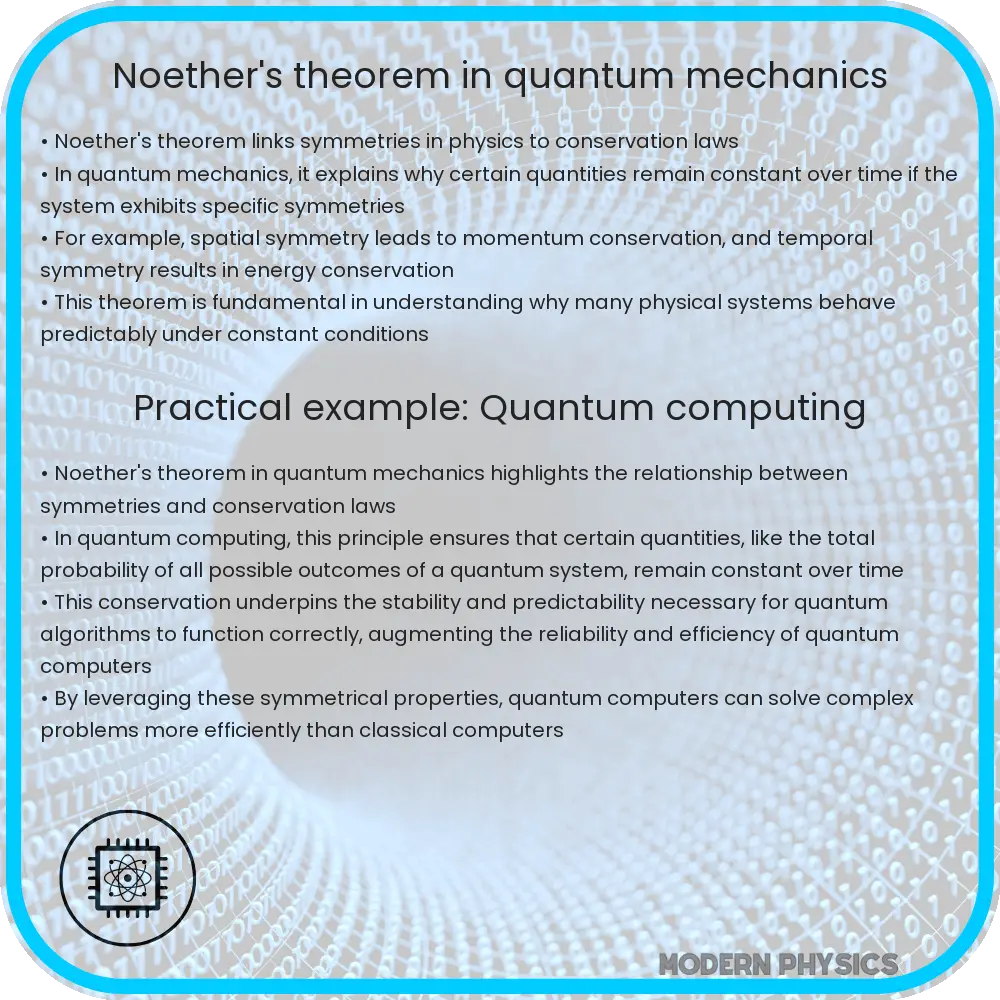
Noether’s Theorem, formulated by mathematician Emmy Noether in 1915, is a cornerstone in theoretical physics, particularly in quantum mechanics. This theorem establishes a profound connection between symmetries and conservation laws, which are fundamental to understanding the behavior of physical systems. The theorem states that every differentiable symmetry of the action of a physical system has a corresponding conservation law.
Symmetry and Conservation in Quantum Mechanics
In quantum mechanics, symmetries play a crucial role in determining the properties and evolution of systems. A symmetry is a transformation that leaves the system unchanged. For example, rotational symmetry implies that a system’s physical properties are invariant under rotations. According to Noether’s Theorem, these symmetries correspond to conservation laws. For rotational symmetry, this is the conservation of angular momentum.
The theorem also applies to more abstract symmetries, such as gauge symmetry, which is central to the formulation of quantum field theories like Quantum Electrodynamics (QED) and Quantum Chromodynamics (QCD). In these theories, gauge symmetries are linked to the conservation of electric charge and color charge, respectively.
Understanding Noether’s Theorem in Quantum Context
Noether’s Theorem helps us understand why certain quantities are conserved in nature. In quantum mechanics, the theorem is often expressed in terms of the Hamiltonian, which describes the total energy of a system. If a system has time translational symmetry, meaning its physical laws do not change over time, Noether’s Theorem implies the conservation of energy.
Similarly, spatial translational symmetry, where the laws of physics are the same at different points in space, leads to the conservation of linear momentum. This symmetry is crucial in explaining the behavior of particles and fields in quantum mechanics.
Application and Fundamental Role
Noether’s Theorem is not just a theoretical concept but has practical applications in various fields of physics. In quantum mechanics, it provides a systematic way to identify conservation laws, which are essential for predicting the outcomes of experiments and understanding the fundamental interactions in nature. The theorem’s elegance and generality make it a powerful tool in the physicist’s arsenal, offering insights into the deep connections between the symmetries of the universe and the laws governing its dynamics.
Expanding the Implications of Noether’s Theorem
Noether’s Theorem extends beyond the basic conservation laws in physics. In the realm of quantum field theory, it provides critical insights into the principles that govern particle interactions. For example, in the Standard Model of particle physics, Noether’s Theorem elucidates the relationships between the symmetries of the quantum fields and the conservation of quantum numbers, like baryon and lepton numbers. These insights are pivotal in predicting the outcomes of high-energy particle collisions and understanding the fundamental forces of nature.
Quantum Mechanics and Advanced Conservation Laws
In advanced quantum mechanics, Noether’s Theorem plays a crucial role in the development of sophisticated models and theories. It underpins the formulation of conserved currents and charges, which are instrumental in quantum electrodynamics and quantum chromodynamics. The theorem’s implications extend to the study of solitons and instantons, non-trivial solutions of field equations that have profound implications in theoretical physics.
Challenges and Future Directions
Despite its wide applicability, Noether’s Theorem also presents challenges, especially in complex systems where symmetries are not readily apparent or are broken. In such cases, the application of the theorem requires a deeper understanding of the underlying physical processes and mathematical frameworks. Furthermore, in the realm of cosmology and the study of the early universe, the implications of Noether’s Theorem and the role of symmetries are areas of ongoing research and debate.
Conclusion
Noether’s Theorem is a fundamental pillar in the understanding of quantum mechanics and the broader field of physics. By establishing a direct link between symmetries and conservation laws, it provides a unifying principle that underlies many of the most significant discoveries and theories in physics. The theorem’s application ranges from explaining basic conservation laws, like energy and momentum, to elucidating the complex interactions in quantum field theory. As researchers continue to explore the frontiers of physics, Noether’s Theorem remains a guiding light, revealing the deep and elegant structure of the universe. Its ongoing relevance underscores the profound impact that mathematical insights can have on our understanding of the natural world.