
Explore the Vafa-Witten Theorem’s impact on quantum field theory, its role in preserving symmetries, and its applications in string theory.
Vafa-Witten Theorem: Unveiling the Mysteries of Quantum Field Theory
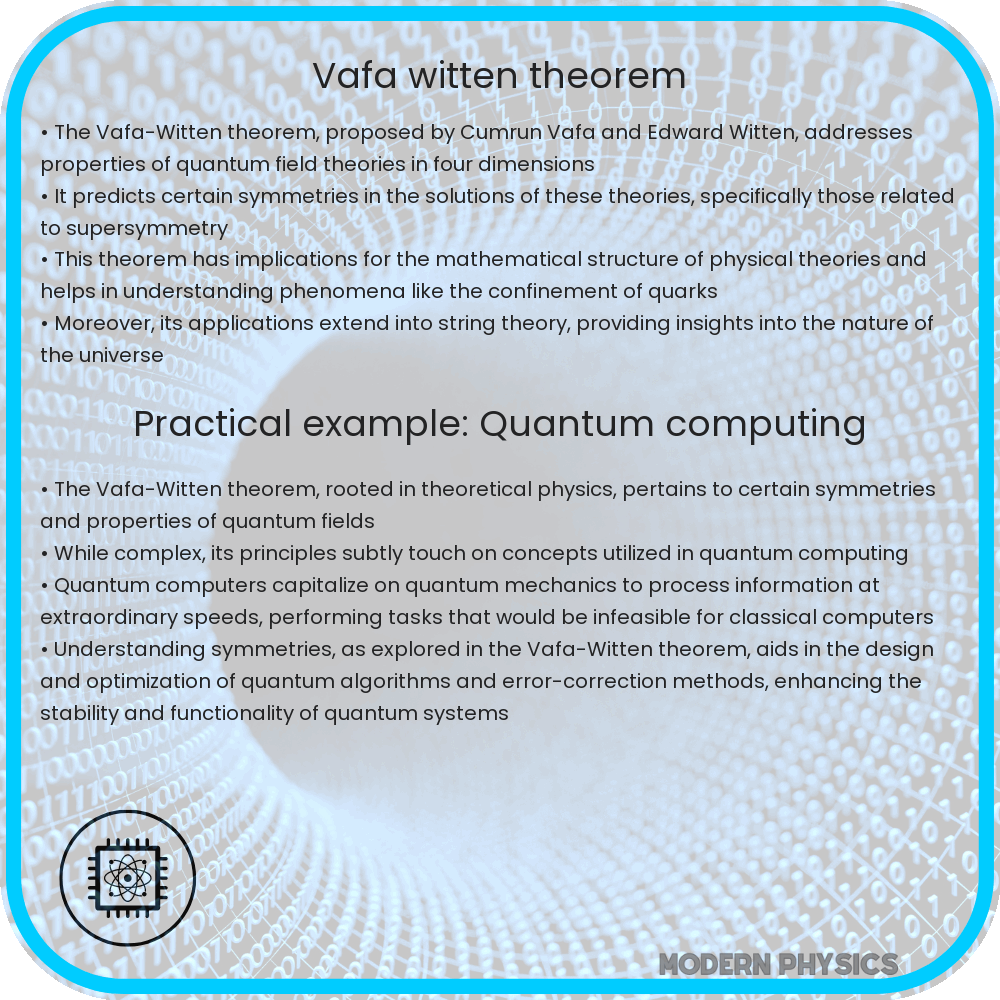
The Vafa-Witten Theorem, named after physicists Cumrun Vafa and Edward Witten, is a significant proposition in the realm of quantum field theory, particularly in the context of supersymmetry and topological quantum field theory. This theorem illuminates crucial aspects of gauge theories, offering profound insights into the nature of quantum fields and their symmetries. Understanding this theorem requires a grasp of several complex concepts in theoretical physics, which we will endeavor to elucidate in a comprehensible manner.
Core Insights of the Vafa-Witten Theorem
At its core, the Vafa-Witten Theorem addresses the issue of symmetry breaking in certain supersymmetric Yang-Mills theories. These theories, which are fundamental to our understanding of particle physics, describe how particles interact with one another through force fields. The theorem asserts that under specific conditions, the parity symmetry (P-symmetry) and time reversal symmetry (T-symmetry) in these theories remain unbroken. This is a profound insight, as symmetry plays a pivotal role in the standard model of particle physics, influencing the behavior and interaction of fundamental particles.
Applications in Quantum Field Theory
The applications of the Vafa-Witten Theorem extend to various areas within quantum field theory. One notable application is in the study of topological quantum field theories (TQFTs), which are used to describe the quantum properties of systems that are insensitive to local changes in their geometry. The theorem provides a framework for understanding how symmetries are preserved in these theories, leading to more accurate models of quantum phenomena.
Another significant application is in the realm of string theory, a theoretical framework that attempts to reconcile quantum mechanics and general relativity. The Vafa-Witten Theorem contributes to this field by offering insights into the nature of supersymmetry, a concept central to string theory. By understanding the conditions under which symmetries are preserved, physicists can better grasp the fundamental structures and interactions in the universe.
Exploring Symmetry in Quantum Fields
One of the most intriguing aspects of the Vafa-Witten Theorem is its exploration of symmetry in quantum fields. Symmetry, in this context, refers to the invariance of a system under certain transformations, such as flipping space (P-symmetry) or reversing time (T-symmetry). The theorem’s assertion that these symmetries remain intact under specific conditions challenges previous notions and opens new avenues for theoretical exploration.
In summary, the Vafa-Witten Theorem stands as a cornerstone in the study of quantum field theory, shedding light on the complex interplay of symmetries in the quantum realm. Its implications extend far beyond theoretical physics, offering a window into the fundamental laws that govern our universe.
Stay tuned for the next part of our exploration into the Vafa-Witten Theorem, where we will delve deeper into its mathematical framework and further applications.
Delving into the Mathematical Framework
The mathematical intricacies of the Vafa-Witten Theorem are rooted in the use of sophisticated tools from gauge theory and algebraic geometry. The theorem employs the concepts of moduli spaces, which are spaces that represent solutions to certain equations defining the gauge theory. These moduli spaces are crucial for understanding the topological properties of quantum fields. The Vafa-Witten Theorem leverages this understanding to predict the non-breaking of specific symmetries in the quantum regime, thereby providing a robust mathematical foundation to these theoretical predictions.
Further Applications in Theoretical Physics
Beyond its immediate implications in quantum field theory and string theory, the Vafa-Witten Theorem finds relevance in other areas of theoretical physics. For instance, it has been instrumental in advancing our understanding of the duality in quantum field theories, a principle suggesting that seemingly different theories can be mathematically equivalent. This has profound implications for the unification of various physical theories and for the study of quantum gravity, a field that seeks to describe gravity according to the principles of quantum mechanics.
Challenges and Future Directions
While the Vafa-Witten Theorem has significantly advanced the field of theoretical physics, it also presents challenges and raises new questions. One of the major challenges is the complexity involved in mathematically proving the theorem in all possible scenarios. This has led to ongoing research and discussions in the physics community, with efforts aimed at further validating and extending the theorem’s applications.
The future of research in this area looks promising, with the potential to uncover more about the universe’s deepest secrets. As computational power and mathematical tools continue to evolve, physicists are optimistic about gaining a more comprehensive understanding of the theorem and its implications.
Conclusion
The Vafa-Witten Theorem is more than a mere equation or statement in theoretical physics; it is a gateway to a deeper understanding of the universe. By providing insights into the nature of symmetries in quantum fields, it has paved the way for significant advancements in our understanding of the fundamental forces and particles that make up our world. Its implications are far-reaching, influencing fields as diverse as quantum gravity, string theory, and the study of quantum fields at a fundamental level. As research continues to evolve, the Vafa-Witten Theorem will undoubtedly remain a key topic of study and discussion, offering exciting possibilities for the future of theoretical physics.