
Explore optimizing heat sink efficiency using thermodynamics, advanced materials, CFD, and sustainable practices for electronic device cooling.
Understanding Heat Sink Efficiency: A Thermodynamic Approach
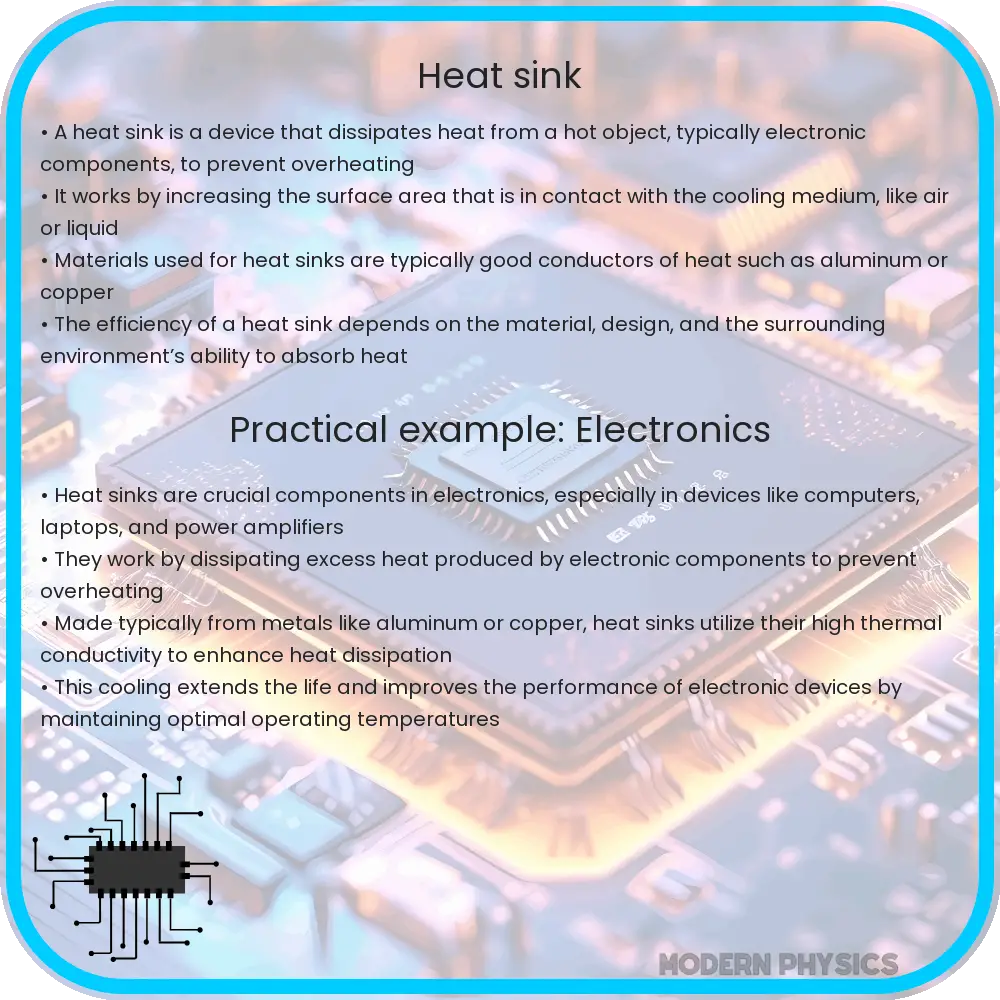
Heat sinks are critical components in electronic devices, ensuring optimal performance by dissipating excess heat. Their efficiency is paramount in stabilizing system temperatures and preventing overheating. In this article, we delve into the principles of thermodynamics to understand how to optimize, cool, and stabilize electronic systems using heat sinks.
Thermodynamics: The Core of Heat Sink Efficiency
At its core, heat sink efficiency is governed by the laws of thermodynamics. The first law, also known as the law of energy conservation, states that energy cannot be created or destroyed, only transformed. In the context of heat sinks, this law implies that the thermal energy generated by electronic components must be effectively transferred and dissipated.
The second law of thermodynamics, which deals with entropy, is equally crucial. It states that the total entropy, or disorder, of an isolated system can never decrease over time. For heat sinks, this means that heat flow from a hotter object (the electronic component) to a cooler one (the heat sink) increases the overall system entropy, facilitating efficient heat dissipation.
Materials and Design: Key Factors in Heat Sink Efficiency
The choice of material and design are vital in determining a heat sink’s efficiency. Materials with high thermal conductivity, like aluminum and copper, are preferred for their ability to quickly transfer heat away from the source. Aluminum, being lighter and less expensive, is commonly used, while copper provides superior conductivity for more demanding applications.
The design of a heat sink, including its size, shape, and fin arrangement, also plays a significant role. A larger surface area facilitates more effective heat dissipation. Fins increase this surface area, and their orientation and spacing can be optimized for specific airflow patterns and thermal loads.
Optimizing Airflow for Enhanced Cooling
Airflow is a critical aspect of heat sink performance. Effective airflow removes the heated air from the vicinity of the heat sink, allowing cooler air to take its place. This process can be optimized through strategic placement of the heat sink and ensuring that there is no obstruction to airflow. Additionally, the use of fans can significantly enhance airflow, further improving the heat sink’s cooling efficiency.
In conclusion, understanding and applying the principles of thermodynamics, selecting appropriate materials and designs, and optimizing airflow are key to maximizing heat sink efficiency. These strategies ensure that electronic devices operate within safe temperature ranges, enhancing their performance and longevity.
Advanced Techniques in Heat Sink Optimization
Advancements in technology have introduced new methods to further enhance heat sink efficiency. One such technique is the use of heat pipes, which are highly effective at transferring heat over larger distances. These pipes contain a liquid that vaporizes at the heat source, carrying heat quickly to a cooler area where it condenses, releasing the heat. This cycle significantly boosts the efficiency of heat dissipation.
Another innovation is the use of phase change materials (PCMs). PCMs absorb a large amount of heat while undergoing a phase transition, for instance, from solid to liquid. Integrating PCMs into heat sink designs allows for temporary storage and gradual release of heat, smoothing out temperature spikes in electronic devices.
Computational Fluid Dynamics (CFD) in Design Optimization
Computational Fluid Dynamics (CFD) plays a crucial role in optimizing heat sink design. CFD simulations allow engineers to analyze heat transfer and fluid flow within a device, enabling them to identify the most efficient design before physical prototyping. This approach saves time and resources, and allows for the exploration of complex geometries that are not feasible with traditional design methods.
Environmental Considerations and Future Trends
Environmental sustainability is becoming increasingly important in the design of heat sinks. Materials like recycled aluminum and methods that reduce energy consumption during manufacturing are gaining attention. Additionally, as electronic devices become smaller and more powerful, the demand for innovative cooling solutions is likely to drive the development of more efficient and compact heat sinks.
Conclusion
In summary, heat sink efficiency is a multi-faceted challenge that requires a deep understanding of thermodynamics, material science, and fluid dynamics. The use of high-conductivity materials, optimized designs, and innovations like heat pipes and PCMs, coupled with advanced techniques such as CFD, are essential in designing effective heat dissipation systems. As technology evolves, the role of heat sinks in maintaining the performance and reliability of electronic devices will continue to grow, with environmental sustainability playing a key role in future developments. By embracing these principles and innovations, we can ensure that our electronic devices remain cool, stable, and efficient in an increasingly digital world.