
Uncover how nanomaterials revolutionize sensor technology, enhancing sensitivity, precision, and durability for diverse applications.
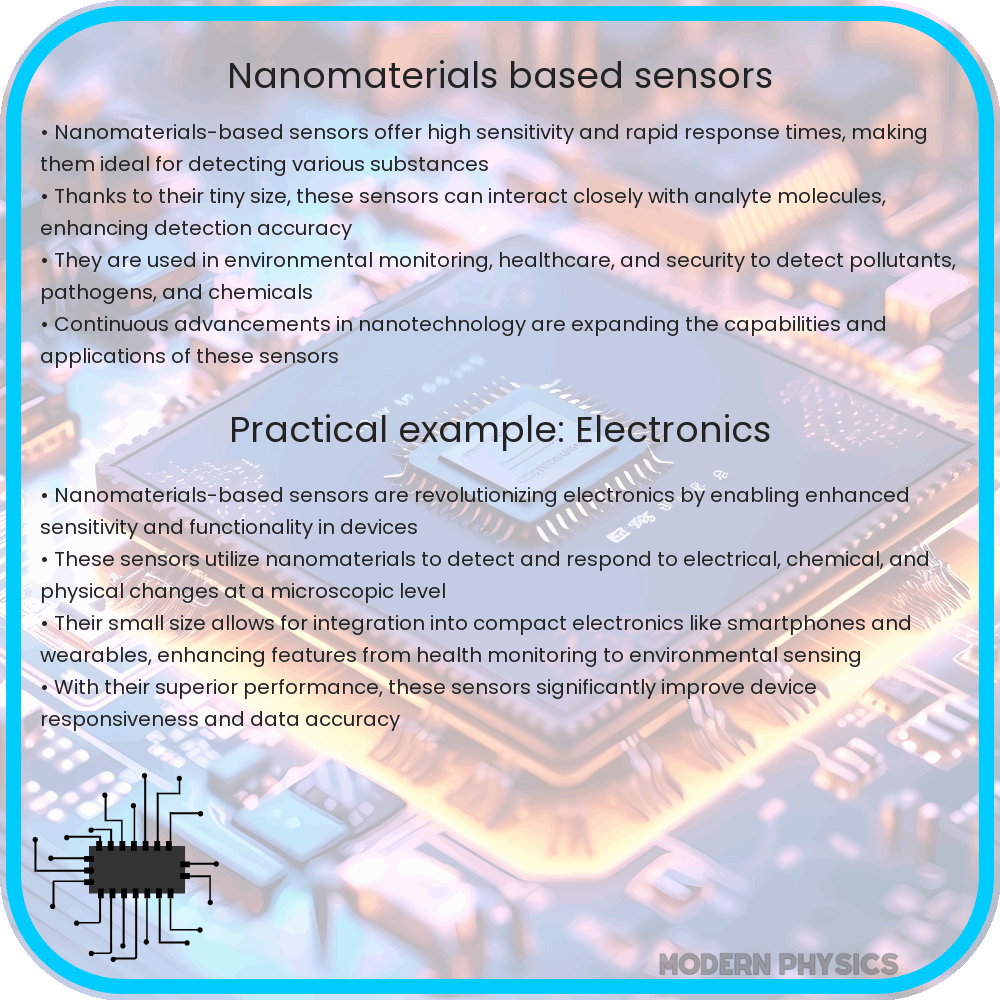
Nanomaterials-based Sensors: Defining Precision, Sensitivity, and Durability
Nanomaterials have revolutionized the field of sensor technology by offering unprecedented sensitivity, precision, and durability. These materials are engineered at the nanoscale level where their physical, chemical, and biological properties significantly differ from their bulk counterparts. This article explores how nanomaterials enhance the capabilities of sensors and the implications of these advancements in various industries.
The Essence of Nanomaterials in Sensing Technologies
At their core, nanomaterials are materials with dimensions significantly less than 100 nanometers. Their exceptionally small size gives them a high surface area to volume ratio, which is a critical factor in sensor performance. The increased surface area of nanomaterials enables greater interaction with analytes (the substances being measured), which in turn boosts the sensitivity and accuracy of the sensors.
- Carbon Nanotubes: Renowned for their electrical conductivity and mechanical strength, carbon nanotubes are used in sensors that detect gases and pollutants at very low concentrations.
- Graphene: Known for its exceptional electrical properties, graphene is utilized in biosensors to detect biomolecules and in environmental sensors for monitoring pollutants.
- Quantum Dots: These are semiconductor particles that possess unique optical properties, making them suitable for optical sensors.
How Nanomaterials Enhance Sensor Performance
The interaction between nanomaterials and analytes can be primarily attributed to the large active surface area, which facilitates various phenomena such as adsorption, catalysis, and electron transfer. These interactions are pivotal for sensors’ responsiveness and sensitivity. Here are key aspects in which nanomaterials improve sensor functionality:
- Increased Sensitivity: The ability of nanomaterials to detect lower concentrations of analytes translates into higher sensitivity. This is crucial in applications such as early disease diagnosis or detecting trace amounts of toxic chemicals.
- Enhanced Precision: Nanomaterials contribute to a lower margin of error in measurement results. This precision is vital in industries where exact readings are critical, such as pharmaceuticals and aerospace.
- Greater Durability: Nanomaterials often exhibit superior stability and robustness, enhancing the longevity and reliability of sensors, even under harsh environmental conditions.
Nanomaterials also introduce versatility in sensor design, allowing for miniaturized yet highly effective sensing units. These miniature sensors can be integrated into various platforms, including wearable technology, smartphones, and medical devices, paving the way for next-generation smart sensing solutions.
Applications in Real-World Scenarios
Nanomaterial-based sensors find applications across a broad spectrum of industries, underscoring their role in driving technological and societal advancements. In healthcare, these sensors enable continuous monitoring of patient health indicators such as glucose levels, heart rate, and other vital signs. Environmental monitoring has benefited from sensors capable of detecting pollutants and hazardous substances with high precision and in real time. Additionally, in the food industry, sensors ensure the safety and quality of food by detecting pathogens and contaminants efficiently.
As the demand for more accurate, reliable, and durable sensors grows, nanomaterials stand at the forefront of research and development efforts. Their ability to operate under a variety of conditions, coupled with their functional adaptability, makes them key elements in the evolution of sensory technology. This is particularly important in an era where data-driven decisions predominate in both business and everyday settings.
The development of nanomaterial-based sensors not only promises enhanced operational capabilities but also opens up new avenues for innovation in sensing technologies. With ongoing research, the future of sensors looks robust, with nanomaterials playing a pivotal role in their transformation.
Challenges and Future Perspectives
Despite their significant advantages, the deployment of nanomaterial-based sensors faces several challenges. Manufacturing processes at the nanoscale can be complex, costly, and require high precision. Ensuring uniformity in the properties of nanomaterials across large batches is another critical issue, which is essential for achieving consistent sensor performance. Additionally, there are concerns related to the environmental impact and potential toxicity of nanomaterials, which must be addressed to ensure their safe integration into consumer products.
Looking ahead, the future of nanomaterial-based sensors seems promising with the potential to revolutionize many aspects of our lives. Advances in nanotechnology and improved manufacturing techniques are expected to overcome current limitations. Research is also focusing on developing biodegradable and eco-friendly nanomaterials, which could alleviate environmental concerns. As technology progresses, smarter and more interconnected sensor networks could be a reality, enabling a more responsive and intuitive environment.
Conclusion
Nanomaterials have ushered in a new era of sensor technology, characterized by enhanced sensitivity, precision, and durability. These materials offer exciting possibilities for innovation across various sectors including healthcare, environmental monitoring, and food safety. While challenges remain in terms of manufacturing and environmental impact, ongoing research and development continue to push the boundaries of what is possible with nanomaterial-based sensors. As we look to the future, the integration of these advanced materials in sensor technology promises to create smarter, more efficient, and more sustainable systems for everyday use and industrial applications. This pushes us not just towards better technology, but also towards a better understanding and interaction with the world around us.