
Explore the transformative power of nanocrystalline materials in enhancing strength, durability, and precision across various industries and their future potential.
Nanocrystalline Materials: Revolutionizing Industrial Standards
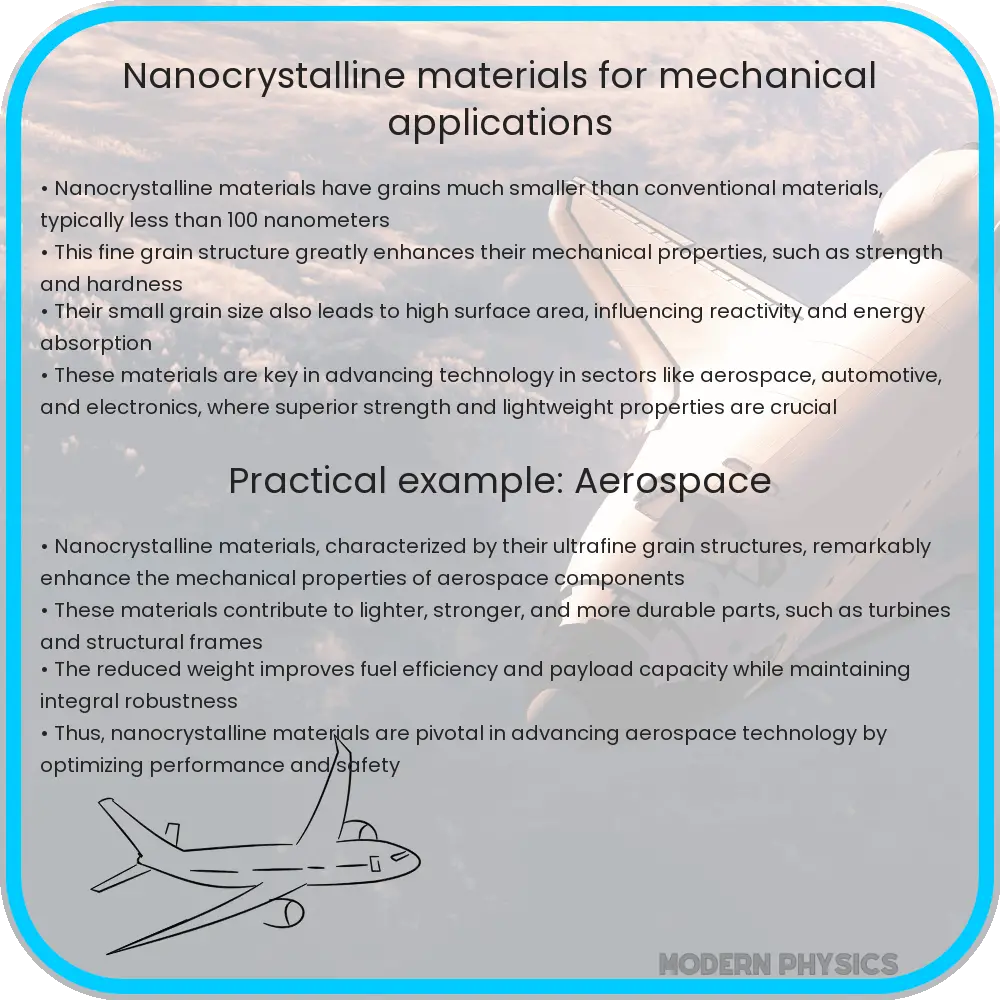
Nanocrystalline materials, with their ultra-fine grain structures, are at the forefront of a materials revolution. By harnessing the unique properties of nanoparticles, these materials offer unprecedented strength, durability, and precision. This transformation is not just limited to one field but spans across various industries including aerospace, automotive, electronics, and medical devices.
Understanding Nanocrystalline Structures
Nanocrystalline materials are characterized by their grain sizes, typically under 100 nanometers. This is significantly smaller compared to their conventional, coarser-grained counterparts. The reduction in grain size to the nanoscale leads to a dramatic increase in the boundary areas between grains, which fundamentally changes their mechanical, thermal, and electrical properties.
Enhanced Mechanical Properties
The hallmark of nanocrystalline materials is their enhanced strength and hardness. According to the Hall-Petch relationship, reducing the grain size of materials results in increased yield strength. This principle is vividly demonstrated in nanocrystalline metals and alloys, where the strength can reach several times that of the same materials with larger grain sizes. Additionally, these materials exhibit high fatigue resistance, making them ideal for applications where materials are subjected to repeated stress.
Improved Durability and Wear Resistance
Beyond strength, nanocrystalline materials showcase superior durability and wear resistance. The dense grain boundaries act as barriers to crack propagation and material wear, significantly extending the life span of components. This is particularly advantageous in environments subjected to harsh conditions, such as high temperatures and corrosive substances.
Precision and Performance
The refined microstructure of nanocrystalline materials also leads to improved precision in manufacturing and performance in application. Their uniform structure and reduced defect rates enable the production of components with exacting dimensions and smoother surfaces. This precision is critical in fields like semiconductor manufacturing and nanotechnology, where even minor imperfections can lead to significant performance issues.
Advancements in Manufacturing Techniques
Advancements in nanotechnology have paved the way for innovative manufacturing processes for nanocrystalline materials. Techniques such as high-energy ball milling, gas phase condensation, and electrodeposition have been refined to produce nanocrystalline structures with controlled composition and purity. These methods enable the mass production of nanocrystalline materials, making them more accessible for industrial applications.
Challenges and Solutions
Despite their superior properties, nanocrystalline materials face challenges, particularly in terms of thermal stability. The increased grain boundary area can lead to grain growth at elevated temperatures, potentially diminishing the advantageous properties. However, research and development efforts are ongoing to overcome these challenges. Alloying and the introduction of stabilizing elements are among the strategies employed to maintain the stability of nanocrystalline structures under operational conditions.
Environmental Impact and Sustainability
The production and utilization of nanocrystalline materials also pose questions regarding environmental impact and sustainability. The energy-intensive manufacturing processes and the use of rare or toxic materials are concerns that need addressing. However, the longer lifespan and reduced material usage due to the enhanced properties of nanocrystalline materials contribute positively to sustainability goals. Furthermore, recycling processes and eco-friendly manufacturing methods are being developed to mitigate environmental impacts.
Conclusion
Nanocrystalline materials represent a significant leap forward in material science, offering enhanced strength, durability, and precision that surpass traditional materials. While challenges such as thermal stability and environmental impact remain, ongoing research and technological advancements are providing viable solutions. As manufacturing processes improve and become more sustainable, the adoption of nanocrystalline materials is set to revolutionize industries, leading to more efficient, reliable, and environmentally friendly products. The future of nanocrystalline materials is not just promising; it is unfolding before our eyes, heralding a new era of material innovation and application.