
Nanocellulose is an innovative, sustainable material derived from abundant cellulose, offering exceptional strength, versatility, and a broad range of industrial applications.
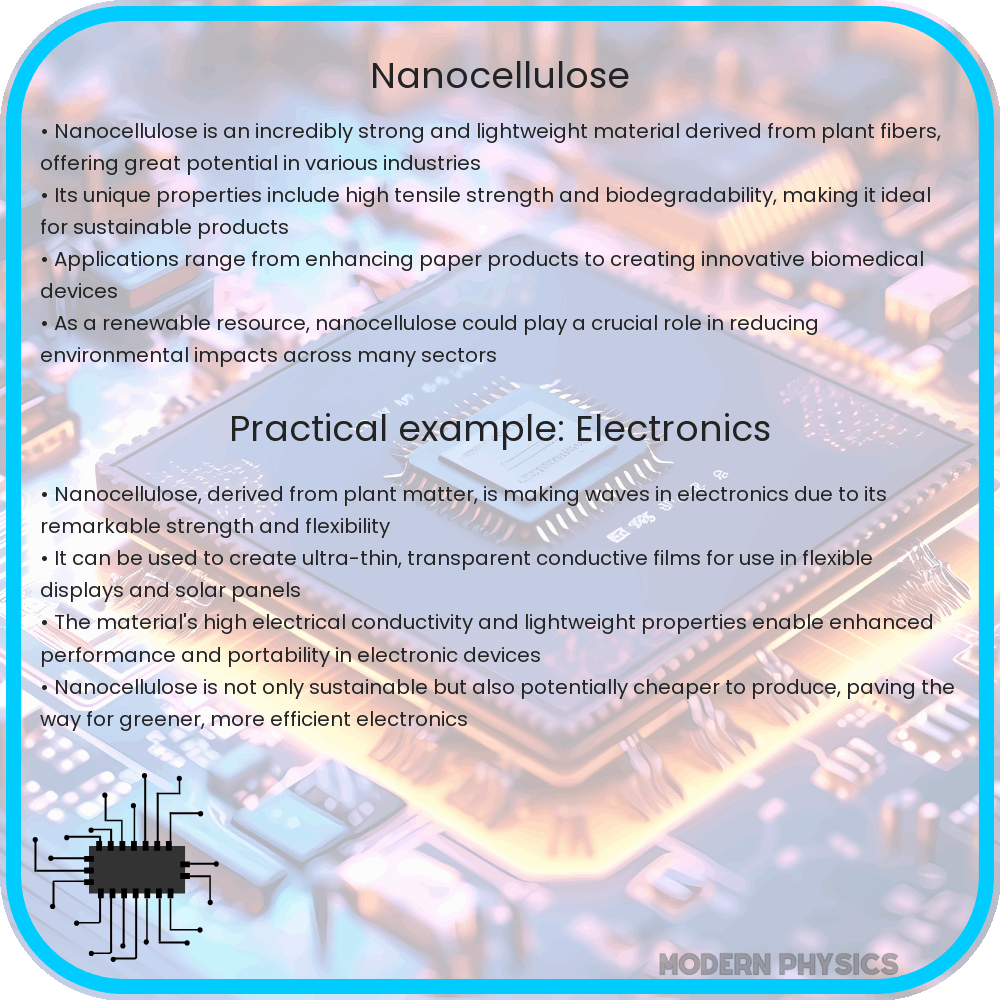
Understanding Nanocellulose: A Sustainable, Strong, and Versatile Material
Nanocellulose, derived from cellulose, which is the most abundant organic polymer on Earth, primarily found in plants, represents a breakthrough in both material science and sustainable technology. This innovative substance has sparked substantial interest due to its remarkable properties and wide array of potential applications across various industries, including biomedical, packaging, and construction. It is not only environmentally friendly but also exhibits extraordinary strength and versatile functionalities.
What is Nanocellulose?
Nanocellulose is comprised of nano-sized cellulose fibrils with a high aspect ratio (length to width). Typically, these fibrils are less than 100 nanometers in diameter and can range from several hundred nanometers to several micrometers in length. This fine scale and the unique properties of cellulose at the nano level give nanocellulose its unique characteristics, including high mechanical strength, robustness, and a reactive surface chemistry which makes it amenable to modifications.
Types of Nanocellulose
There are primarily three forms of nanocellulose, each differing by the method of production and resultant properties:
- Cellulose Nanocrystals (CNCs): Obtained by acid hydrolysis of bulk cellulose, causing the amorphous regions to be removed and leaving the crystalline parts. CNCs are highly stiff and strong.
- Cellulose Nanofibrils (CNFs): Produced by mechanically disintegrating cellulose fibers down to the nanoscale. CNFs have a high length-to-width ratio which contributes to their ability to form strong, flexible films.
- Bacterial Nanocellulose (BNC): Synthesized by certain bacteria, BNC is notable for its high purity and an impressive degree of crystallinity.
Exceptional Mechanical Properties
The exceptional tensile strength and stiffness of nanocellulose stand out among its physical properties. Remarkably, its strength-to-weight ratio is superior to that of steel, and it also exhibits excellent thermal stability and high optical transparency. These features make nanocellulose a particularly attractive alternative to more traditional materials, especially in applications where low weight and high strength are crucial.
Sustainability Aspects
One of nanocellulose’s most compelling advantages is its sustainability. As it is derived from abundant and renewable plant sources, nanocellulose represents a notable advancement in the development of eco-friendly materials. Its production process, which often uses less energy compared to synthetic materials and results in minimal waste, adds an additional layer of environmental benefit.
Furthermore, nanocellulose biodegrades completely, which could significantly reduce the environmental impact compared to petroleum-based products. This biodegradability coupled with the material’s strength and lightweight makes it an appealing option in numerous greener products and technologies, from biodegradable packaging to lightweight automotive components, potentially leading to significant reductions in carbon footprint.
Applications and Future Potential
The wide range of properties that nanocellulose offers means it can be used in a diverse set of applications. It is already being explored for use in transparent paper products, as a barrier in food packaging, and as a reinforcing agent in bio-composites. It also holds potential in high-tech applications such as optically transparent films, electronics, and as substrates in biomedical applications like tissue engineering and wound healing.
Innovations continue as researchers explore ways to functionally modify nanocellulose, such as imparting electrical conductivity or hydrophobicity, further broadening its potential uses. Its compatibility with inorganic and organic materials opens up exciting possibilities for creating hybrid materials with tailored properties for specific applications. This interplay of sustainability and versatility not only highlights the potential of nanocellulose as a material of the future but also underscores its role in driving forward sustainable technologies and greener engineering solutions.
To fully realize the potential of nanocellulose, however, challenges such as scaling up production and ensuring uniformity in quality across batches need to be addressed. Additionally, while the material itself is environmentally friendly, it is crucial to continuously evaluate and optimize the sustainability of the processes through which it is manufactured and utilized.
Challenges and Future Directions
Despite its promising attributes, the journey to widespread adoption of nanocellulose faces several technical and economic hurdles. Scaling up production from the laboratory to industrial levels poses significant challenges, including maintaining consistent quality and optimizing manufacturing processes to reduce costs. Additionally, there are regulatory considerations that must be addressed to ensure that nanocellulose products are safe and sustainable over their lifecycle.
Future research will need to focus on developing efficient and eco-friendly approaches to produce and process nanocellulose. This could involve innovations in genetic engineering to create engineered plants that yield higher cellulose content, or advancements in microbial methods to boost the output and purity of bacterial nanocellulose.
Educational and Economic Impact
Nanocellulose also represents a significant opportunity for educational advancement. By integrating studies on nanocellulose into science and engineering curriculums, educational institutions can prepare a new generation of researchers and professionals equipped to drive innovations in this field. Moreover, as industries adopt nanocellulose, new jobs will be created in research, production, and application areas, potentially leading to significant economic impacts.
Conclusion
Nanocellulose is poised to be a cornerstone material for the future, bridging sustainability with advanced technological utility. From its impressive mechanical properties and environmental friendliness to its broad range of applications, nanocellulose showcases the confluence of nature, science, and technology. As research progresses and overcomes existing challenges, it has the potential to revolutionize industries and pave the way for a more sustainable world. Emphasizing both academic studies and practical applications will be essential in achieving the full potential of nanocellulose. As this material heads towards commercialization, its impact on our daily lives and on global sustainability efforts could be profound, making it a true material of the future.