
Explore the Nambu-Jona-Lasinio Model’s role in quantum physics, its impact on mass generation, symmetry breaking, and future research directions.
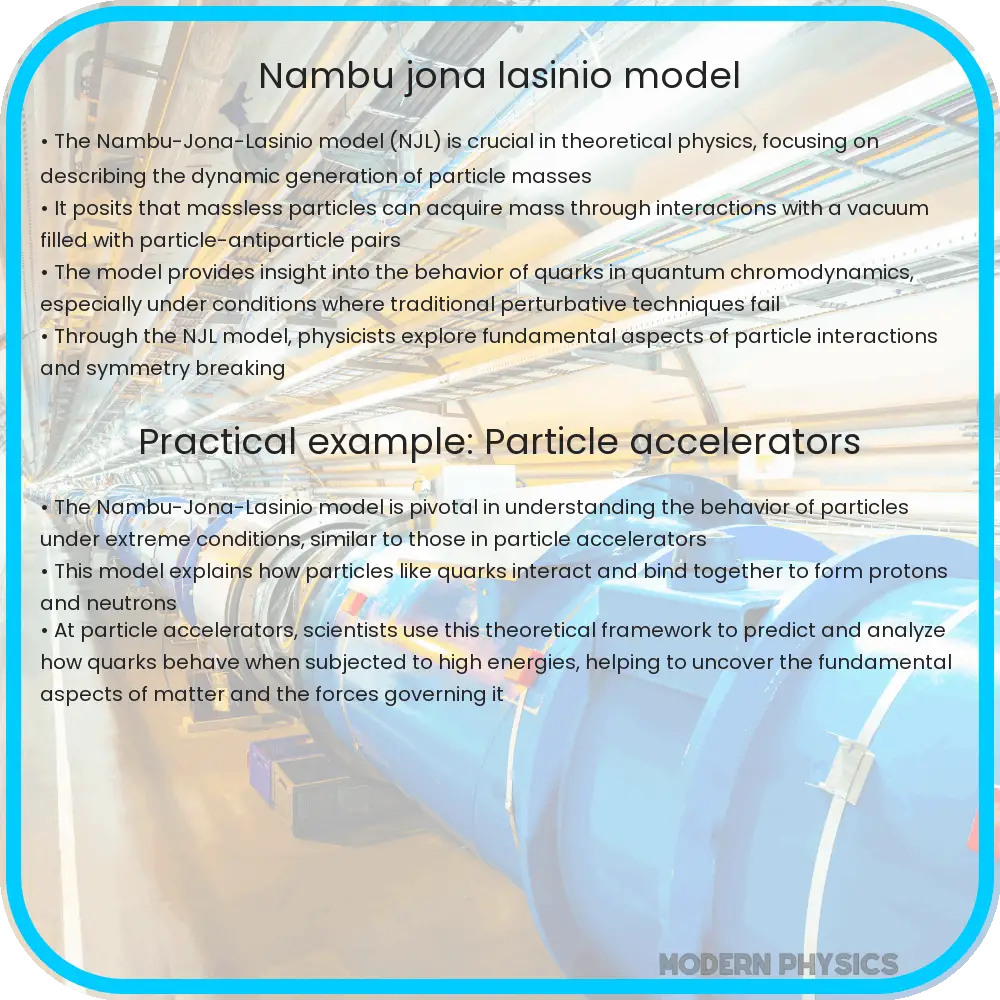
Nambu-Jona-Lasinio Model: A Paradigm Shift in Quantum Field Theory
The Nambu-Jona-Lasinio (NJL) model, introduced in the early 1960s by Yoichiro Nambu and Giovanni Jona-Lasinio, marked a significant milestone in the evolution of quantum field theory. This groundbreaking model provided a new framework for understanding the generation of mass in subatomic particles, a concept pivotal in modern physics, particularly in the realms of quantum fields, symmetry, and mass generation.
Understanding the Quantum Fields
At the heart of the NJL model lies the concept of quantum fields. Quantum fields are the fundamental entities in quantum field theory, representing the quantum states of elementary particles. In simpler terms, these fields can be imagined as an ocean of energy, with particles manifesting as waves within this ocean. The NJL model employs these fields to explain how particles like protons and neutrons acquire mass.
Symmetry Breaking in Quantum Fields
A central aspect of the NJL model is its approach to symmetry breaking. Symmetry in physics refers to the property of a system to remain unchanged under certain transformations. The NJL model proposes that at high energy levels, quantum fields exhibit a certain symmetry. However, as energy decreases, this symmetry is spontaneously broken, leading to the emergence of particle mass. This phenomenon is analogous to how the uniform temperature in a cooling liquid can suddenly result in the formation of ice crystals, breaking the uniformity.
Mass Generation: The Role of the NJL Model
In the standard model of particle physics, the Higgs mechanism is responsible for mass generation. However, the NJL model provides an alternative perspective. It suggests that mass arises from the interactions within the quantum field itself, without the need for a separate Higgs field. This interaction-driven mass generation is a cornerstone of the NJL model, challenging traditional views on how fundamental particles gain their mass.
Furthermore, the NJL model has profound implications in understanding the strong nuclear force, one of the four fundamental forces of nature. This model helps in explaining how quarks, the building blocks of protons and neutrons, interact with each other within the nucleus of an atom.
The NJL model’s approach to quantum fields, symmetry, and mass has not only enriched our understanding of fundamental physics but
also opened avenues for novel theoretical explorations. Its implications extend beyond the realm of particle physics into cosmology, shedding light on the early universe’s conditions and the genesis of matter as we know it.
Impact on Modern Physics
The influence of the Nambu-Jona-Lasinio model in modern physics cannot be overstated. It has paved the way for advanced theories and models that seek to unify the fundamental forces of nature and explain the most intricate behaviors of subatomic particles. Its principles have been instrumental in developing quantum chromodynamics (QCD), the theory that describes the strong interaction, one of the fundamental forces that govern the behavior of nuclear particles.
In summary, the Nambu-Jona-Lasinio model represents a pivotal point in the history of quantum physics. Its innovative approach to mass generation, symmetry breaking, and quantum fields has profoundly influenced the field, offering a unique lens through which to view the subatomic world. The model continues to inspire physicists and researchers, serving as a foundation for ongoing inquiries into the mysteries of the universe.
Conclusion
As we delve deeper into the quantum realm, the NJL model’s relevance remains undiminished, offering insights and raising questions that propel the frontiers of physics forward. It epitomizes the dynamic nature of scientific inquiry, demonstrating how theoretical models can revolutionize our understanding of the natural world.
Challenges and Advancements in the NJL Model
Despite its significant contributions, the Nambu-Jona-Lasinio model faces certain challenges and limitations. One major issue is its non-renormalizability, meaning that certain calculations within the model lead to infinite results that cannot be easily resolved. This aspect limits the model’s applicability in predicting physical phenomena at very high energy scales. Nonetheless, these challenges have spurred further research and development, leading to more refined and comprehensive theories in quantum physics.
Applications and Future Directions
The NJL model has found applications in various areas of physics, including condensed matter physics and cosmology. It has been instrumental in understanding phenomena such as superconductivity and the behavior of dense nuclear matter in neutron stars. Moreover, the model’s framework has inspired research in beyond-the-Standard-Model theories, exploring new particles and forces that could exist in our universe.
Looking towards the future, the NJL model continues to be a valuable tool in theoretical physics. Its concepts and methodologies are being applied and extended in the pursuit of a more unified and comprehensive understanding of the fundamental forces of nature. Researchers are actively exploring ways to integrate the NJL model with other theoretical frameworks, aiming to bridge gaps in our current understanding of particle physics and cosmology.
Conclusion: The Enduring Legacy of the NJL Model
In conclusion, the Nambu-Jona-Lasinio model remains a cornerstone in the field of quantum physics. Its innovative approach to understanding mass generation, symmetry breaking, and the behavior of quantum fields has profoundly impacted our understanding of the fundamental aspects of the universe. While the model presents certain theoretical challenges, it continues to inspire and guide research in various domains of physics. The NJL model, with its enduring legacy, encapsulates the essence of scientific progress — a continuous journey of discovery, refinement, and understanding of the natural world.