
Explore the efficiency of nail guns, focusing on speed, force, motion dynamics, advanced features, and user skills for optimal performance.
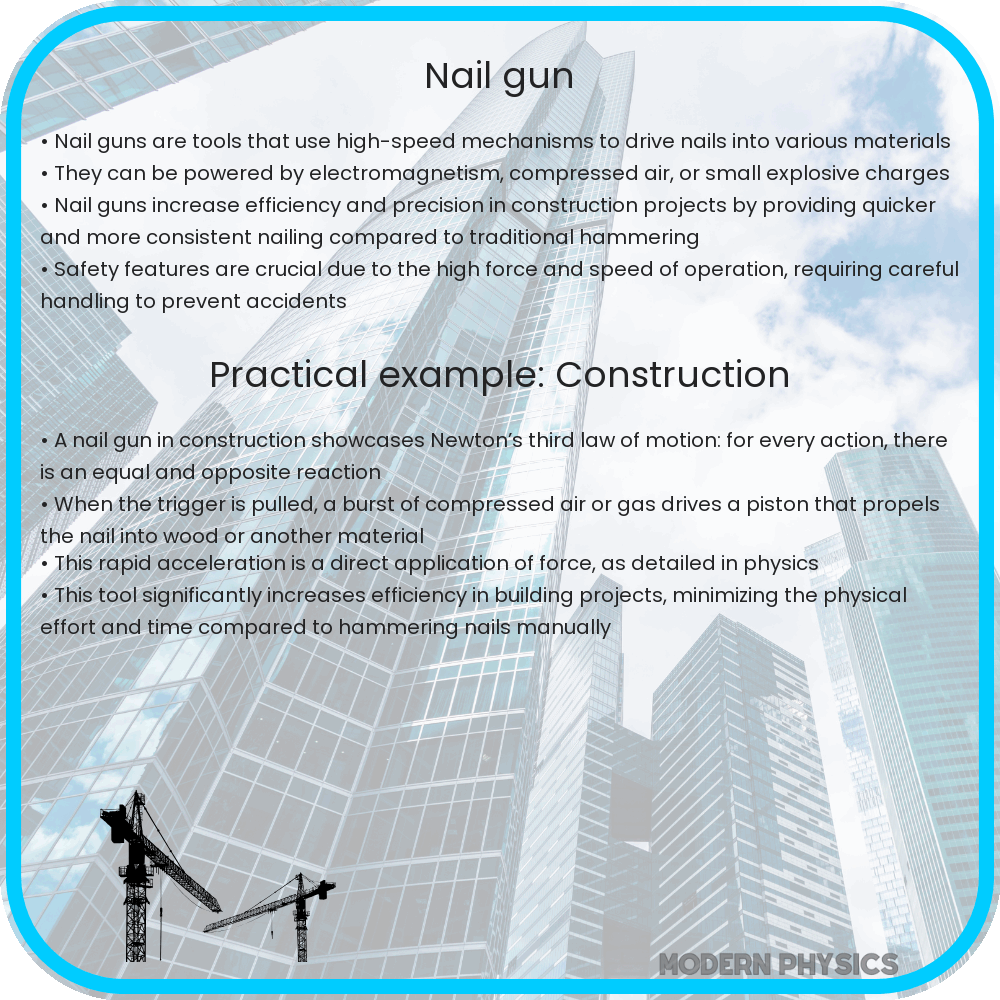
Understanding Nail Gun Efficiency: The Interplay of Speed, Force, and Motion Dynamics
The efficiency of a nail gun is a crucial aspect in construction and carpentry, combining principles of physics and engineering to deliver optimal performance. This article delves into the core elements that define nail gun efficiency: speed, force, and motion dynamics.
Speed: The Driving Factor
Speed in a nail gun is defined by the rate at which it drives nails into a surface. This rapidity is essential for time efficiency in projects. Two main factors influence the speed of a nail gun: the power source and the design of the firing mechanism. Pneumatic nail guns, powered by air compressors, typically offer higher speeds due to the constant pressure provided. Electric and battery-operated models, while more portable, may have slightly lower speed outputs.
Force: The Impact of Power
The force exerted by a nail gun is directly related to its ability to penetrate different materials. Force, measured in Newtons (N), depends on the power source and the internal mechanism of the gun. Pneumatic models usually provide a higher force, making them suitable for heavy-duty tasks. The formula for force can be expressed as F = ma, where m is mass and a is acceleration. This equation highlights the importance of the nail gun’s design in maximizing force while minimizing recoil.
Motion Dynamics: Precision and Control
Motion dynamics in nail guns encompass the movement and control mechanisms that determine the accuracy and safety of the tool. Factors such as the shape and size of the nail magazine, the balance of the gun, and the precision of the firing pin play a crucial role. Advanced nail guns incorporate ergonomic designs and adjustable settings to enhance control, allowing for precise nail placement and reduced material damage.
Understanding these components is vital for choosing the right nail gun for a specific task. The interplay of speed, force, and motion dynamics not only affects the efficiency of the nail gun but also impacts the overall quality and speed of construction and carpentry projects.
Optimizing Nail Gun Efficiency: Advanced Features and User Considerations
Advanced features in modern nail guns further enhance their efficiency. Variable speed triggers, depth adjustment settings, and selectable firing modes are examples of such features. These adjustments allow users to tailor the nail gun’s performance to the specific needs of the task at hand, whether it requires delicate precision or robust force.
Moreover, the safety mechanisms in nail guns are a critical aspect of their design. Features like trigger locks and anti-jamming technology not only prevent accidents but also contribute to the tool’s efficiency by minimizing downtime and maintenance needs.
User Skill and Maintenance: Key to Maximizing Efficiency
The efficiency of a nail gun is not solely dependent on its mechanical attributes; the skill of the user and proper maintenance are also vital. Experienced users can optimize the tool’s performance by understanding the appropriate force, speed, and motion dynamics for various materials and project types. Regular maintenance, including cleaning and lubrication, ensures that the nail gun operates at peak efficiency, extending its lifespan and reliability.
Environmental and Economic Impact
The efficiency of nail guns also has significant environmental and economic implications. Efficient nail guns reduce waste and energy consumption, contributing to more sustainable construction practices. Economically, higher efficiency translates to reduced labor costs and faster project completion times, making it a financially viable choice for businesses and individual contractors alike.
Conclusion
In conclusion, the efficiency of nail guns is a multifaceted concept, incorporating speed, force, and motion dynamics, alongside advanced features, safety considerations, user expertise, and maintenance. Understanding and optimizing these factors can lead to significant improvements in work quality, safety, and productivity. As technology continues to evolve, the future of nail gun efficiency promises even greater precision, power, and user-friendly designs, aligning with the ever-growing demands of the construction and carpentry industries.