
Learn how microwave radiometers detect atmospheric microwave radiation to collect crucial data for weather forecasting and climate research.
Understanding Microwave Radiometers and Their Role in Atmospheric Data Collection
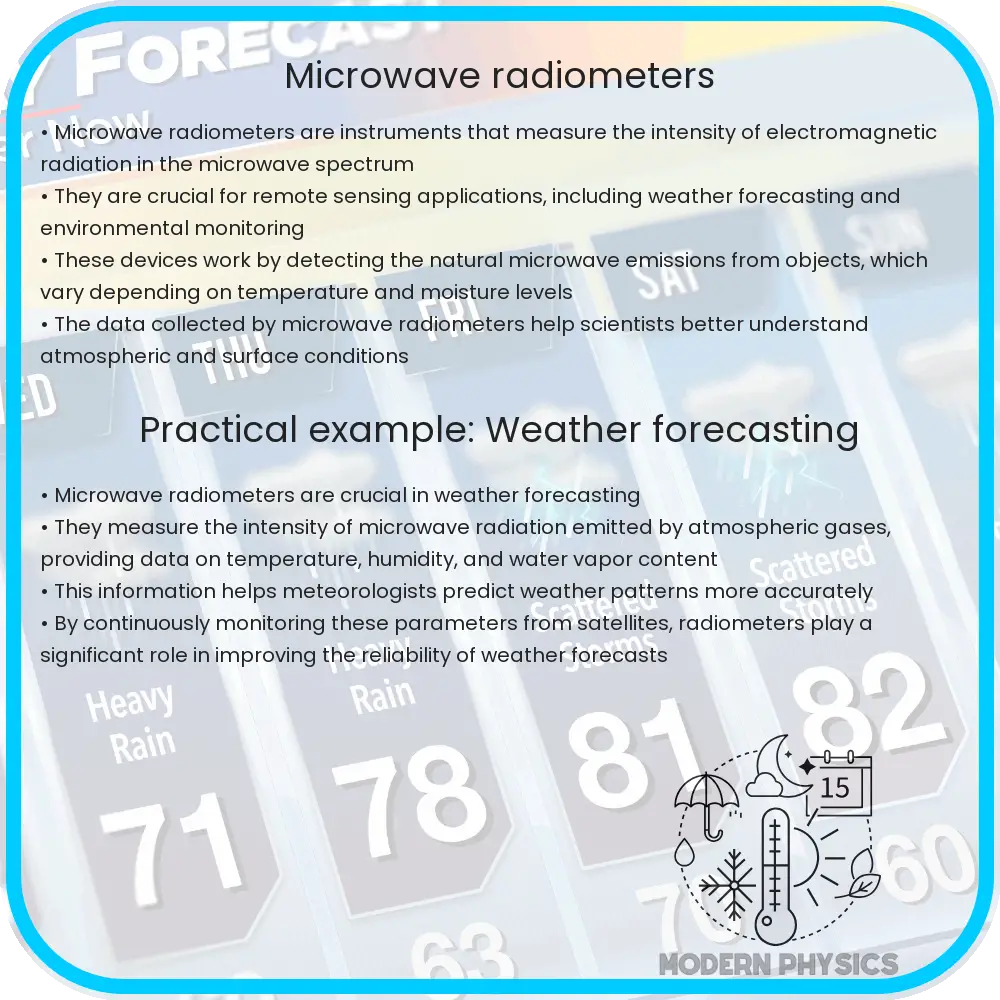
Microwave radiometers are sophisticated instruments used extensively in the study of Earth’s atmosphere. These devices operate by detecting the natural microwave electromagnetic radiation emitted or reflected from the atmosphere or ground. The data collected is crucial for various applications, including weather forecasting, climate research, and environmental monitoring.
How Microwave Radiometers Work
Microwave radiometers function by measuring the intensity and distribution of microwave radiation at different frequencies. The basic principle of operation involves the detection of microwave energy at specific wavelengths, which is directly related to the thermal emissions from atmospheric constituents such as water vapor, oxygen, and cloud droplets. By analyzing these emissions, scientists can infer important properties of the atmosphere like temperature, humidity, and cloud liquid water content.
The core component of a microwave radiometer is the antenna, which receives the microwave signals. These signals are then processed by a receiver which quantifies the radiation intensity at various frequencies. The signal processing involves filtering the noise and amplifying the relevant signals to derive accurate atmospheric data.
Applications of Microwave Radiometry in Weather Forecasting
- Temperature Profiling: Microwave radiometers provide vertical profiles of atmospheric temperature. This data is essential for understanding the thermal structure of the atmosphere, which is crucial for weather prediction models.
- Humidity Measurements: Accurate measurements of atmospheric humidity are possible through microwave radiometry. These measurements are vital for predicting weather patterns, especially in the prediction of rain and storms.
- Cloud Analysis: The ability to examine the water content in clouds helps meteorologists understand cloud formations and predict precipitation events effectively. Microwave radiometers can detect the minute liquid droplets and ice particles in clouds, offering detailed insights into their structure and dynamics.
Advantages of Using Microwave Radiometers
Microwave radiometers provide several advantages over traditional sensing techniques. Firstly, they can operate under almost any weather conditions, unlike optical and infrared sensors that require clear skies. They can penetrate through clouds, offering continuous observational capabilities during both day and night. This makes microwave radiometers extremely valuable for continuous climate monitoring and severe weather surveillance.
Furthermore, the ability to collect data over large spatial and temporal scales allows for a comprehensive understanding of atmospheric trends and patterns. This information is pivotal for long-term climate modeling and assessing changes in the environment.
Precision in Microwave Radiometry
The precision of microwave radiometers depends significantly on their calibration and the stability of their components. Calibration is essential to account for signal drifts and biases that might occur due to variations in instrument temperatures or aging of components. Regular calibration against known standards ensures the accuracy of the data collected, making it reliable for scientific research and operational forecasting.
Microwave radiometer data can also be cross-validated with other observational methods such as radiosondes or satellite data, enhancing the certainty of the interpretations and findings. This integrated approach helps in refining the models and forecasts based on microwave radiometric data.
Trends in Microwave Radiometry Technology
Recent advancements in technology have significantly enhanced the capabilities of microwave radiometers. Improvements in sensitivity and resolution allow for more detailed atmospheric observations. Innovations in electronic and digital technologies have not only reduced the size and cost of these instruments but also improved their operational efficiency and data processing capabilities.
Modern microwave radiometers are increasingly integrated with automated systems and are part of larger observational networks. This integration allows for real-time data acquisition and analysis, fostering more dynamic and responsive atmospheric monitoring systems.
Challenges Facing Microwave Radiometry
Despite the substantial benefits, microwave radiometry faces several challenges. Interference from man-made sources, such as communication signals, can distort the natural microwave signals captured by radiometers. Addressing these interferences requires sophisticated filtering techniques and regulatory measures to preserve the integrity of atmospheric data.
Environmental factors like rain, snow, and wind, although penetrable by microwave technology, can still affect the precision of readings. Additionally, the complexity and high costs associated with deploying and maintaining these advanced instruments can limit their widespread use, especially in developing regions.
Future Prospects of Microwave Radiometers
Looking ahead, the future of microwave radiometry appears promising with ongoing research aimed at overcoming current limitations and enhancing technology. Efforts are geared towards developing more compact, cost-effective radiometers that are easier to deploy and maintain. Researchers are also exploring the synergy between microwave radiometry and other technologies such as artificial intelligence and big data analytics, which could revolutionize the way atmospheric data is analyzed and applied.
Moreover, international collaborations and global data-sharing initiatives may further expand the capabilities of microwave radiometers, making comprehensive atmospheric monitoring a more attainable goal worldwide.
Conclusion
Microwave radiometers are integral to our understanding and monitoring of the earth’s atmosphere. By providing vital data that is crucial for weather forecasting, climate research, and environmental monitoring, these tools play a pivotal role in meteorology and climate science. Their ability to operate under nearly all weather conditions and provide real-time, accurate measurements makes them invaluable. Despite facing technological and environmental challenges, continuous advancements and international cooperation are paving the way for broader applications and enhanced efficacy in atmospheric research. As technology progresses, microwave radiometers will undoubtedly become even more integral to our ability to understand and respond to atmospheric events on a global scale.