
Explore the Michelson-Morley Experiment’s role in disproving aether theory and shaping modern physics, pivotal to Einstein’s Special Relativity.
Michelson-Morley Experiment: Unraveling the Aether Wind Hypothesis
In the late 19th century, the Michelson-Morley Experiment emerged as a pivotal scientific endeavor aiming to detect the presence of ‘aether’, a hypothesized medium for light waves. Albert A. Michelson and Edward W. Morley, in 1887, designed an intricate experiment to observe the subtle effects of aether on the speed of light. This experiment’s implications were far-reaching, ultimately paving the way for a significant paradigm shift in physics.
The Experimental Setup
The Michelson-Morley Experiment utilized an interferometer, a device capable of splitting a light beam into two perpendicular rays. These rays traveled different paths, reflected back, and then recombined. According to the aether wind hypothesis, the speed of light would vary based on its direction relative to the aether. As Earth moved through this medium, one beam was expected to travel faster than the other, creating a phase shift detectable through interference patterns.
Unexpected Results and Implications
Contrary to expectations, Michelson and Morley observed no significant difference in the speed of light in any direction. This null result was initially met with skepticism, as it challenged the prevailing aether theory. However, it laid the groundwork for a fundamental reevaluation of the concepts of space, time, and light.
Special Relativity and the Demise of Aether
The experiment’s findings were crucial in the development of Albert Einstein’s Special Theory of Relativity in 1905. Einstein’s theory, which posits that the laws of physics are the same for all non-accelerating observers and that the speed of light within a vacuum is constant regardless of the motion of the light source, fundamentally contradicted the aether theory. By eliminating the need for aether as a light-propagating medium, Einstein’s theory resolved the conundrum posed by the Michelson-Morley Experiment.
The Special Theory of Relativity introduced revolutionary concepts, such as time dilation and length contraction, reshaping our understanding of the universe. It suggested that measurements of time and space are relative to the observer’s state of motion, a stark departure from the previously absolute concepts upheld by Newtonian mechanics.
This remarkable experiment, though initially perceived as a failure due to its null results, became a cornerstone in the development of modern physics, challenging established norms and ushering in a new era of scientific understanding.
Reanalysis of the Michelson-Morley Experiment
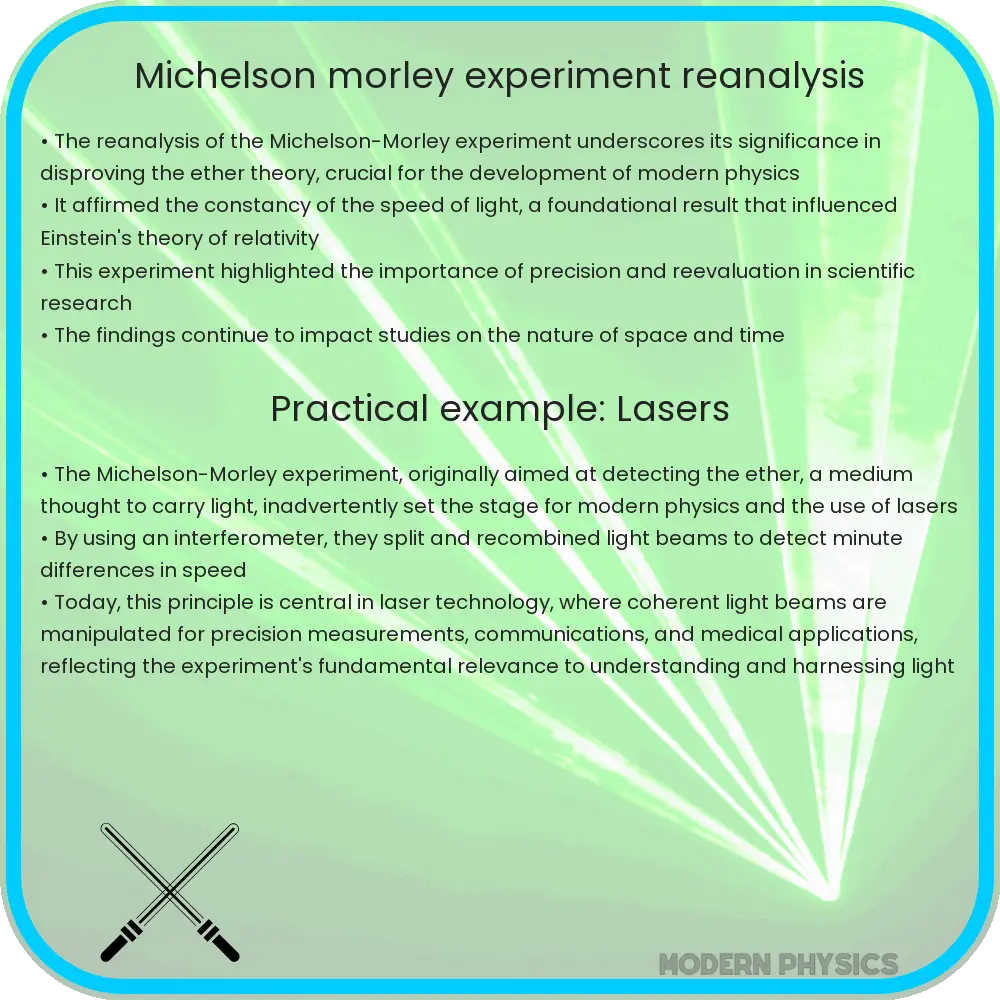
In the years following the Michelson-Morley Experiment, numerous reanalyses and replications have been conducted, each affirming the original findings. Advanced versions of the experiment, employing more sensitive equipment and accounting for potential sources of error, have consistently failed to detect the presence of aether. These repeated validations have reinforced the experiment’s significant role in the foundation of modern physics.
Impact on Contemporary Science
The implications of the Michelson-Morley Experiment extend far beyond its original scope. By challenging the aether theory, it prompted scientists to rethink the nature of light and motion. This reevaluation has had a profound impact on various fields, from astrophysics to quantum mechanics, influencing how scientists interpret phenomena at both cosmic and subatomic scales.
Legacy and Educational Significance
The Michelson-Morley Experiment is not just a historical footnote but a vital part of physics education. It serves as a classic example of how empirical evidence can overturn long-standing theories and assumptions. The experiment’s methodology, emphasizing precision and careful control of variables, continues to be a model for scientific investigation.
Conclusion
The Michelson-Morley Experiment, initially seen as a perplexing anomaly, proved to be a turning point in the history of physics. Its null result, though unexpected, catalyzed the abandonment of the aether theory and set the stage for Einstein’s revolutionary Special Theory of Relativity. The experiment’s enduring legacy lies in its demonstration of the power of empirical evidence to challenge and refine our understanding of the universe. It reminds us that in science, sometimes the most profound discoveries come not from finding what we expect, but from observing the unexpected and having the courage to explore its implications. In this sense, the Michelson-Morley Experiment continues to inspire current and future generations of scientists to question, explore, and innovate.