
Atmospheric reanalysis combines historical weather data and modern models to study climate trends and predict weather accurately.
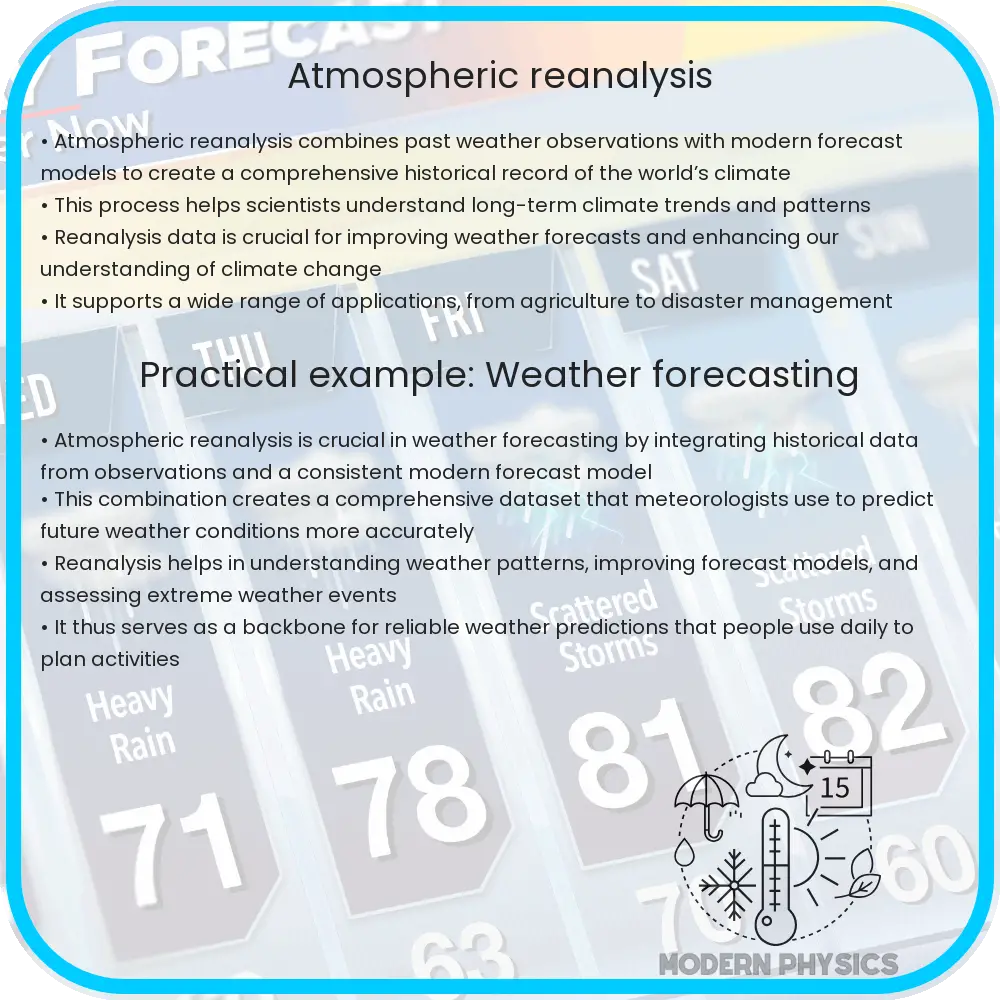
Understanding Atmospheric Reanalysis
Atmospheric reanalysis is a scientific method used by meteorologists and climate scientists to understand past weather and climate conditions. By combining historical weather observations with modern forecasting models, atmospheric reanalysis provides a comprehensive and coherent dataset that spans several decades. This data plays a crucial role in our understanding of climate change, weather prediction, and the dynamics of the Earth’s atmosphere.
How Atmospheric Reanalysis Works
The process of atmospheric reanalysis begins with the collection of data from various sources such as satellites, weather balloons, buoys, and surface weather stations. This extensive dataset includes information about temperatures, wind speeds, humidity levels, atmospheric pressure, and other meteorological elements. Once collected, these pieces of observational data are fed into a sophisticated climate model.
This model is programmed to simulate the physics and dynamics of the atmosphere. The key to reanalysis is the use of a consistent scientific model that remains unchanged over the entire reanalysis period. This consistency allows for the direct comparison of climate data over time, helping scientists to detect trends and changes in the atmosphere’s behavior.
Accuracy of Atmospheric Reanalysis
The accuracy of atmospheric reanalysis data is highly dependent on both the quality of the historical observations and the reliability of the models used to simulate the atmosphere. Over the years, improvements in both areas have significantly enhanced the credibility of reanalysis outputs. However, there are still limitations due to gaps in historical data, especially in remote areas like the Polar Regions and oceans.
Moreover, the quality of reanalysis can also be affected by changes in observation technology over time. For instance, the transition from manual observations to automated sensing technologies has altered the types of data available for reanalysis, occasionally introducing inconsistencies that need to be carefully managed.
The Role of Reanalysis in Understanding Climate Trends
Atmospheric reanalysis is invaluable in studying climate change because it allows scientists to create extended records of climate data that can be used to identify long-term trends. For example, reanalysis data has been instrumental in confirming the global increase in temperatures and changing patterns of precipitation over the decades.
This long-term perspective is critical when attempting to separate natural variability in climate from human-induced changes. By providing a detailed and dynamic picture of the climate system over time, reanalysis helps in understanding the complexities of climate phenomena such as El Niño and La Niña, the polarization vortex, and other significant patterns that influence global weather systems.
Challenges in Atmospheric Reanalysis
Despite its advantages, atmospheric reanalysis faces several challenges. One of the primary issues is the integration of data from different periods and technologies, which can lead to discrepancies in the data. Data assimilation—the process of integrating new observations with past reanalysis—requires advanced algorithms and continuous refinement to maintain accuracy. Furthermore, the interpretation of reanalysis data demands a deep understanding of both the strengths and limitations of the models used.
- Data Sparsity: In some regions, especially historically, observational data are sparse, which can create uncertainties in reanalysis outputs.
- Technological Evolution: Changes in measurement technology over time introduce variability that must be carefully adjusted for consistency.
- Computational Limits: The computational demand for running sophisticated climate models with decades of data is enormous, requiring substantial computational resources.
Future of Atmospheric Reanalysis
Future advancements in atmospheric reanalysis are likely to be driven by improvements in computational technologies and increased availability of observational data. Enhanced computing power will allow for finer spatial and temporal resolution in models, leading to more detailed and accurate reanalysis datasets. Additionally, emerging technologies such as artificial intelligence and machine learning are set to play a pivotal role in improving data assimilation processes and in filling gaps in historical data records.
Collaborations across international borders and disciplines will also enhance the scope and accuracy of atmospheric reanalysis, leading to better global climate models and more reliable predictions of future climate conditions.
Conclusion
Atmospheric reanalysis is a vital tool in the arsenal of meteorologists and climate scientists, enabling a precise understanding of past, present, and potentially future atmospheric and climatic conditions. Despite facing challenges such as data integration and computational demands, ongoing advancements in technology and collaborative scientific efforts are expected to pave the way for more refined and comprehensive reanalysis datasets. As this field continues to evolve, it remains a cornerstone of climate science, providing indispensable insights into the dynamics of our planet’s atmosphere and contributing significantly to our understanding of global climate change.