
Explore the Michelson Interferometer’s precision, fringe analysis, and coherence in optical physics for groundbreaking measurements and technology applications.
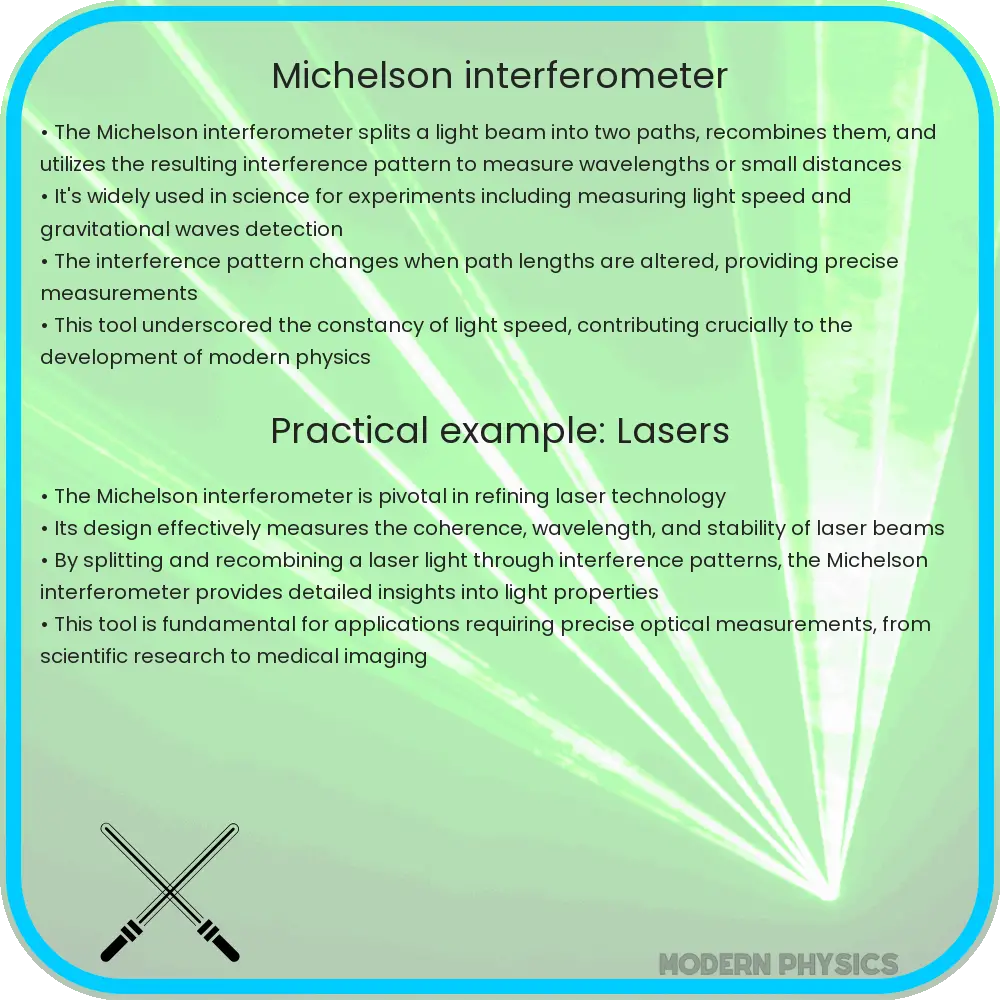
Understanding the Michelson Interferometer
The Michelson Interferometer stands as a cornerstone in the field of optical physics, providing unparalleled precision in measuring distances, refractive indices, and the coherence of light. Invented by Albert A. Michelson in the late 19th century, this instrument uses the interference of light to make precise measurements. Its ability to dissect light into its constituent wavelengths has made it instrumental in numerous scientific breakthroughs, including the famous Michelson-Morley experiment which contributed to the development of the theory of relativity.
Precision and Measurement Technique
At the heart of the Michelson Interferometer’s precision lies its ability to split a single light beam into two paths, which are then reflected back to recombine. This recombination produces interference patterns, or “fringes,” that can be analyzed to determine various physical properties. The precision of the interferometer is such that it can detect changes in distance or refractive index on the order of a fraction of a wavelength of light, making it an invaluable tool in both experimental and applied physics.
Fringe Analysis
The analysis of interference fringes provides a direct measure of the path difference between the two beams of light within the interferometer. By counting the number of fringes that shift as one of the mirrors in the interferometer is moved, scientists can calculate the change in distance with extraordinary accuracy. Fringe analysis has applications ranging from material science to the calibration of optical components and even in gravitational wave detection.
Coherence
Coherence is a measure of the correlation between waves at different points in space and time. In the context of the Michelson Interferometer, coherence is crucial for the formation of clear and stable interference patterns. The coherence length of the light source determines the maximum path difference between the two arms of the interferometer for which interference fringes can be observed. This makes the interferometer an essential tool for studying the coherence properties of light sources, including lasers and white light.
Through its applications in measuring precision, analyzing fringe patterns, and assessing coherence, the Michelson Interferometer continues to be a fundamental instrument in the advancement of optical science and technology.
Applications of the Michelson Interferometer
The versatility of the Michelson Interferometer extends beyond basic scientific research. It plays a pivotal role in various applications, including spectroscopy, metrology, and even in the field of astronomy. In spectroscopy, it helps in the precise determination of spectral lines of elements, thereby aiding in the identification of chemical compositions of stars and distant celestial bodies. In metrology, the interferometer’s precision is harnessed for calibrating measuring instruments and ensuring the accuracy of length measurements at the nanometer scale.
Enhancements and Modern Adaptations
Modern adaptations of the Michelson Interferometer incorporate advanced technologies to enhance its capabilities. The use of lasers as light sources provides a high degree of coherence, enabling even more precise measurements. Moreover, digital imaging and computer software have revolutionized fringe analysis, allowing for automatic and highly accurate measurements. These technological advancements have expanded the scope of the interferometer’s applications, including its use in optical coherence tomography (OCT) in medical imaging, where it can provide detailed images of the retina and other tissues.
Challenges and Future Directions
Despite its widespread use, the Michelson Interferometer faces challenges, particularly in terms of sensitivity to environmental factors like vibrations and thermal expansion. Researchers continue to develop methods to mitigate these effects, such as using vibration isolation techniques and temperature-controlled environments. The future of interferometry lies in the exploration of quantum interferometry, which promises even greater precision by utilizing the principles of quantum mechanics.
Conclusion
The Michelson Interferometer, with its ability to make precise measurements through the analysis of light interference, remains a fundamental tool in the scientific toolkit. Its contributions to physics, astronomy, and engineering underscore the ongoing relevance of classical optical instruments in the age of quantum and digital technologies. As we push the boundaries of what is measurable, the principles underlying the Michelson Interferometer guide us towards new discoveries and innovations. The journey from its initial conception to its modern applications exemplifies the enduring value of curiosity-driven exploration and the continuous pursuit of precision in scientific inquiry.