
Insights and analysis of meteorite impacts on Earth, studying their geophysical effects and how they shape planetary surfaces.
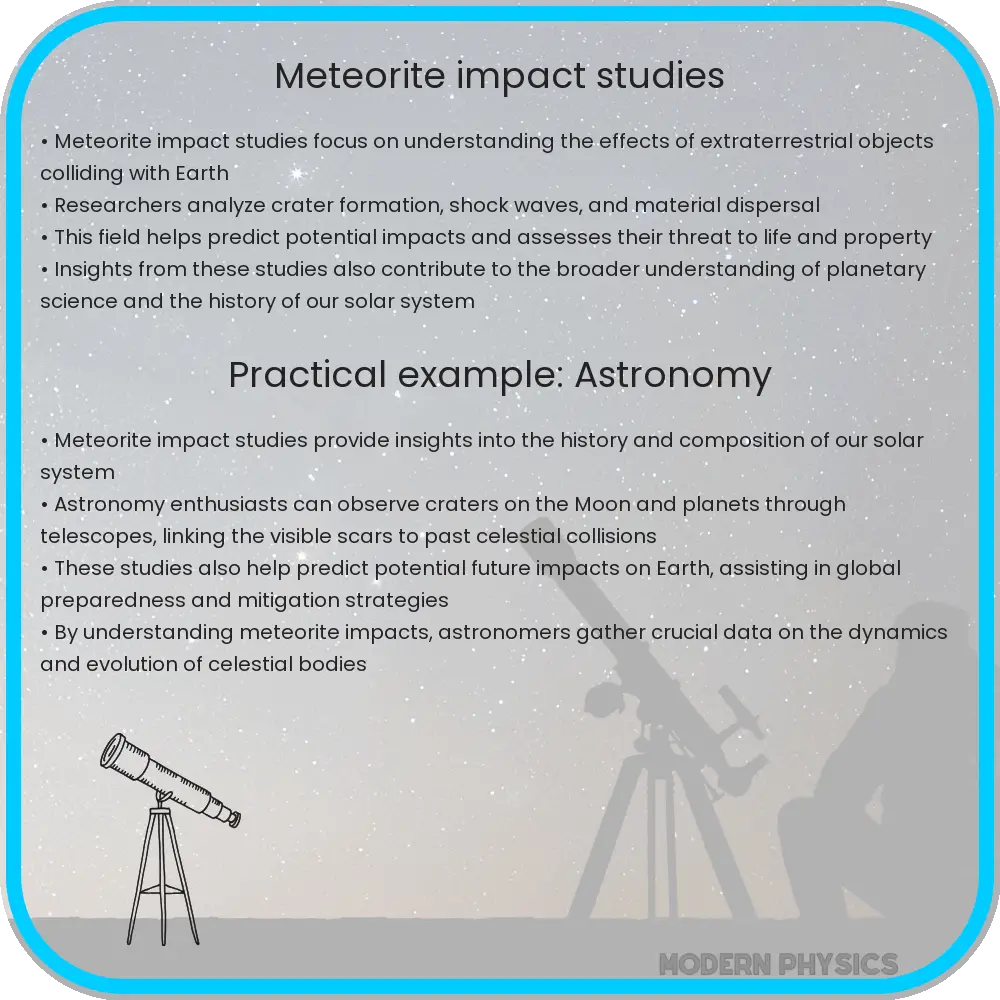
Meteorite Impact Studies: Geophysics Insights & Analysis
Meteorite impacts on Earth are not just spectacular events; they are powerful natural events that offer significant insights into geophysical processes. These impacts have shaped the surface of our planet and other celestial bodies throughout the history of the solar system.
Understanding Meteorite Impact Cratering
When a meteorite strikes the Earth, it releases a tremendous amount of energy—typically in the form of kinetic energy—which results in the formation of an impact crater. The size and shape of these craters can tell scientists a lot about the properties of both the impactor and the surface it strikes.
The basic physical process involves the rapid conversion of the meteorite’s kinetic energy into shock waves that propagate through the surrounding medium. These shock waves are responsible for the initial compression and subsequent excavation of the crater. The formula generally used to estimate the impact energy E is:
E = (1/2) * m * v2
where:
- m is the mass of the meteorite,
- v is the velocity at impact.
Understanding the energy release helps scientists infer important factors such as impactor size, density, velocity, and angle of impact—all of which are crucial for understanding the dynamics and consequences of these events.
Geophysical Changes Post-Impact
The immediate aftermath of a meteorite impact extends far beyond the formation of a crater. The shock wave can induce seismic activity, vaporize materials, and even result in changes to the chemical composition of the local environment. In some cases, impacts have led to significant climatic changes.
Studies of the Chicxulub impactor, which is linked with the mass extinction event that wiped out the dinosaurs, show how far-reaching the effects of an impact can be. Beyond initial devastation, ejecta from this impact entered the atmosphere, affecting global climate and ecosystems significantly.
Exploring Impact Craters
Geophysicists employ a variety of methods to study impact craters, including ground surveys, satellite imagery, and remote sensing techniques. These studies can help reveal not just the visible surface structures but also subsurface anomalies.
Data gathered from these methods can provide valuable information about the subsurface structure and composition, which can in turn illuminate broader geological features and processes. It’s these insights that help scientists build more comprehensive models of Earth’s geological activity and history.
By analyzing impact craters, scientists can also gather data pertinent to other planetary bodies. Comparisons between Earth’s craters and those on the Moon, Mars, or Mercury can offer clues about their geological histories and provide critical information for future space exploration missions.
The Role of Modern Technology in Meteorite Impact Studies
Technological advancements have substantially enhanced our abilities to study and understand meteorite impacts. High-resolution imaging, 3D modeling, and isotopic dating techniques have refined our insights into the age, origin, and frequency of impacts. These technologies allow scientists to link specific craters to known impact events and to track changes in Earth’s surface over geological time scales.
Additionally, computer modeling enables researchers to simulate impacts under various conditions to study potential outcomes and effects. These simulations are crucial for preparing for future impacts and assessing potential threats to Earth.
As our toolkit expands, so too does our knowledge of how meteorite impacts have influenced our planet and our universe. Through the continued study of these powerful events, we gain more than just an understanding of past impacts; we equip ourselves with the knowledge to better predict and potentially mitigate the effects of future impacts.
Meteorite Impact Research and Environmental Implications
The research into meteorite impacts extends into environmental studies, where scientists assess how these events have historically affected Earth’s ecosystems. For instance, the dust and particles ejected into the atmosphere can lead to “impact winters,” where sunlight is blocked, leading to cooler global temperatures that can affect plant and animal life. Analyzing these phenomena helps researchers understand not only past environmental changes but also contemporary environmental management and disaster response strategies.
Moreover, the study of rare minerals and elements brought by meteorites can provide insights into new resources. These elements, sometimes not naturally occurring in Earth’s crust, can have various applications, from new materials engineering to the potential enhancement of existing technologies.
Educational and Policy Impact
Meteorite impact studies also play a vital role in education and policy-making. They provide a dramatic and engaging way to introduce students and the public to geophysical sciences. For policymakers, understanding the potential threats and effects of impacts can help in formulating global strategies for disaster readiness and space policy, emphasizing international cooperation in monitoring and potentially deflecting hazardous objects.
These studies often bring together experts from diverse fields such as geology, physics, chemistry, and engineering, highlighting the interdisciplinary nature of modern scientific research. This convergence fosters a synthesis of ideas and innovations beneficial for multiple scientific communities and the broader public interest.
Conclusion
Meteorite impacts, while infrequent, offer a unique window into the dynamic processes that shape our planet and other celestial bodies. Through the study of these spectacular events, scientists glean insights into geophysical changes, environmental impacts, and the broader cosmos’s history. The development of technologies such as high-resolution imaging and computer simulations has only deepened our understanding and expanded our capacity to predict and potentially mitigate future events.
Furthermore, by studying these natural phenomena, we not only prepare ourselves better for future scenarios but also enrich our knowledge of the universe, contributing to education and helping shape policies that protect our planet. As research techniques evolve and our understanding deepens, the mysteries of meteorite impacts continue to unravel, promising new discoveries in the realms of science, technology, and environmental stewardship.