
Explore the Mermin-Wagner Theorem’s impact on quantum fields, symmetry, and phase transitions in low-dimensional systems in theoretical physics.
Understanding the Mermin-Wagner Theorem: Implications in Quantum Fields and Phase Transitions
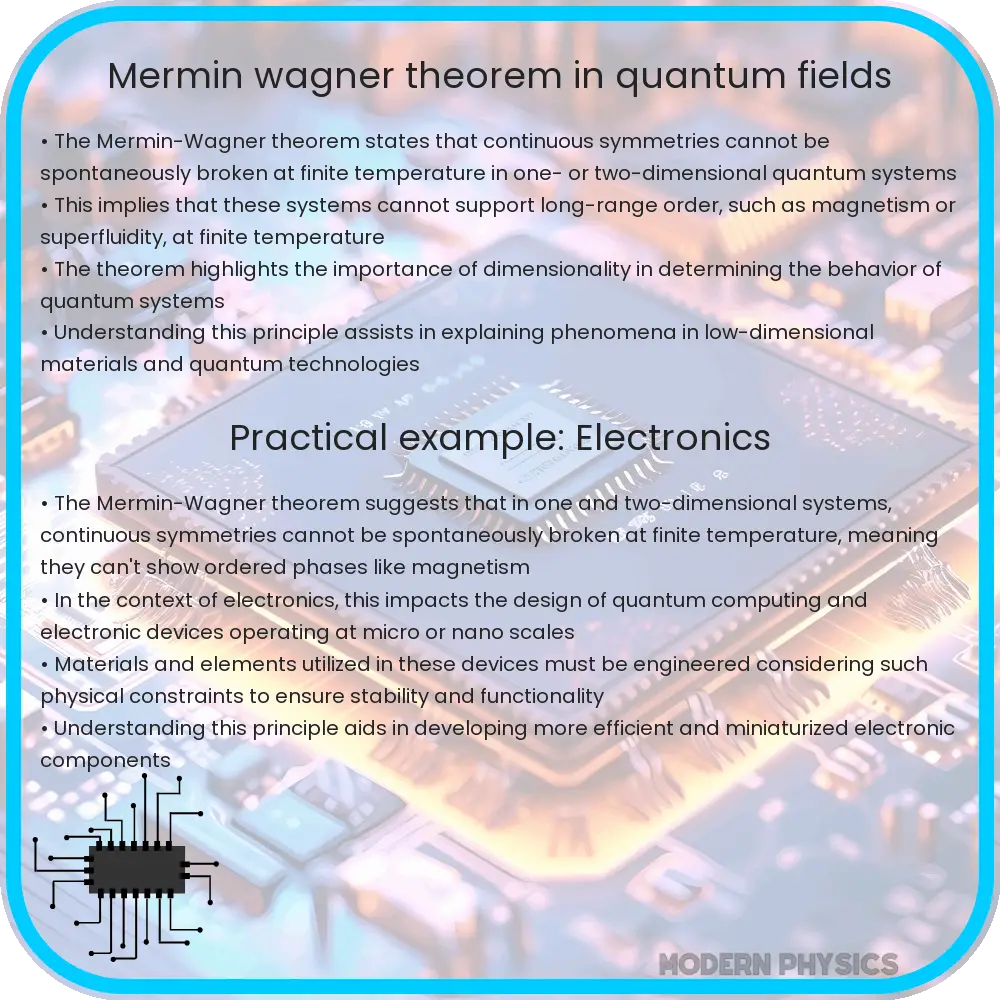
The Mermin-Wagner Theorem, a cornerstone in the field of theoretical physics, plays a crucial role in our understanding of symmetry breaking and phase transitions within quantum field theory. This theorem, proposed by N. D. Mermin and H. Wagner in 1966, asserts a fundamental limitation on spontaneous symmetry breaking in low-dimensional systems. Specifically, it states that continuous symmetries cannot be spontaneously broken at finite temperature in systems with one or two spatial dimensions, due to the presence of long-wavelength fluctuations.
At the heart of this theorem lies the concept of continuous symmetries, which are symmetries described by a continuous set of operations, such as rotations or translations. In the realm of quantum fields, these symmetries play a pivotal role in defining the behavior of particles and fields. The Mermin-Wagner Theorem essentially tells us that in one or two-dimensional systems, these symmetries cannot be broken spontaneously, implying that certain phase transitions, like the transition to magnetism or superfluidity, are prohibited in low-dimensional systems.
Implications in Quantum Field Theory
In quantum field theory, the Mermin-Wagner Theorem has profound implications. It dictates that phenomena like Bose-Einstein condensation or ferromagnetism, which rely on symmetry breaking, cannot occur in an infinite one-dimensional or two-dimensional system at finite temperatures. This is because thermal fluctuations in these systems are strong enough to disrupt the ordered state necessary for these phenomena.
Consider, for example, a two-dimensional lattice of spins that could potentially exhibit ferromagnetic ordering. According to the Mermin-Wagner Theorem, at any finite temperature, the thermal fluctuations will be sufficient to destroy the long-range order needed for ferromagnetism. This result is in stark contrast to three-dimensional systems, where such ordering can indeed occur.
Application in Phase Transitions
The Mermin-Wagner Theorem also finds significant application in the study of phase transitions. Phase transitions, like the transition from a liquid to a solid, often involve symmetry breaking. The theorem provides a crucial understanding of why certain transitions cannot occur in low-dimensional systems. It tells us that the long-range order necessary for a phase transition, such as crystallization, cannot be sustained in the face of thermal fluctuations in one or two dimensions.
This understanding has led to a deeper exploration of low-dimensional systems, where exotic states of matter might exist. Researchers have been investigating the peculiarities of these systems, where the usual rules of phase transitions do not apply. This exploration has opened new avenues in condensed matter physics, leading to the discovery of new materials and phenomena.
In conclusion, the Mermin-Wagner Theorem stands as a pivotal principle in theoretical physics, particularly in the fields of quantum field theory and condensed matter physics. It provides a fundamental understanding of the limitations of phase transitions and symmetry breaking in low-dimensional systems, guiding researchers in their exploration of the complex and fascinating world of quantum fields.
Exploring Beyond the Mermin-Wagner Theorem
While the Mermin-Wagner Theorem sets clear boundaries in low-dimensional quantum systems, it also sparks curiosity about the behavior of such systems under different conditions. Researchers have explored scenarios where the constraints of the theorem can be circumvented. For example, in the presence of anisotropy or long-range interactions, systems might exhibit behavior that seemingly contradicts the theorem. These investigations have led to a richer understanding of quantum field behavior in diverse conditions.
Another area of interest is the study of quantum fluctuations in low-dimensional systems. Quantum fluctuations can sometimes lead to unexpected phenomena that do not align with the classical interpretations suggested by the Mermin-Wagner Theorem. This has implications in the study of quantum phase transitions, where quantum fluctuations, rather than thermal ones, drive the transition.
Technological Implications and Future Directions
The Mermin-Wagner Theorem is not just a theoretical construct but has practical implications in the development of new technologies. Understanding the limitations imposed by the theorem helps in the design of low-dimensional materials, like graphene, where the unique properties are a result of their two-dimensional nature. These materials have wide applications, from electronics to materials science, and understanding their fundamental properties is crucial for innovative applications.
Looking to the future, the study of systems that defy the Mermin-Wagner Theorem could lead to breakthroughs in understanding high-temperature superconductivity and other exotic states of matter. The theorem serves as a guideline and a challenge for physicists exploring the uncharted territories of low-dimensional quantum systems.
Conclusion
The Mermin-Wagner Theorem stands as a testament to the power of theoretical physics in providing fundamental insights into the nature of matter. By delineating the constraints on symmetry breaking and phase transitions in low-dimensional systems, it has deepened our understanding of quantum fields and condensed matter. Its implications extend beyond pure theory, influencing the development of new materials and technologies. As research continues to push the boundaries of what is known, the Mermin-Wagner Theorem remains a critical reference point, guiding physicists in their quest to unravel the mysteries of the quantum world. In this journey, the theorem not only defines the limits but also challenges scientists to explore beyond them, promising a future rich with discovery and innovation in the realm of quantum physics.