
Explore the intriguing quest for magnetic monopoles in physics, covering theories, experiments, and their potential impact on our understanding of the universe.
Magnetic Monopole: A Theoretical Enigma in Physics
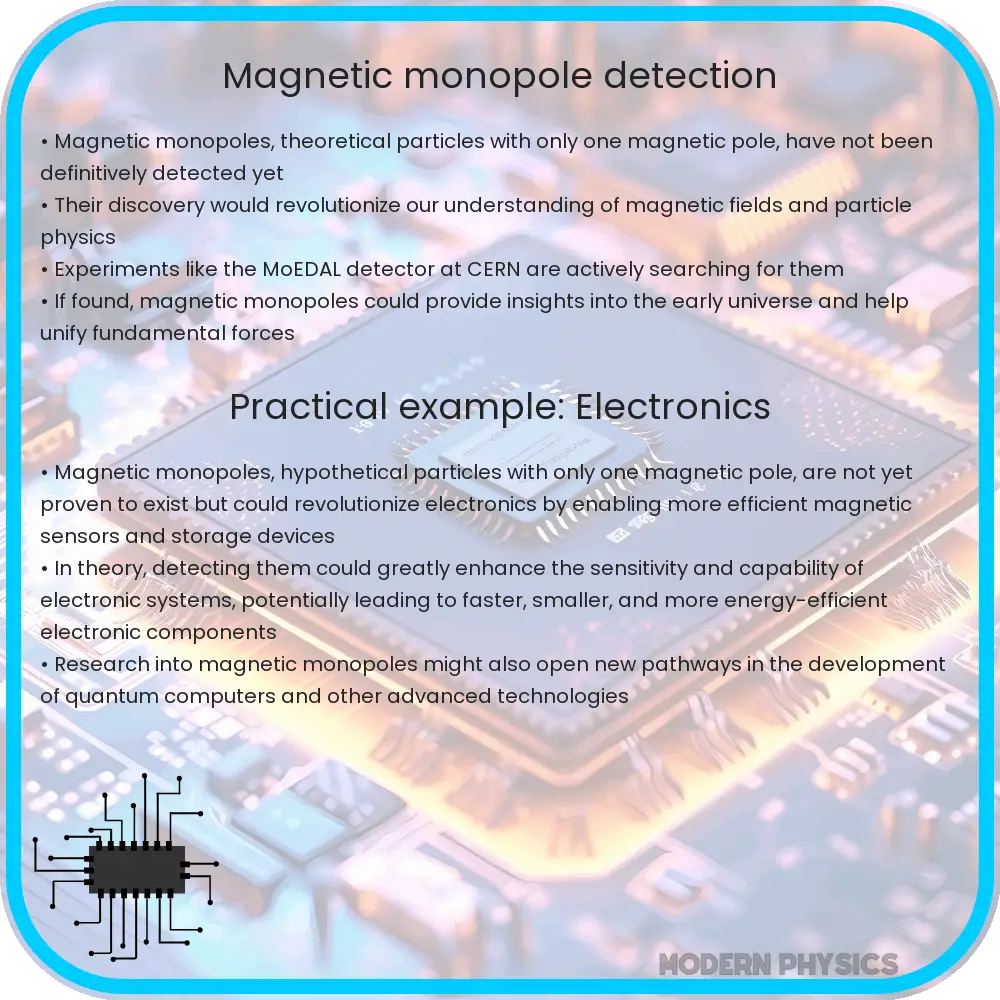
The concept of a magnetic monopole has intrigued physicists for decades. Unlike the common dipole magnets with north and south poles, a magnetic monopole is a hypothetical particle with only one magnetic pole, either north or south. This idea challenges the classical understanding of magnetism, which is based on Maxwell’s equations stating that magnetic field lines always run from a north to a south pole.
Theoretical Foundations
The search for magnetic monopoles is deeply rooted in theoretical physics. In the 1930s, physicist Paul Dirac introduced the idea, linking it to the quantization of electric charge. Dirac’s theory suggested that the existence of even a single magnetic monopole in the universe could explain why electric charge is quantized. His formulation implies that magnetic monopoles should have a massive magnetic charge and mass, making them elusive to detect.
Experimental Pursuits
Over the years, several experiments have sought to detect these elusive particles. Initially, searches focused on cosmic rays and later extended to high-energy particle accelerators and large-scale detectors like those used in particle physics. Despite these efforts, no conclusive evidence of magnetic monopoles has been found. However, in condensed matter physics, quasi-particles resembling monopoles have been observed in exotic materials, fueling further interest.
Significance in Modern Physics
The pursuit of magnetic monopoles is not just a quest for a new particle; it holds profound implications for our understanding of the universe. Their discovery would be a monumental breakthrough, providing evidence for grand unified theories and potentially explaining mysteries such as the dominance of matter over antimatter in the universe. Moreover, it could lead to a deeper understanding of quantum mechanics and revolutionize magnetic technology.
Despite the lack of empirical evidence, the search for magnetic monopoles continues to be a significant aspect of modern physics. Advanced experiments like the Large Hadron Collider (LHC) and dedicated monopole detectors are constantly refining their techniques in hopes of detecting these theoretical entities. The discovery of a magnetic monopole would not only confirm a longstanding theoretical prediction but also open new avenues in the realm of physics.
Advanced Techniques in Monopole Detection
Recent advancements in technology have significantly enhanced the search for magnetic monopoles. The use of superconducting quantum interference devices (SQUIDs) offers high sensitivity to magnetic fields, potentially capable of detecting the signature of a monopole. Additionally, particle accelerators like the LHC provide high-energy environments where monopoles might be created in particle collisions. Researchers also utilize specialized detectors deep underground or underwater to shield from cosmic rays, creating ideal conditions for detecting rare particle interactions.
Implications in Cosmology and Astrophysics
The existence of magnetic monopoles carries substantial implications for cosmology and astrophysics. Their presence could offer insights into the early universe’s conditions and the unification of fundamental forces. Some cosmological theories, such as inflation, predict relics from the early universe, potentially including magnetic monopoles. Detecting these particles could provide empirical support for these theories and deepen our understanding of the universe’s evolution.
Challenges and Future Prospects
Despite technological advancements, the detection of magnetic monopoles remains a daunting challenge. One significant hurdle is the predicted rarity and massive energy required to produce these particles. Additionally, distinguishing a monopole signal from background noise in detectors is a complex task. Future endeavors in this field may involve even more sensitive detection methods or novel theoretical approaches that could predict monopole properties more accurately.
Conclusion
The quest for magnetic monopoles continues to be a captivating journey in the field of physics. While they remain undetected, their theoretical significance and potential implications keep the scientific community’s interest alive. The pursuit of magnetic monopoles represents the broader endeavor of physics to understand the fundamental constituents and forces of our universe. Whether these elusive particles are eventually found or not, the search itself drives innovation in experimental techniques and deepens our theoretical understanding, embodying the relentless spirit of scientific inquiry.