
Explore the precision and versatility of Magnetic Circular Dichroism Spectrometry, a key tool in analyzing molecular structures and transitions.
Understanding Magnetic Circular Dichroism (MCD) Spectrometry
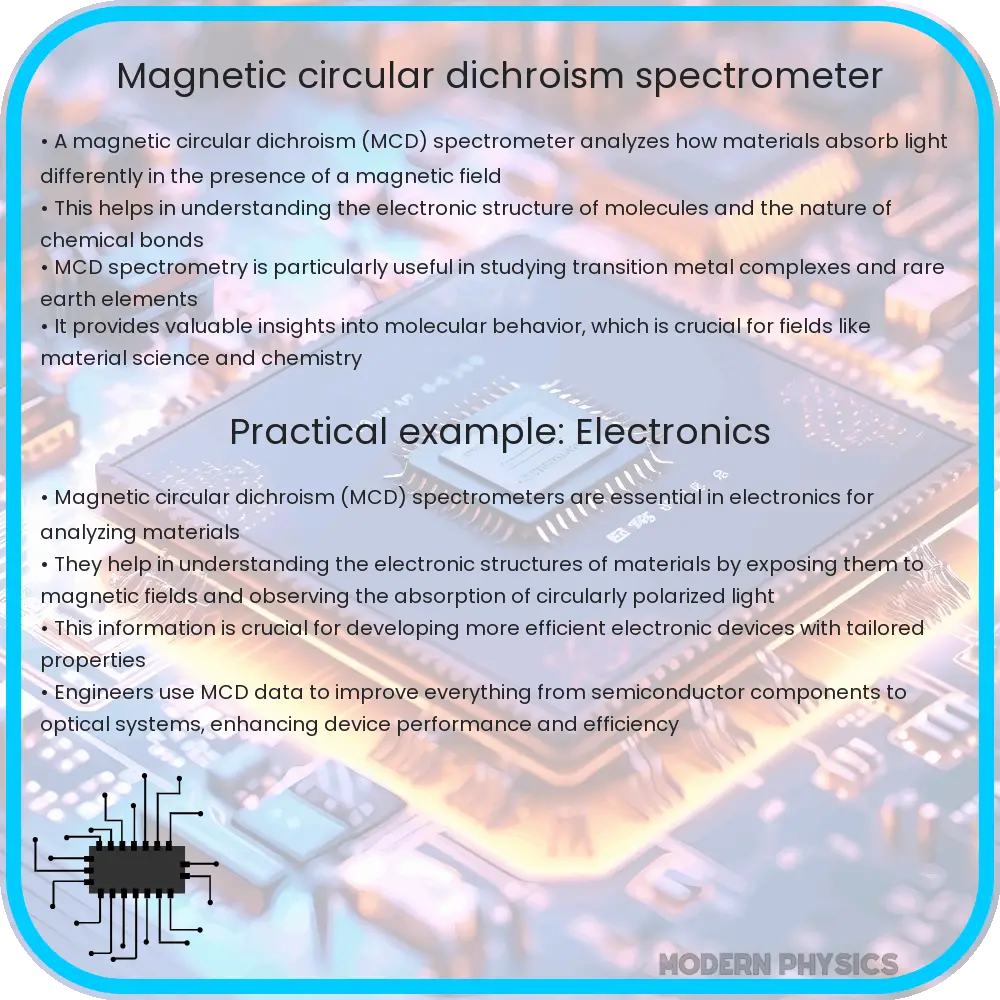
Magnetic Circular Dichroism (MCD) Spectrometry is a sophisticated analytical technique that has revolutionized the study of molecular structures and electronic transitions. This technique leverages the principles of circular dichroism in the presence of a magnetic field, offering unparalleled precision, sensitivity, and speed in the analysis of chemical and biological systems.
Principles of MCD Spectrometry
At its core, MCD spectrometry is based on the differential absorption of left and right circularly polarized light by a sample in a magnetic field. This phenomenon occurs due to the magnetic dipole and electric quadrupole transitions within the sample. Unlike traditional absorption spectroscopy, MCD provides additional information about the electronic structures and geometric arrangements of molecules, particularly in transition metal complexes and rare earth elements.
Components of an MCD Spectrometer
An MCD spectrometer consists of several key components:
- A source of circularly polarized light, typically a monochromator or laser.
- A high-precision electromagnet or superconducting magnet that generates a strong magnetic field.
- A sample holder designed to maintain the sample in the magnetic field and optical path.
- Detection systems, often including photomultiplier tubes or charge-coupled devices (CCDs), to measure the differential absorption.
Applications of MCD Spectrometry
MCD spectrometry finds applications in various scientific fields:
- Chemistry: In analyzing the electronic structures of coordination compounds, especially those containing transition metals like iron (Fe2+/Fe3+) or copper (Cu+/Cu2+).
- Material Science: For investigating the properties of novel materials, including semiconductors and nanoparticles.
- Biophysics and Biochemistry: In studying the active sites of metalloproteins and enzymes, providing insights into their function and mechanism.
MCD spectrometry’s high sensitivity makes it ideal for studying samples with low concentration or in cases where only small amounts are available. Its speed and precision facilitate real-time analysis and high-throughput screening, critical in research and industrial applications.
The integration of MCD spectrometry into research and diagnostic laboratories marks a significant advancement in spectroscopic analysis. By offering detailed insights into molecular and electronic structures, it paves the way for new discoveries in chemistry, biology, and materials science.
Advantages of MCD Spectrometry
MCD spectrometry offers several unique advantages over traditional spectroscopic methods. Its high sensitivity allows for the detection of subtle changes in molecular structure and electronic states. This is particularly useful in studying chiral molecules and in situations where the sample size is limited. The precision of MCD spectrometry is also noteworthy, providing detailed spectral information that is often unattainable with other techniques.
Technological Innovations in MCD Spectrometry
Recent advancements in MCD spectrometry technology have further enhanced its capabilities. Innovations in magnet technology, such as the development of stronger and more stable superconducting magnets, have significantly improved the resolution and sensitivity of MCD measurements. Similarly, advancements in light sources and detectors have allowed for more accurate and faster data acquisition, making MCD spectrometry suitable for a wide range of applications, from fundamental research to industrial quality control.
Challenges and Future Directions
Despite its numerous advantages, MCD spectrometry faces certain challenges. The requirement for a strong magnetic field and the sensitivity of the technique to environmental factors, such as temperature and light polarization, can complicate measurements. Additionally, interpreting MCD spectra requires specialized knowledge and can be more complex compared to other spectroscopic methods. Future developments in MCD spectrometry are likely to focus on overcoming these challenges, enhancing the usability and accessibility of this technique.
Conclusion
Magnetic Circular Dichroism Spectrometry stands out as a powerful tool in the analytical scientist’s arsenal. Its unique ability to probe the electronic and geometric structures of molecules with high precision and sensitivity makes it invaluable in diverse fields like chemistry, biochemistry, and material science. The ongoing technological advancements in this field promise to further expand its applications and improve its usability. As researchers continue to explore the potential of MCD spectrometry, we can expect it to play an increasingly vital role in scientific discovery and technological innovation.