
Explore the dynamics of electromagnetic waves, their interaction, motion, and force, with insights into practical applications and fundamental physics.
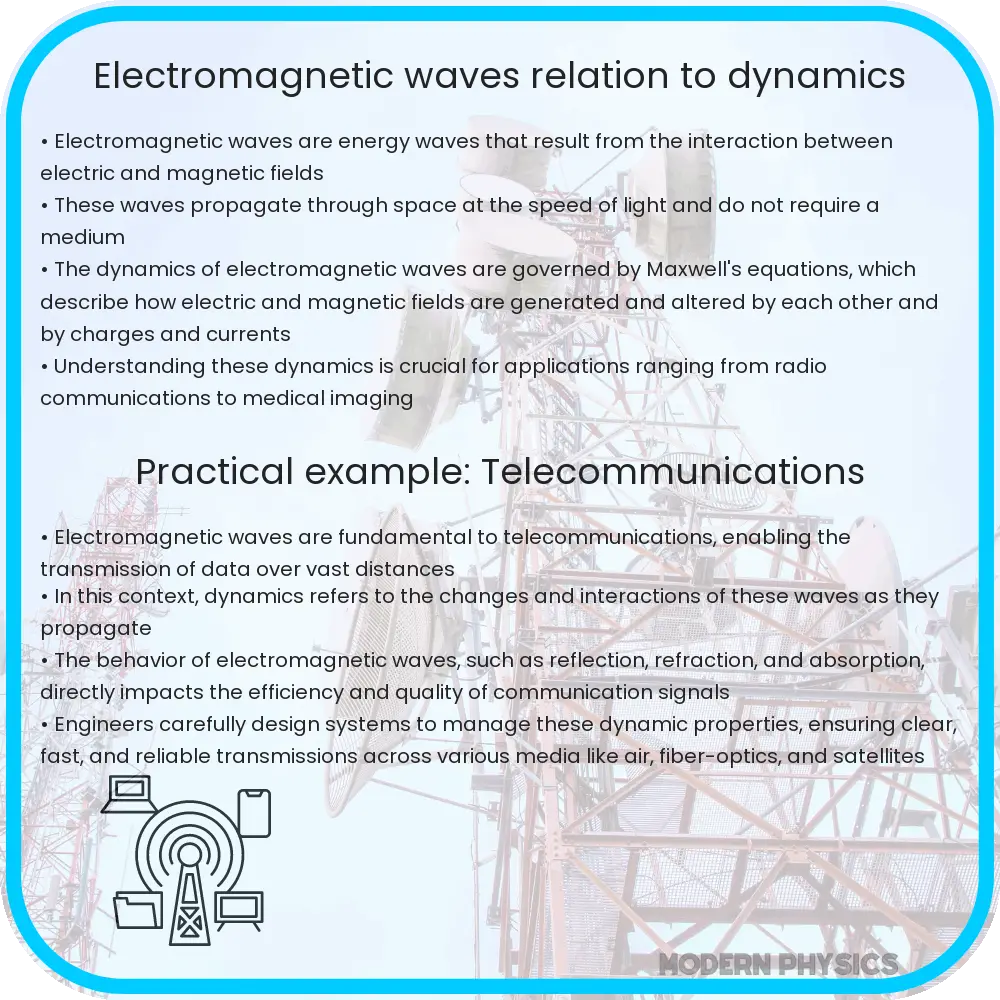
Understanding Electromagnetic Waves: Interaction, Motion, and Force
Electromagnetic waves, a fundamental concept in physics, are ripples in the electromagnetic field, propagating through space and carrying energy from one place to another. These waves encompass a broad spectrum, including radio waves, microwaves, infrared, visible light, ultraviolet, X-rays, and gamma rays. This article delves into the intriguing dynamics of electromagnetic waves, particularly focusing on their interaction, motion, and the forces they exert.
Interaction of Electromagnetic Waves
Electromagnetic waves interact with matter in various ways depending on their frequency and the nature of the material. When they encounter matter, several phenomena can occur: reflection, refraction, diffraction, and absorption. Reflection involves the wave bouncing back from a surface, while refraction is the bending of the wave as it passes from one medium to another. Diffraction occurs when waves bend around obstacles or spread out after passing through small openings. Absorption involves the transfer of wave energy to the material’s particles, often leading to heating.
Motion of Electromagnetic Waves
The motion of electromagnetic waves is governed by Maxwell’s equations, a set of four fundamental equations that describe how electric and magnetic fields are generated and altered by each other and by charges and currents. These waves travel at the speed of light (approximately \(3 \times 10^{8}\) meters per second in a vacuum), which is a fundamental constant of nature. The speed of these waves can vary slightly when they travel through different media.
Force Exerted by Electromagnetic Waves
Electromagnetic waves exert a force when they interact with charged particles. This force is the basis for the concept of radiation pressure. Although typically very small for everyday light sources, radiation pressure can have significant effects in high-intensity scenarios, such as in laser applications or in the pressure exerted by sunlight on spacecraft. The force exerted by electromagnetic waves is also crucial in the understanding of phenomena like the photoelectric effect, where light can cause the emission of electrons from a material.
In conclusion, electromagnetic waves play a pivotal role in various physical phenomena and technological applications. Their interaction, motion, and the forces they exert are fundamental to understanding both classical and modern physics.
Further Exploration
In the next section, we will explore practical applications of electromagnetic waves, delve deeper into the mathematical description of their behavior, and look at some of the groundbreaking experiments and theories related to electromagnetic waves.
Practical Applications of Electromagnetic Waves
Electromagnetic waves find myriad applications in everyday life and scientific research. For instance, radio waves are crucial in communication technologies, such as television, radio, and cell phones. Microwaves are extensively used in cooking and satellite communications. Infrared waves are vital in thermal imaging, while visible light is essential for photography and human vision. Ultraviolet light has applications in sterilization, and X-rays are indispensable in medical imaging. Gamma rays play a crucial role in nuclear medicine and astrophysical observations.
Mathematical Description of Electromagnetic Waves
The behavior of electromagnetic waves can be mathematically described using Maxwell’s equations combined with the wave equation. The wave equation, derived from Maxwell’s equations, is \( \nabla^{2}E = \frac{1}{c^{2}}\frac{\partial^{2}E}{\partial t^{2}} \), where \( E \) represents the electric field, \( c \) is the speed of light, and \( t \) is time. This equation describes how the electric field (and similarly the magnetic field) propagates through space and time as an electromagnetic wave.
Groundbreaking Experiments and Theories
The study of electromagnetic waves has led to groundbreaking experiments and theories in physics. The famous Michelson-Morley experiment, for instance, disproved the existence of the “aether,” leading to the development of Einstein’s theory of special relativity. The photoelectric effect, explained by Einstein, demonstrated that light can be thought of as both a wave and a particle, a concept fundamental to quantum mechanics.
Conclusion
The exploration of electromagnetic waves offers a window into the fundamental principles of physics. From their diverse practical applications to their role in shaping modern scientific theories, these waves are integral to our understanding of the universe. The study of their interaction, motion, and the force they exert continues to unveil new technologies and deepen our grasp of both the macroscopic and microscopic worlds. As we continue to explore these fascinating phenomena, we can expect to uncover more mysteries and applications that will propel scientific and technological advancements into the future.