
Explore the revolutionary Luneburg lens in radar technology for enhanced range, clarity, and precision, and its future applications across industries.
Exploring the Luneburg Lens: A Revolution in Radar Technology
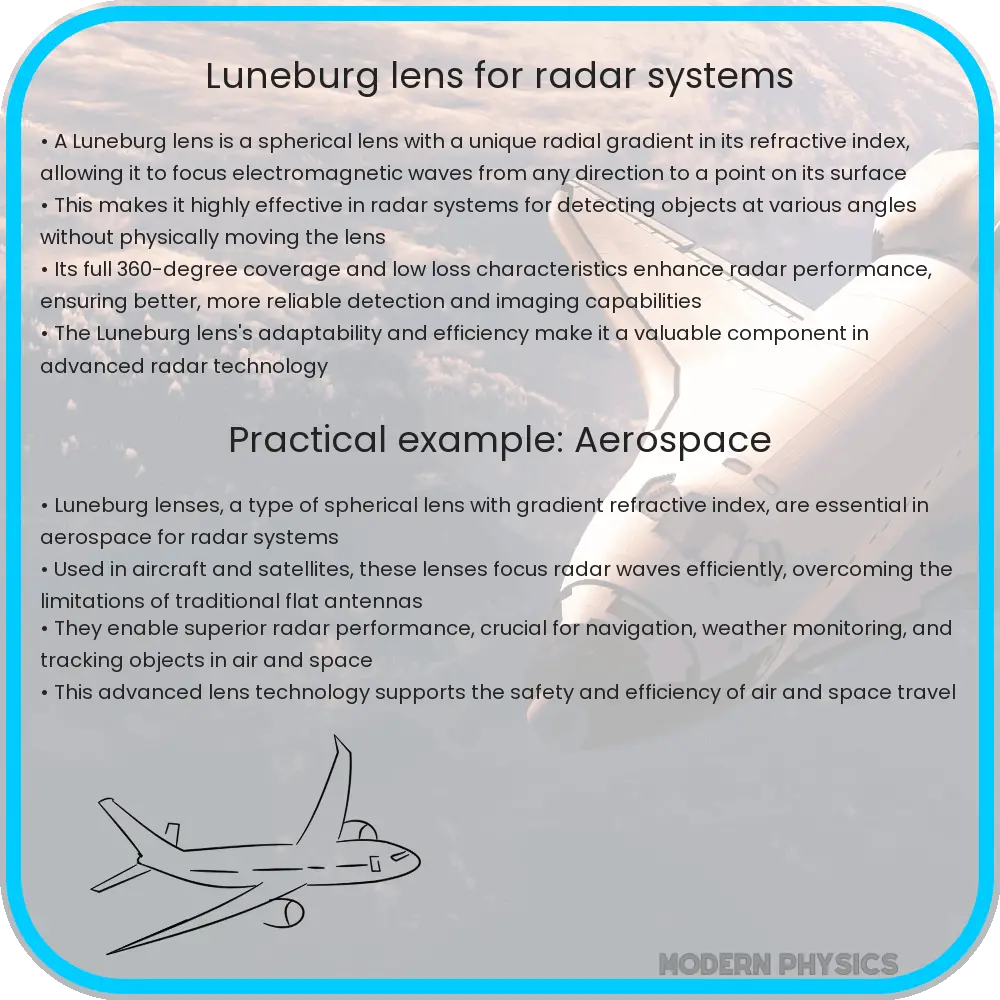
The Luneburg lens, a spherical, gradient-index lens, has emerged as a transformative technology in radar systems, offering enhanced range, clarity, and precision. This innovative lens design, based on the mathematical principles discovered by Rudolf Luneburg, manipulates the path of electromagnetic waves to focus them precisely, regardless of the incident angle. This characteristic makes it uniquely advantageous for radar applications, where detecting and tracking objects with high precision is paramount.
The Mechanism Behind Luneburg Lenses
At the heart of the Luneburg lens is its gradient refractive index (GRIN) profile, which varies radially from the center to the surface. This gradient causes electromagnetic waves entering the lens to bend gradually and focus on the opposite surface of the sphere. The refractive index at the lens’s center is higher and decreases towards the outer surface, following a specific mathematical relationship: \(n(r) = \sqrt{2 – (r/R)^2}\), where \(n\) is the refractive index, \(r\) is the radial distance from the center, and \(R\) is the radius of the lens.
Advantages in Radar Applications
- Enhanced Range and Clarity: The Luneburg lens’s ability to focus electromagnetic waves with high precision greatly improves the radar’s range and clarity. This allows for the detection of objects at greater distances and with higher resolution than traditional radar systems.
- Omni-directional Functionality: Unlike conventional lenses, the Luneburg lens can focus signals from any direction without the need for mechanical movement. This omnidirectional capability ensures continuous monitoring and tracking of objects in all directions.
- Improved Precision: The precision focusing of electromagnetic waves enhances the radar’s ability to discriminate between objects that are close together, significantly improving its precision and reducing the likelihood of false positives.
The integration of Luneburg lenses into radar systems represents a significant leap forward in surveillance, navigation, and object detection technologies. Their unique properties enable more efficient, accurate, and reliable radar performance, opening up new possibilities for military, aviation, and maritime applications.
Is this conversation helpful so far?
Material and Design Innovations
Advancements in materials science have played a crucial role in the development and optimization of Luneburg lenses for radar applications. Modern manufacturing techniques enable the creation of lenses with precise gradient-index profiles, using materials such as polymers and composite dielectrics. These materials are chosen for their ability to manipulate electromagnetic wave propagation effectively and withstand harsh environmental conditions, ensuring durability and long-term performance.
Future Perspectives and Applications
The versatility and superior performance of Luneburg lenses hold promise for a wide range of future applications beyond traditional radar systems. Potential fields include wireless communications, where they could enhance signal strength and coverage, and astronomy, where they might improve the capabilities of telescopes for deep-space observation. Additionally, the ongoing miniaturization and cost reduction of these lenses could enable their integration into consumer electronics, automotive sensors, and drones, further expanding their utility and impact.
Conclusion
The Luneburg lens represents a significant advancement in radar and electromagnetic wave manipulation technology. Its unique gradient-index profile offers unmatched precision, range, and clarity, making it a pivotal tool in enhancing the capabilities of radar systems. As material and design innovations continue to evolve, the potential applications of the Luneburg lens are set to expand, promising to revolutionize fields ranging from national defense to consumer electronics. The ongoing research and development in this area not only underscore the lens’s versatility but also highlight its role in shaping the future of technology. Embracing these innovations, we can look forward to a new era of precision, efficiency, and connectivity in radar and beyond.