
Explore how Negative Index Materials revolutionize lens technology, offering enhanced focus, clarity, and groundbreaking applications in optics and photonics.
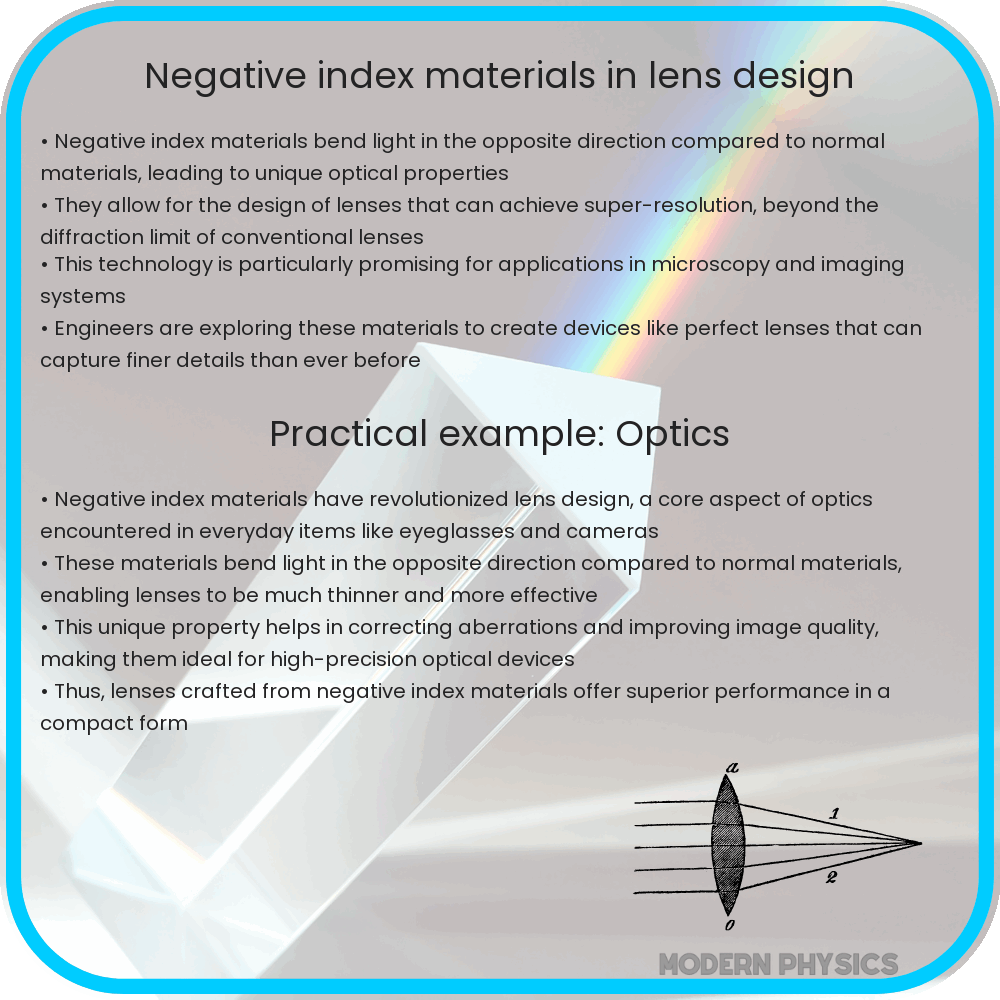
Negative Index Materials: Pioneering the Future of Lens Technology
Negative index materials (NIMs) are revolutionizing the field of optics by offering unprecedented control over light. These innovative materials have a negative refractive index, allowing them to bend light in ways that traditional materials cannot. This unique property opens up new possibilities for lens design, enabling enhanced focus and clarity that were once thought to be beyond reach.
Understanding Negative Refraction
At the heart of NIMs is the concept of negative refraction, a phenomenon where light rays are bent in the opposite direction when passing through a material. Unlike conventional materials, where light bends away from the normal, NIMs bend light towards the normal. This counterintuitive behavior is key to their unique applications in optical devices.
The Role of Metamaterials
NIMs are often made from metamaterials, engineered composites that exhibit properties not found in nature. These materials are structured on a scale smaller than the wavelength of light, allowing them to manipulate electromagnetic waves in novel ways. By carefully designing the microstructure of these materials, scientists can achieve the desired negative refractive index.
Advancements in Lens Innovation
The application of NIMs in lens technology is particularly exciting. Traditional lenses suffer from limitations such as chromatic aberration and spherical aberration, which can blur images and reduce clarity. NIMs, with their ability to precisely control the path of light, promise to overcome these limitations. Lenses made from negative index materials can focus light more accurately, resulting in sharper images and higher resolution.
Enhanced Focus and Clarity
By harnessing the power of NIMs, researchers are developing lenses that offer enhanced focus and clarity. These lenses can potentially provide a level of detail and precision that is unattainable with conventional materials. Applications range from improved optical instruments, such as microscopes and telescopes, to consumer electronics, including cameras and smartphones, promising to transform our visual experience.
Is this conversation helpful so far?
Negative Index Materials: Pioneering Advances in Lens Technology
Negative Index Materials (NIMs) represent a groundbreaking shift in optical technology, offering unprecedented opportunities for lens innovation. These materials, characterized by their ability to refract light in the opposite direction to that of conventional materials, have unlocked new possibilities in the design and functionality of lenses. This article delves into the science behind NIMs, their application in enhancing focus and clarity, and the implications for future optical technologies.
Understanding Negative Index Materials
At the heart of NIMs’ unique properties is their negative refractive index, a phenomenon that contradicts traditional optics. In standard materials, the refractive index—a measure of how much light bends when it enters a material—is positive, causing light to refract towards the normal. NIMs, however, exhibit a negative refractive index, causing light to refract away from the normal. This unusual behavior stems from their engineered structure, which manipulates electromagnetic waves in ways not found in nature.
Revolutionizing Lens Design with Enhanced Focus and Clarity
NIMs have the potential to revolutionize lens design by enabling lenses that can overcome the limitations of traditional materials. For instance, lenses made from NIMs can focus light more efficiently, leading to sharper and clearer images. This is particularly beneficial in applications requiring high precision, such as microscopy and photography, where enhanced focus and clarity are paramount. Additionally, the unique properties of NIMs open the door to the development of “superlenses” that can focus light beyond the diffraction limit of conventional lenses, potentially allowing for the imaging of objects at the nanoscale.
Implications for Future Optical Technologies
The advent of NIMs heralds a new era in optical technology, with wide-ranging implications for various fields. Beyond imaging, NIMs are poised to impact telecommunications, where they can be used to create more efficient and compact components for optical networks. Furthermore, the ability of NIMs to control light at a subwavelength scale offers exciting possibilities for the development of advanced optical devices, including invisibility cloaks and highly sensitive sensors.
Conclusion
Negative Index Materials stand at the frontier of optical science, offering a glimpse into a future where the manipulation of light transcends current boundaries. The implications of these materials are vast, extending across multiple domains from enhanced imaging technologies to novel optical devices that could reshape our interaction with light. As research progresses, the potential applications of NIMs continue to expand, promising to revolutionize the fields of optics and photonics. The journey of NIMs from theoretical concept to practical application underscores the power of innovation and the endless possibilities that emerge from exploring the unknown. As we delve deeper into the capabilities of these extraordinary materials, we edge closer to unlocking new dimensions of clarity, precision, and functionality in optical technologies.