
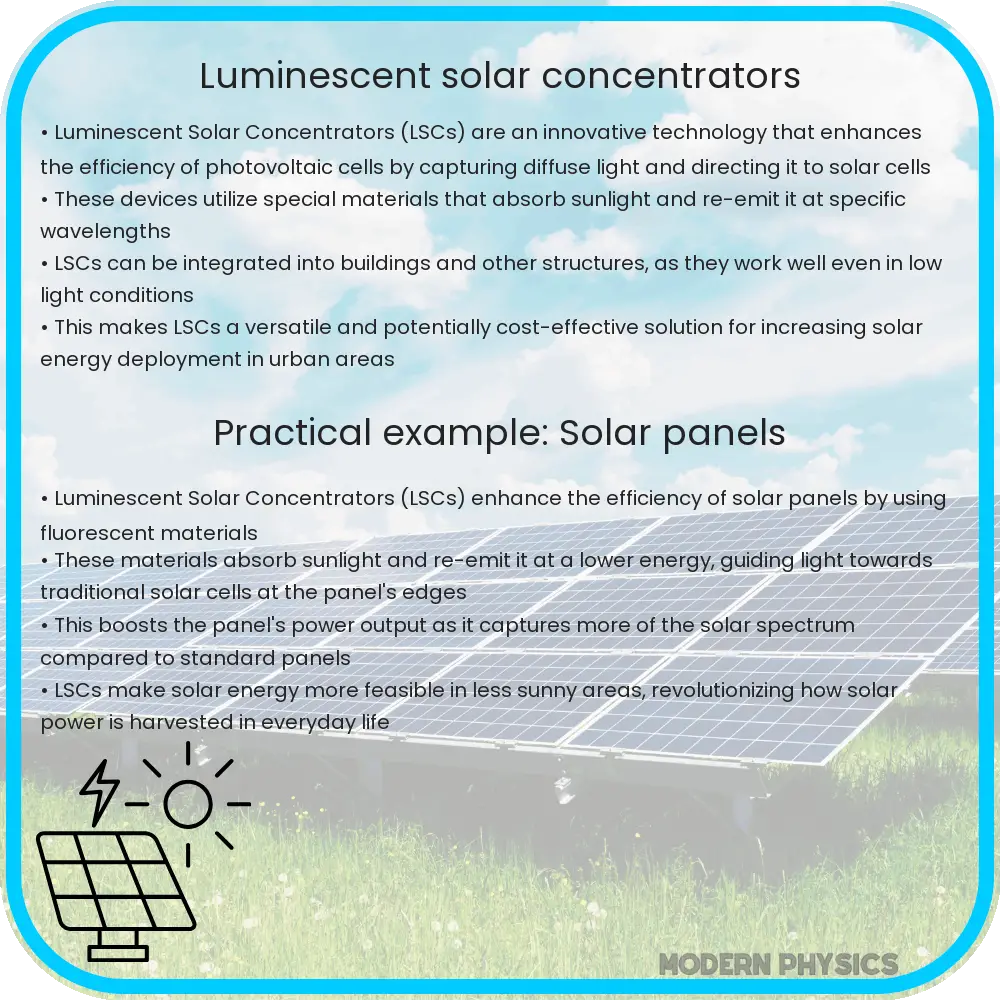
Luminescent Solar Concentrators (LSCs) are innovative devices that use luminescent materials embedded in transparent plates to capture and convert sunlight into electricity efficiently.
Exploring Luminescent Solar Concentrators: The Path to Efficient, Novel, and Sustainable Energy
Solar energy has emerged as a leading player in the quest for clean, renewable energy. Among the many innovative technologies contributing to this field, luminescent solar concentrators (LSCs) stand out for their potential to significantly enhance the efficiency and practicality of harvesting solar power. LSCs not only promise to lower the cost of solar energy but also offer an aesthetically pleasing solution that can be integrated into urban environments with minimal visual impact.
Understanding Luminescent Solar Concentrators
Luminescent Solar Concentrators are a fascinating technology that utilizes luminescent materials to capture sunlight and convert it into electricity. Structurally, an LSC comprises a transparent plate embedded with luminescent materials like organic dyes or phosphorescent compounds. These materials have the unique ability to absorb sunlight over a wide range of wavelengths and re-emit it at a lower energy level.
Once absorbed, the light is re-emitted isotropically. However, due to the internal reflection within the high refractive index material of the LSC, a significant proportion of this re-emitted light is guided towards the edges of the concentrator. Here, small, high-efficiency solar cells — much smaller than those used in traditional solar panels — are placed to convert the concentrated light into electrical energy.
The Advantages of Using LSCs
- Increased Efficiency: LSCs can potentially enhance the solar energy conversion efficiency by directing and concentrating diffuse light, which might otherwise be lost. This is particularly beneficial in cloudy or non-ideal weather conditions where traditional photovoltaics might underperform.
- Reduced Cost: Since LSCs require significantly smaller active photovoltaic areas, they can drastically reduce the cost associated with the solar cells. The primary cost then shifts to the panel’s luminescent materials and the transparent substrate, which are generally less expensive than the photovoltaic materials used in standard solar panels.
- Architectural Integration: LSCs can be designed in various colors and shapes, making them versatile for integration into buildings, windows, or even vehicles without the aesthetic disruptions typically associated with conventional solar panels. This feature allows for larger areas to be utilized for energy harvesting without compromising the design and appearance of structures.
The enhanced compatibility of LSCs with existing urban structures combined with their improving efficiency metrics illuminates their role in the future of photovoltaic technology. By turning everyday surfaces into energy producers, LSC technology not only challenges the traditional notions of solar power arrays but also expands the horizons for sustainable architecture and design.
Challenges and Innovations in LSC Technology
Despite their potential, LSCs face specific challenges that affect their widespread adoption and efficiency. One of the main hurdles is the self-absorption of re-emitted light by luminescent materials within the concentrator, which can significantly reduce the concentrator’s overall optical efficiency. Innovations in material science are crucial to developing new luminescent materials with lower self-absorption rates and higher photostability, which would profoundly impact the viability of LSCs.
Moreover, the optimization of the solar cell placement and concentrator design plays a critical role in maximizing the capture and conversion of redirected light to electricity. Engineers and scientists are continuously experimenting with different configurations and materials to enhance the overall performance of these devices.
In summary, while luminescent solar concentrators present a promising alternative to traditional solar panels, they are in a phase of continuous development. Enhancing their efficiency and integration capabilities will be crucial to their success and broader application in sustainable energy systems. The ongoing research focuses on overcoming the technological barriers and scaling the viable models for commercial and residential use.
Future Prospects and Environmental Impact
The future of luminescent solar concentrators appears bright as research delves deeper into enhancing their efficiency and applicability. With continued advancements, LSCs have the potential to become a ubiquitous part of our energy landscape, embedded in skyscrapers, vehicles, and even everyday objects like street furniture or advertising billboards. This widespread use could lead to a substantial increase in the total area available for energy harvesting without the need for additional land, thereby preserving natural habitats and reducing land use conflicts often associated with large-scale solar farms.
Furthermore, the environmental impact of adopting LSCs could be remarkably positive. By reducing the dependency on fossil fuels and lowering greenhouse gas emissions, LSC technology supports global efforts in combating climate change. Additionally, since LSCs are capable of using existing surfaces for energy production, they minimize the ecological footprint typically associated with energy production, offering a cleaner, more sustainable solution.
Conclusion
In conclusion, luminescent solar concentrators represent a significant technological advancement in the field of renewable energy. By harnessing the power of luminescent materials to improve the efficiency and aesthetics of solar energy harvesting, LSCs present a versatile and eco-friendly alternative to traditional solar technologies. Although challenges such as material optimization and light self-absorption need to be addressed, the ongoing research and development in this area are paving the way for more efficient and sustainable energy solutions. As these devices continue to evolve, they hold the promise of seamlessly integrating into the fabric of urban environments, turning passive structures into active energy producers. Ultimately, the adoption of LSC technology could play a pivotal role in achieving a sustainable energy future, making solar power more accessible, less invasive, and visually appealing.