
Explore the challenging Lorentz-Violating Field Theory, its impact on quantum mechanics and relativity, and the quest for new physics frontiers.
Lorentz-Violating Field Theory: Unraveling the Fabric of Space and Time
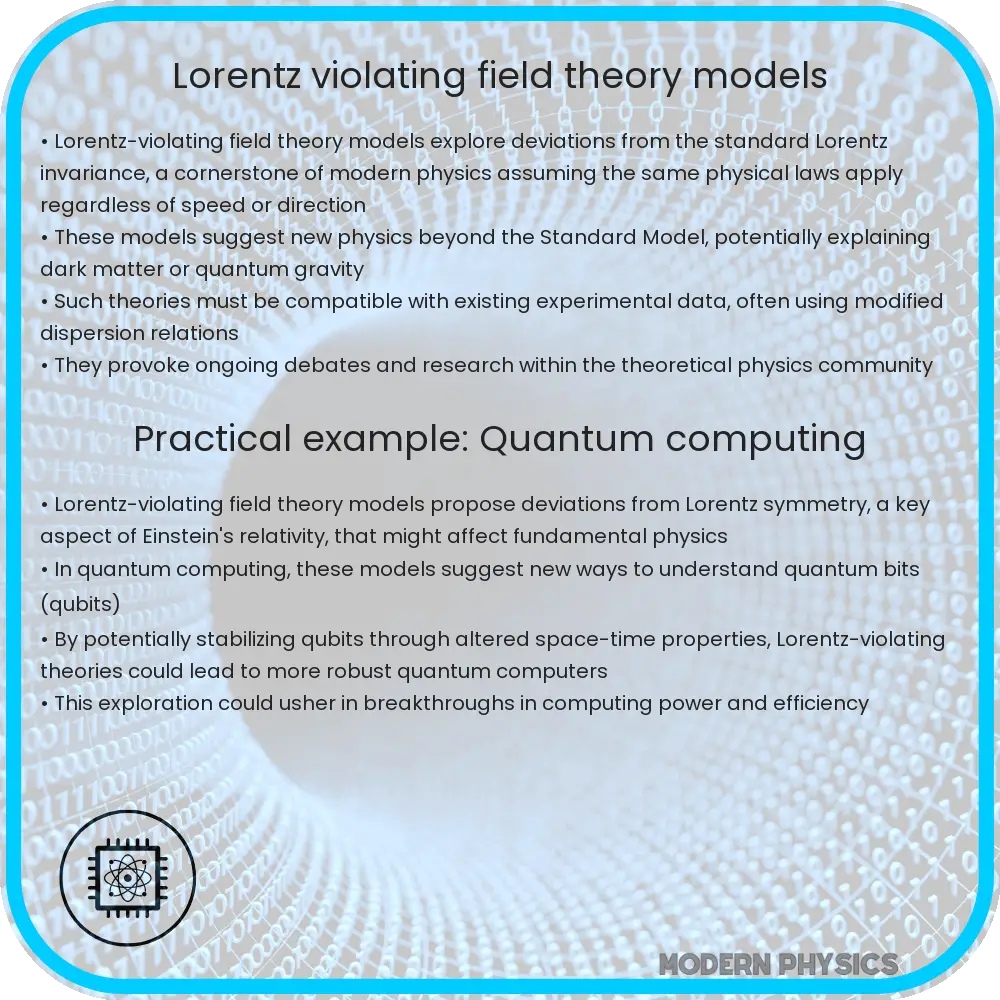
The concept of Lorentz-Violating Field Theory (LVFT) marks a revolutionary leap in our understanding of fundamental physics, challenging the established norms of relativity and quantum mechanics. At its core, LVFT proposes that the Lorentz invariance, a cornerstone principle of Einstein’s theory of relativity, might not hold universally. This audacious idea opens up a myriad of questions and possibilities in the realm of theoretical physics.
Quantum Mechanics and Lorentz Invariance
Quantum mechanics, the bedrock of modern physics, operates under the assumption that certain symmetries are preserved in nature. Among these, Lorentz invariance is pivotal. It states that the laws of physics are the same for all observers, regardless of their velocity or orientation in space-time. This invariance is integral to the theory of relativity, which posits that the speed of light is constant in all inertial frames of reference.
Breaking the Symmetry: Lorentz-Violation Hypothesis
The LVFT suggests a paradigm shift by hypothesizing that Lorentz symmetry might be broken under certain extreme conditions. This implies that at high energies, typically at scales close to the Planck length (1.616 x 10⁻³⁵ meters), the universal laws as we know them could behave differently. This notion, while controversial, offers exciting pathways to reconcile the discrepancies between general relativity and quantum mechanics.
Experimental Tests and Observational Evidence
Testing the limits of Lorentz invariance has become a crucial aspect of experimental physics. Advanced experiments, such as those conducted at the Large Hadron Collider (LHC) and through observations of high-energy cosmic rays, are at the forefront of seeking evidence for or against Lorentz violation. These tests focus on detecting minute deviations in the behavior of particles at extremely high energies, which could indicate a departure from the expected Lorentz invariant framework.
Implications for Physics and Beyond
The potential discovery of Lorentz violation would have profound implications for our understanding of the universe. It could lead to a new theory of quantum gravity, help in solving the dark matter and dark energy mysteries, and even pave the way for novel technologies based on the principles of quantum mechanics and relativity. As physicists delve deeper into the fabric of the cosmos, the quest to understand whether Lorentz invariance holds at all scales remains one of the most exhilarating challenges in modern science.
Exploring the Quantum Limits: A Closer Look
The exploration of Lorentz-Violating Field Theory (LVFT) is not just a theoretical endeavor but also a practical challenge in understanding the quantum limits of our universe. If Lorentz invariance is violated at quantum scales, it could unveil new aspects of particle physics, potentially leading to the discovery of unknown particles or forces. Theorists speculate that such violations might manifest in subtle but measurable ways, such as variations in the speed of light for different energy photons or alterations in the behavior of particles under extreme gravitational forces.
Relativity in the Balance
Albert Einstein’s theory of relativity, a pillar of modern physics, stands at the crossroads in the face of LVFT. Should Lorentz violations be proven, it would necessitate a radical revision of relativity theory. This does not imply discarding Einstein’s insights but rather extending them to account for phenomena beyond current understanding. Such advancements could lead to a unified theory that seamlessly integrates relativity with quantum mechanics, a longstanding goal in physics.
Challenges in Verification and Theoretical Modeling
One of the biggest challenges in verifying LVFT lies in the technological limitations of current experiments. Detecting Lorentz violations requires incredibly precise measurements at energy scales or gravitational strengths not yet achievable. Furthermore, developing a coherent theoretical framework that incorporates Lorentz violations without contradicting well-established physical laws is a daunting task for physicists.
Conclusion: The Future of Physics in the Light of LVFT
The investigation into Lorentz-Violating Field Theory stands at the frontier of physics, representing a bold inquiry into the deepest laws of the universe. Whether or not Lorentz invariance is upheld at all scales, the research journey promises to yield rich insights. The potential discovery of Lorentz violations could revolutionize our understanding of space, time, and matter, leading to a new era in physics. As technology advances and theoretical models become more refined, the scientific community eagerly anticipates breakthroughs that could reshape our comprehension of the cosmos. In this quest, LVFT is not just a topic of academic interest but a beacon guiding us toward the unknown realms of the universe, holding the promise of answering some of the most profound questions ever posed by humanity.