
Tests of Lorentz Invariance Violation examine potential discrepancies in the fundamental symmetry of spacetime, crucial to Special Relativity, through various high-energy and precision experiments.
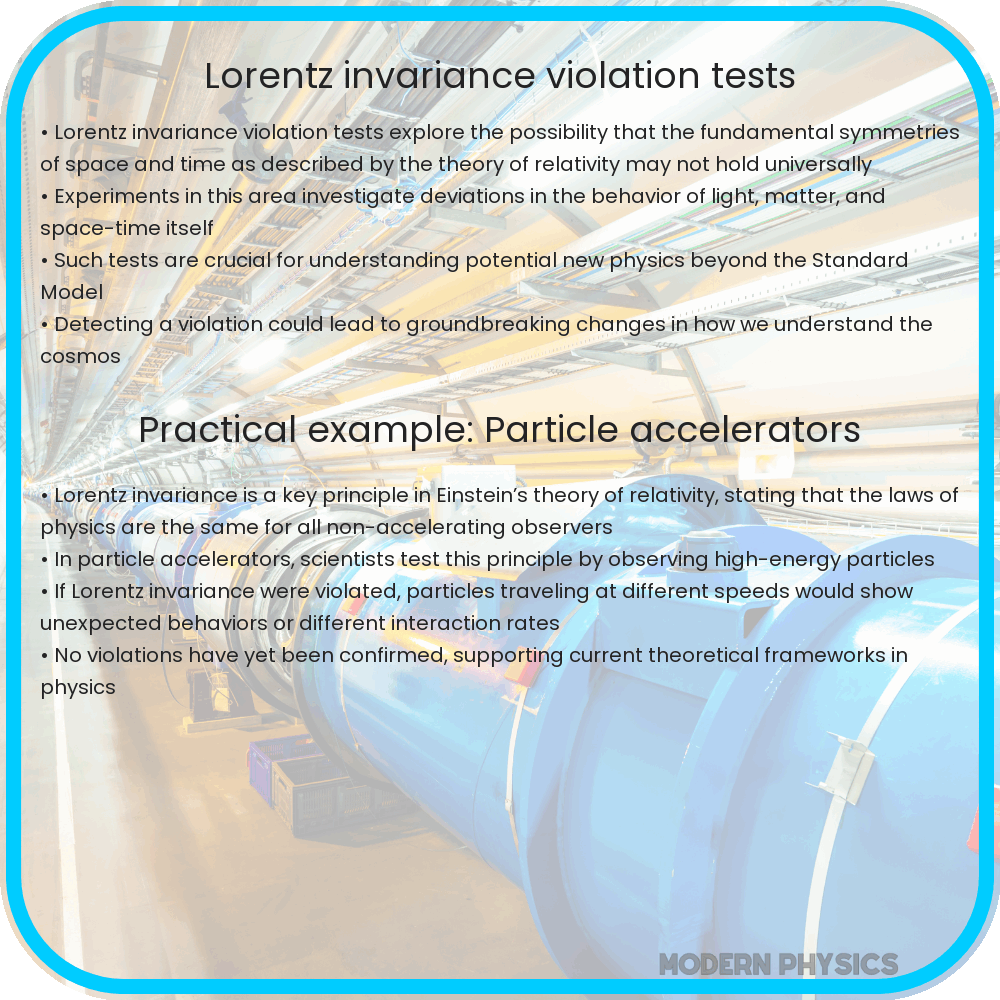
Lorentz Invariance Violation Tests | Experiments & Evidence
One of the cornerstones of modern physics is the principle of Lorentz Invariance, a fundamental symmetry underlying the theory of Special Relativity proposed by Albert Einstein in 1905. This principle states that the laws of physics are the same for all observers, regardless of their relative motion or orientation in spacetime.
However, in the quest to unify gravity with the other fundamental forces, some theories predict that Lorentz Invariance might be violated at very high energy scales. Investigating potential violations of Lorentz Invariance could therefore offer a glimpse into new physics beyond our current understanding.
Understanding Lorentz Invariance
Lorentz Invariance is closely related to the constancy of the speed of light. Mathematically, the invariance implies that the spacetime interval between two events is the same for all inertial observers, which can be written as:
s^2 = c^2 * t^2 - x^2 - y^2 - z^2
where s is the spacetime interval, c is the speed of light, and t, x, y, and z are the time and spatial coordinates of the events. This form remains unchanged under a Lorentz transformation, which mathematically represents a change in coordinates due to relative motion between observers.
Experiments Testing Lorentz Invariance
Several experimental approaches have been employed to test the validity of Lorentz Invariance. These tests can be broadly categorized into three types:
- Particle Physics Experiments
- Astrophysical Observations
- Laboratory-based Precision Measurements
Particle Physics Experiments
High-energy particle accelerators, such as the Large Hadron Collider (LHC), provide an excellent platform to test Lorentz Invariance. By smashing protons at near-light speeds, physicists can probe the behaviors of particles, looking for any discrepancies from predicted norms that might indicate Lorentz Invariance violations.
Astrophysical Observations
Natural astrophysical phenomena offer another avenue to test Lorentz Invariance. Observations of high-energy cosmic rays, gamma-ray bursts, and other distant astrophysical sources can reveal potential anomalies in the propagation of these signals over vast distances. Since any violation could accumulate over large scales, astrophysical observations can be extremely sensitive to tiny deviations.
Laboratory-based Precision Measurements
Laboratory-based experiments, including those involving atomic clocks and interferometers, provide precise tests of Lorentz Invariance. For instance, variations in the speed of light due to the Earth’s motion through hypothesized preferred frames of reference could be detected by monitoring the behavior of highly stable optical cavities or atomic transitions.
Key Experimental Evidence
To date, no conclusive evidence has been found indicating the violation of Lorentz Invariance. Some of the significant experiments and their results include:
- Michelson-Morley Experiment: One of the earliest and most famous tests, it failed to detect any difference in the speed of light due to Earth’s motion through the hypothetical “aether,” subsequently supporting Lorentz Invariance.
- FERMI Gamma-ray Space Telescope: Observations of gamma-ray bursts in distant galaxies show no detectable differences in arrival times that could suggest Lorentz Invariance violations.
- ATLAS Experiment at LHC: Data from particle collisions haven’t shown deviations from the expected results that might indicate Lorentz violation.
Challenges in Detecting Lorentz Invariance Violation
Despite the numerous experiments conducted to test Lorentz Invariance, detecting any potential violation remains a significant challenge. Several factors contribute to the difficulty:
- High Precision Requirements: The effects predicted by theories suggesting Lorentz Invariance violations are often incredibly small, requiring extremely precise measurement tools and methods.
- Environmental Noise: Any experiment sensitive enough to detect these small effects must also account for and mitigate environmental noise and other influences that could obscure the results.
- Complex Data Analysis: The interpretation of experimental data in the context of potential Lorentz Invariance violations involves complex statistical analysis and comparison with robust theoretical models.
Future Prospects and Ongoing Research
Research into Lorentz Invariance violations is ongoing and remains a critical area of interest for physicists. Future experiments and technological advancements may bring new insights. Some promising directions include:
- Next-Generation Particle Colliders: New particle accelerators with higher energy capacities and enhanced detection capabilities could provide more stringent tests of Lorentz Invariance.
- Improved Space-based Observatories: Future space missions, equipped with state-of-the-art instruments, may enhance our ability to observe high-energy cosmic phenomena with greater precision.
- Advanced Timekeeping Techniques: Developments in atomic clock technology and interferometric techniques may further refine laboratory-based tests.
Conclusion
Testing Lorentz Invariance remains a cornerstone of modern physics research, with numerous experiments aiming to find any potential deviations that could signal new physics. While no conclusive evidence for Lorentz Invariance violations has been found to date, the continued investigation offers valuable insights into the fundamental nature of our universe. With advances in technology and methodology, future experiments hold the promise of revealing answers to one of the most profound questions in theoretical physics.