
Explore the precision, clarity, and innovation in holography setups that shape the future of optics, offering insights into advancements and applications.
Holography Setups: Navigating Precision, Clarity, and Innovation in Optics
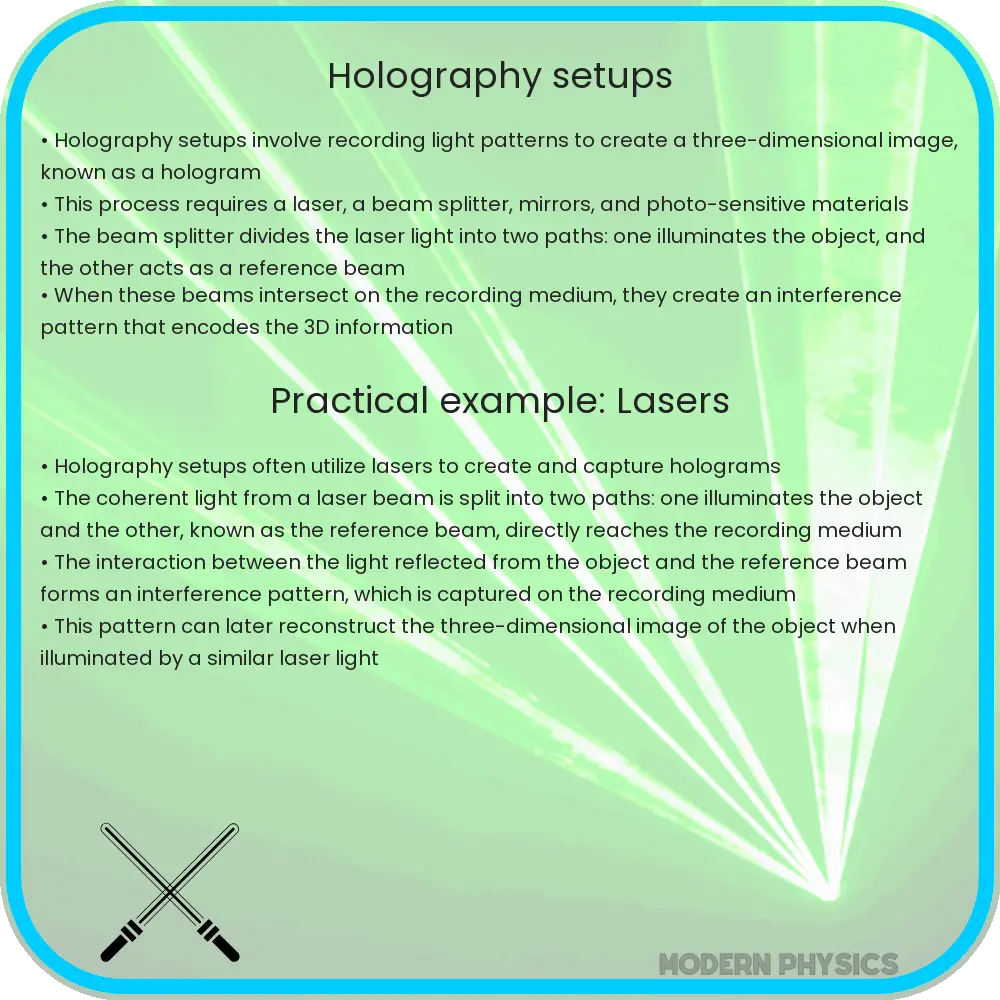
The realm of holography, a technique for recording and displaying three-dimensional images, is a fascinating intersection of physics, optics, and artistry. This advanced imaging technology relies heavily on precision, clarity, and innovative optical setups to create holograms that are not only visually stunning but also scientifically significant. In this exploration, we delve into the critical aspects of holography setups, highlighting the importance of these three pillars in the creation of high-quality holographic images.
Precision in Holographic Optics
At the core of holography is the concept of interference and diffraction of light waves, a phenomenon that requires meticulous precision in optical alignment. Precision in holography setups is paramount, as even the slightest deviation can lead to significant errors in the final hologram. This precision involves the accurate positioning of lasers, mirrors, and lenses to ensure coherent light is directed precisely onto the recording medium. The use of high-quality optical components, capable of minimizing aberrations and maintaining the integrity of the light wavefronts, is essential for achieving the desired accuracy.
Clarity in Hologram Production
Clarity in holography not only pertains to the visual quality of the hologram but also to the coherence and quality of the light source used. Lasers, with their high coherence and monochromatic properties, serve as the ideal light source for holography. The clarity of a hologram is directly related to the coherence length of the laser, where a longer coherence length facilitates the creation of clearer and more detailed holographic images. Additionally, the recording medium’s resolution plays a critical role in capturing the fine interference patterns necessary for high-definition holography.
Innovation in Holographic Techniques
Innovation in holography setups has led to the development of new techniques and materials that expand the possibilities of holographic imaging. Digital holography, for example, employs digital sensors and computer algorithms to reconstruct holographic images, allowing for greater flexibility and applications in data storage, microscopy, and even in the realm of art. Emerging materials like photopolymer films offer higher resolution and sensitivity, enabling the capture of more complex holographic images without the need for chemical development processes.
Advancements in Holographic Display Technologies
The evolution of holography setups has not only improved the quality of holographic images but also paved the way for innovative display technologies. Recent advancements include holographic projectors that can display full-color, high-resolution images and videos in mid-air, offering a new dimension to visual presentations and entertainment. These projectors utilize sophisticated optics and digital processing to create images that appear to float in space, visible without the need for special glasses. This breakthrough represents a significant leap forward in creating immersive and interactive experiences.
Challenges and Future Directions
Despite the significant progress in holographic technologies, challenges remain. High on the list is the need for increased brightness and visibility of holographic displays under various lighting conditions, especially in direct sunlight. Furthermore, the quest for more compact and energy-efficient holography setups continues, with ongoing research focused on integrating nanotechnology and advanced materials science to achieve these goals.
Future directions in holography also include the expansion of its applications beyond imaging and display. Holographic data storage presents a promising avenue for handling the exponential growth of data, offering high density and fast retrieval speeds. Additionally, holographic optical elements (HOEs) are being explored for their potential in augmenting the capabilities of optical systems, including sensors, lenses, and even solar panels, by manipulating light in novel ways.
Conclusion
Holography setups, characterized by their precision, clarity, and innovative approaches, continue to revolutionize the field of optics and imaging. As technology advances, the boundaries of what can be achieved with holography are continually expanding, offering new opportunities for scientific research, data storage, and even in creating immersive visual experiences. The challenges that lie ahead serve not as roadblocks but as stepping stones towards the next generation of holographic technologies. With ongoing research and development, the future of holography looks brighter than ever, promising to bring the wonders of three-dimensional imaging closer to everyday life.