
Explore the mysteries of the Leo I Dwarf Galaxy, its structure, evolution, and dark matter significance in this insightful article on galactic archaeology and cosmic history.
The Enigmatic Realm of Leo I Dwarf Galaxy
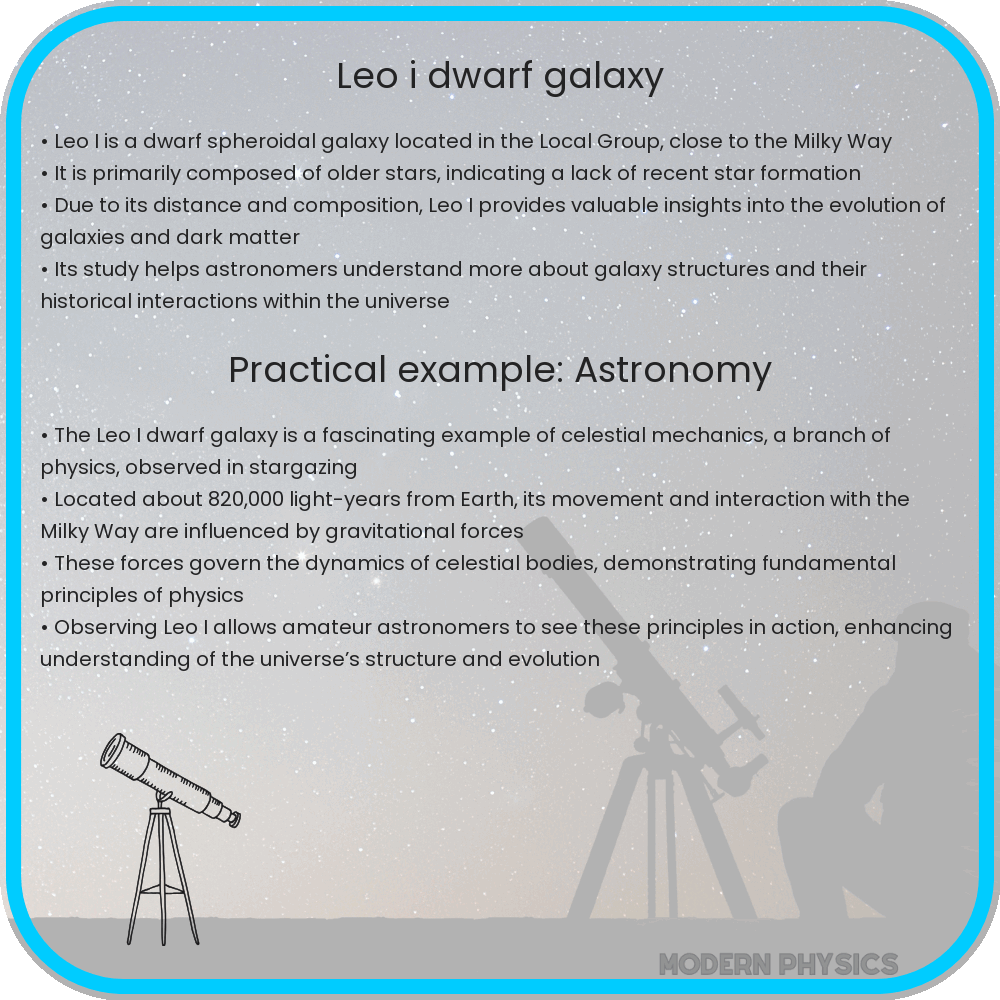
The Leo I Dwarf Galaxy is a fascinating celestial object, nestled in the constellation of Leo, and is part of the Local Group of galaxies that includes the Milky Way. This enigmatic galaxy holds key insights into the mysteries of galactic formation, evolution, and the nature of dark matter. Despite its diminutive size, Leo I provides a unique window into the past, presenting an almost untouched record of the early universe.
Understanding Leo I’s Structure
Leo I is classified as a dwarf spheroidal galaxy, characterized by its elliptical shape and lack of clear structure such as spiral arms or a bright nucleus common in larger galaxies. Dwarf spheroidals are among the most common types of galaxies in the universe, yet they remain elusive due to their low brightness and sparse stellar content. Leo I is particularly notable for its extreme distance from the Milky Way, situated approximately 820,000 light-years away, making it one of the most remote satellites of our galaxy.
The stellar composition of Leo I is intriguing, as it is predominantly made up of old stars, indicating that the majority of its star formation occurred billions of years ago. This ancient stellar population provides invaluable clues to astronomers studying the early stages of galaxy formation and the evolutionary processes that have shaped the cosmos.
Mysteries of Dark Matter in Leo I
One of the most compelling aspects of the Leo I Dwarf Galaxy is its role in the ongoing investigation into dark matter. Despite its small size, the gravitational effects observed in Leo I suggest the presence of a significant amount of dark matter, much like other dwarf spheroidal galaxies. The dynamics of stars within Leo I cannot be explained solely by the visible matter present, leading scientists to propose that dark matter constitutes a large portion of the galaxy’s mass.
This invisible substance does not emit, absorb, or reflect light, making it incredibly difficult to detect. However, by studying galaxies like Leo I, astronomers can infer the presence and properties of dark matter based on the gravitational influence it exerts on visible stars and gas.
Evolutionary Insights from Leo I
The evolutionary history of Leo I is marked by its isolation and the cessation of star formation activities. Unlike more dynamic galaxies, Leo I appears to have undergone a relatively quiet evolution, with most of its stars forming over 10 billion years ago. This cessation of star formation is possibly due to the galaxy losing its interstellar gas, either stripped away by interactions with the Milky Way or used up in its early bursts of star formation. This scenario provides a stark contrast to more active galaxies and helps scientists understand the varied evolutionary paths that galaxies can take.
Furthermore, the isolated nature of Leo I allows astronomers to study a system that has been largely undisturbed by external forces. This makes it an ideal candidate for studying the intrinsic properties of dwarf galaxies and their dark matter content without the complications of recent interactions with other galaxies.
Leo I’s Contribution to Galactic Archaeology
Galactic archaeology is a field of study that uses the positions, motions, and chemical compositions of stars within galaxies to reconstruct their evolutionary histories. Leo I, with its ancient stars and relative simplicity, serves as an excellent subject for this type of study. The chemical abundances in its stars, particularly the relative amounts of elements such as hydrogen, helium, and heavier metals, can tell scientists a great deal about the galaxy’s formation and evolution.
Studies of Leo I contribute to our understanding of how galaxies evolve in isolation, the nature and distribution of dark matter, and the processes that drive star formation and cessation. This knowledge not only illuminates the history of the Leo I Dwarf Galaxy itself but also enhances our understanding of the universe’s structure and the fundamental principles governing it.
Conclusion
The Leo I Dwarf Galaxy, while small in size, plays a monumental role in our understanding of the cosmos. Its ancient stars, predominance of dark matter, and evolutionary silence speak volumes about the early universe, the nature of dark matter, and the pathways of galactic evolution. By studying this quiet galaxy, astronomers unlock secrets of the past, providing insights into the formation and growth of the universe’s myriad galaxies. Leo I stands as a testament to the significance of even the smallest members of the cosmic family, reminding us that in the vast expanse of the universe, every object has a story to tell, contributing to the greater narrative of space and time.