
Explore the mystery of the Galactic Center Gamma-Ray Excess, its potential origins from dark matter to pulsars, and the challenges in unraveling this cosmic enigma.
Galactic Center Gamma-Ray Excess: Unraveling the Cosmic Enigma
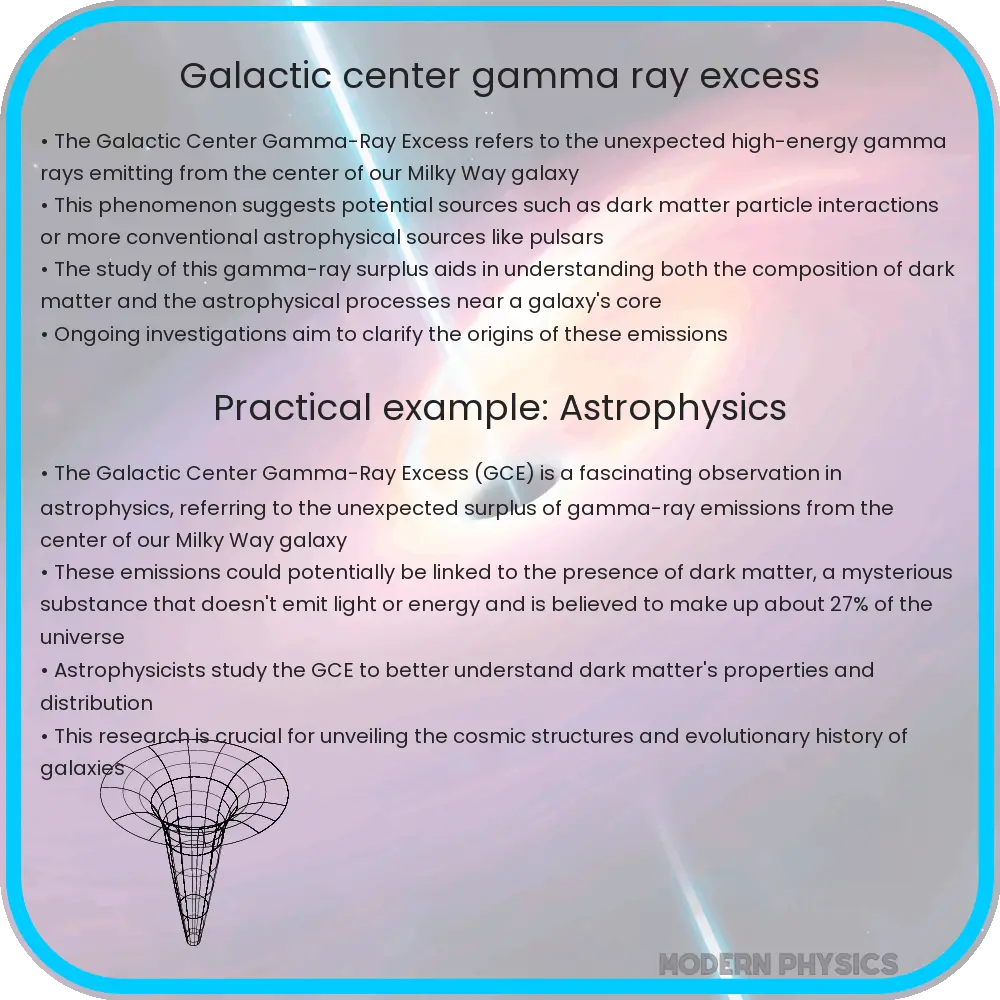
The Galactic Center Gamma-Ray Excess (GCE) refers to the unexpected surge of gamma-ray emissions from the center of our Milky Way galaxy. This phenomenon has puzzled astronomers and astrophysicists since its discovery in the early 2000s. Gamma rays, the most energetic form of light, hold crucial information about the most extreme conditions in the universe, such as black holes, neutron stars, and supernova remnants.
The origin of the GCE remains a subject of intense debate and speculation within the scientific community. Several theories have been proposed to explain the source of these enigmatic emissions. One popular hypothesis suggests that the excess gamma rays could be the result of dark matter annihilation. Dark matter, a hypothetical form of matter that does not emit, absorb, or reflect light, is believed to make up approximately 85% of the matter in the universe. If dark matter particles, such as Weakly Interacting Massive Particles (WIMPs), were to collide and annihilate each other, they could potentially emit gamma rays, contributing to the GCE.
Alternatively, the excess could be attributed to more conventional astrophysical sources. For instance, a large population of millisecond pulsars (MSPs) — rapidly spinning neutron stars emitting beams of radiation — in the Galactic Center could be responsible for the gamma-ray emissions. These MSPs are difficult to detect individually due to their distance, dimness, and the crowded nature of the Galactic Center, but collectively, they could produce a significant amount of gamma radiation.
Other potential explanations include the presence of outflows from the supermassive black hole at the galaxy’s center or the remnants of supernova explosions. Each of these sources is known to emit gamma rays, contributing to the complex and rich gamma-ray background of our galaxy.
Understanding the GCE is crucial for our comprehension of the Galactic Center’s environment and the processes occurring within it. It also has profound implications for our understanding of dark matter, one of the most significant mysteries in modern astrophysics. Through continuous observation and analysis, scientists aim to unravel the origins of this gamma-ray excess, shedding light on the dark corners of our universe.
Advancements and Challenges in Understanding the Galactic Center Gamma-Ray Excess
To delve deeper into the mystery of the Galactic Center Gamma-Ray Excess, researchers utilize a variety of sophisticated instruments and methodologies. Observations from space-based gamma-ray telescopes, such as the Fermi Large Area Telescope (LAT), have been instrumental in providing high-resolution data of the gamma-ray sky. These observations are complemented by theoretical models and simulations that attempt to replicate the conditions of the Galactic Center and predict gamma-ray emissions.
Despite these efforts, the GCE remains an unresolved enigma. The interpretation of the data is complicated by the dense and dynamic nature of the Galactic Center, which is filled with various sources of gamma rays. Additionally, the potential signals from dark matter or other exotic phenomena are subtle and easily masked by the background noise from more mundane astrophysical processes.
The scientific community continues to explore new avenues to resolve this cosmic mystery. Upcoming missions and telescopes, equipped with more sensitive detectors and advanced technology, promise to provide clearer insights. Moreover, interdisciplinary approaches combining gamma-ray astronomy with other fields, such as particle physics and cosmology, are expected to play a crucial role in advancing our understanding.
Conclusion
The Galactic Center Gamma-Ray Excess is a captivating puzzle that sits at the crossroads of astronomy, astrophysics, and particle physics. It challenges our understanding of the cosmos, pushing the boundaries of our scientific knowledge and technological capabilities. The mystery of the GCE not only highlights the complexities of the universe but also underscores the importance of continued exploration and collaboration in the scientific community.
As research progresses, the resolution of the GCE could lead to groundbreaking discoveries, potentially unveiling the nature of dark matter or revealing new astrophysical phenomena. Regardless of the outcome, the journey to understand the Galactic Center Gamma-Ray Excess is a testament to human curiosity and our relentless pursuit of the unknown. As we stand on the brink of new discoveries, the Galactic Center continues to be a beacon, inviting us to delve deeper into the mysteries of the universe.