
Laser interferometry is a precise optical measurement technique using laser properties to measure distances and surface details accurately.
Laser Interferometry in Optics
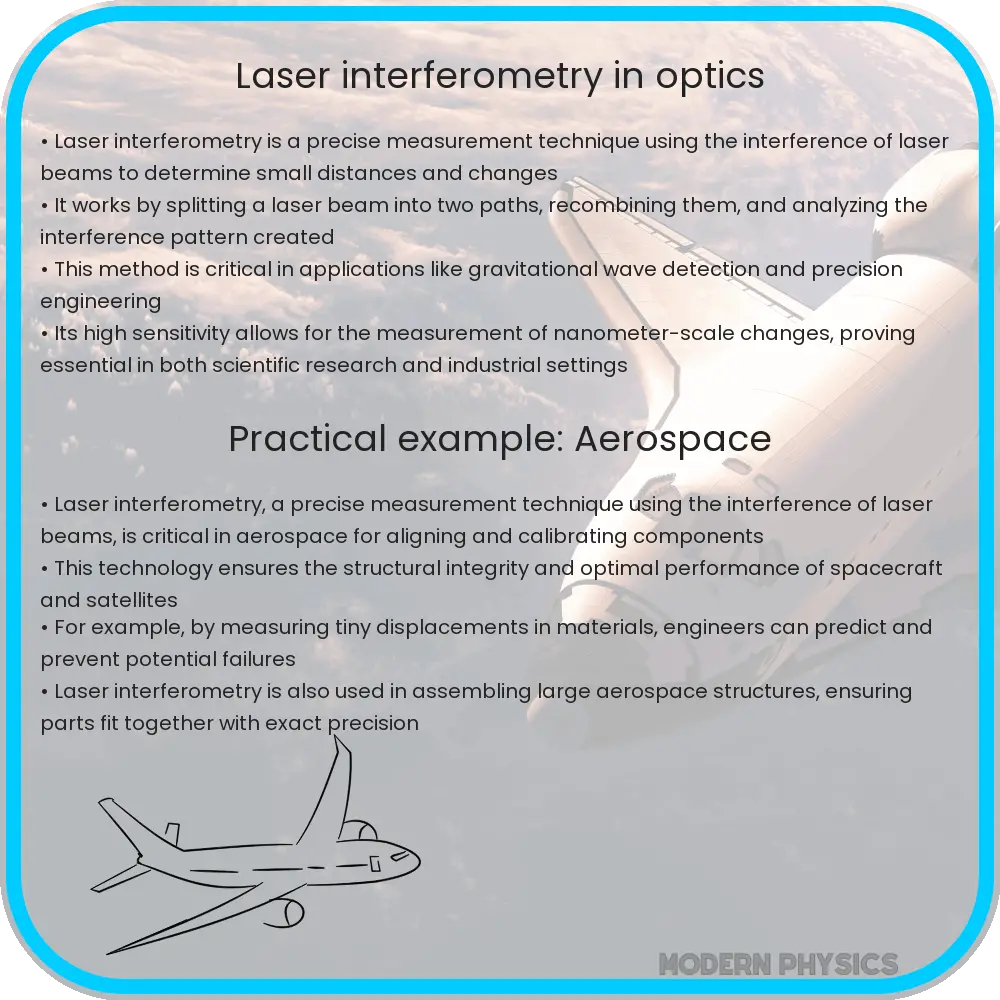
Laser interferometry is a powerful and precise measurement tool used in the field of optics, characterized by its high accuracy and precision. This technology utilizes the properties of lasers to measure distances, changes in position, and surface irregularities with exceptional precision. It is particularly useful in applications where minute measurements are critical, ranging from engineering and manufacturing to fundamental science research.
Principles of Laser Interferometry
At its core, laser interferometry involves the superposition of light waves emitted from a laser source. This process is governed by the principle of interference, which occurs when two or more waves superpose to form a resultant wave of greater, lower, or the same amplitude. In practical terms, a laser beam is typically split into two paths: a reference path and a measurement path. After reflecting off their respective mirrors, the beams are recombined. The pattern of interference created by the overlapping beams provides detailed information about the difference in distance traveled by the two beams.
The fundamental equation governing laser interferometry is expressed as:
\[ \Delta L = \frac{\lambda}{2} \cdot N \]
where:
- \(\Delta L\) represents the change in length or displacement,
- \(\lambda\) is the wavelength of the laser light,
- \(N\) is the number of fringes or interference lines observed.
Accuracy and Precision
The accuracy of laser interferometry is predominantly influenced by the wavelength of the laser used. Since the wavelength of light is extremely small and can be precisely measured, laser interferometers can achieve measurements with accuracies up to the sub-nanometer level. Precision, on the other hand, is enhanced by the stability of the laser output, the quality of optical components, and environmental control to mitigate the effects of temperature, vibration, and air turbulence.
Applications of Laser Interferometry
Laser interferometry has wide-ranging applications across various fields. Here are some of the most notable uses:
- Engineering and Manufacturing: In the production of mechanical parts, laser interferometry is used to measure and ensure the precision of components. It is also vital in the alignment and calibration of machinery.
- Optical Testing: It plays an essential role in the testing and quality assurance of optical components, such as lenses and mirrors, ensuring they meet stringent specifications.
- Earth Sciences: Laser interferometers are employed to monitor tectonic movements and vibrations in the earth’s crust, which can provide valuable data for earthquake prediction.
- Gravitational Wave Detection: One of the most groundbreaking applications is in the field of astrophysics, where laser interferometry is used in projects like LIGO (Laser Interferometer Gravitational-Wave Observatory) to detect gravitational waves, providing insights into cosmic events like black hole mergers.
With its precision and versatility, laser interferometry continues to be a cornerstone technique in both scientific research and technical disciplines. Its ability to provide accurate measurements down to the molecular level underscores its importance in today’s technologically driven world.
Challenges and Limitations
Despite its numerous advantages, laser interferometry does face certain challenges and limitations. Precision can be influenced by external factors such as air currents, temperature fluctuations, and mechanical vibrations. Specialized environments or equipment, such as vacuum chambers or vibration isolation systems, are often required to mitigate these effects. Additionally, the complexity of the setup and the need for highly reflective surfaces can limit its applicability in some scenarios.
The Future of Laser Interferometry
Advancements in technology continue to enhance the capabilities of laser interferometry. Innovations in laser sources, optical materials, and digital signal processing are expected to improve not only the accuracy and precision but also the ease of use and flexibility of the setups. Furthermore, the integration of artificial intelligence and machine learning could lead to smarter, more adaptive interferometric systems, capable of automatic calibration and error correction.
Researchers are also exploring new applications of laser interferometry, such as in biomedical imaging and environmental monitoring. These developments promise to open new frontiers in both applied and theoretical fields, making laser interferometry an ever-evolving tool in the arsenal of modern science and engineering.
Conclusion
Laser interferometry, with its foundation on the principles of wave interference and precise measurement capabilities, continues to be an indispensable technology in numerous fields. From enhancing the production quality of industrial components to probing the mysteries of the universe through gravitational wave detection, its applications are as vast as they are impactful. Despite facing some challenges related to environmental influences and operational complexities, ongoing technological advancements are steadily overcoming these barriers, paving the way for more robust and wide-ranging applications in the future.
As we look forward, the evolution of laser interferometry promises not only to refine our measurement capabilities but also to expand our understanding of the natural world. It stands as a testament to the power of merging fundamental physics with cutting-edge technology to solve real-world problems.