
Explore the Keldysh Formalism and its impact on quantum theory, from non-equilibrium dynamics to practical applications in nanotechnology.
Keldysh Formalism: Unraveling the Mysteries of Non-Equilibrium Dynamics in Quantum Theory
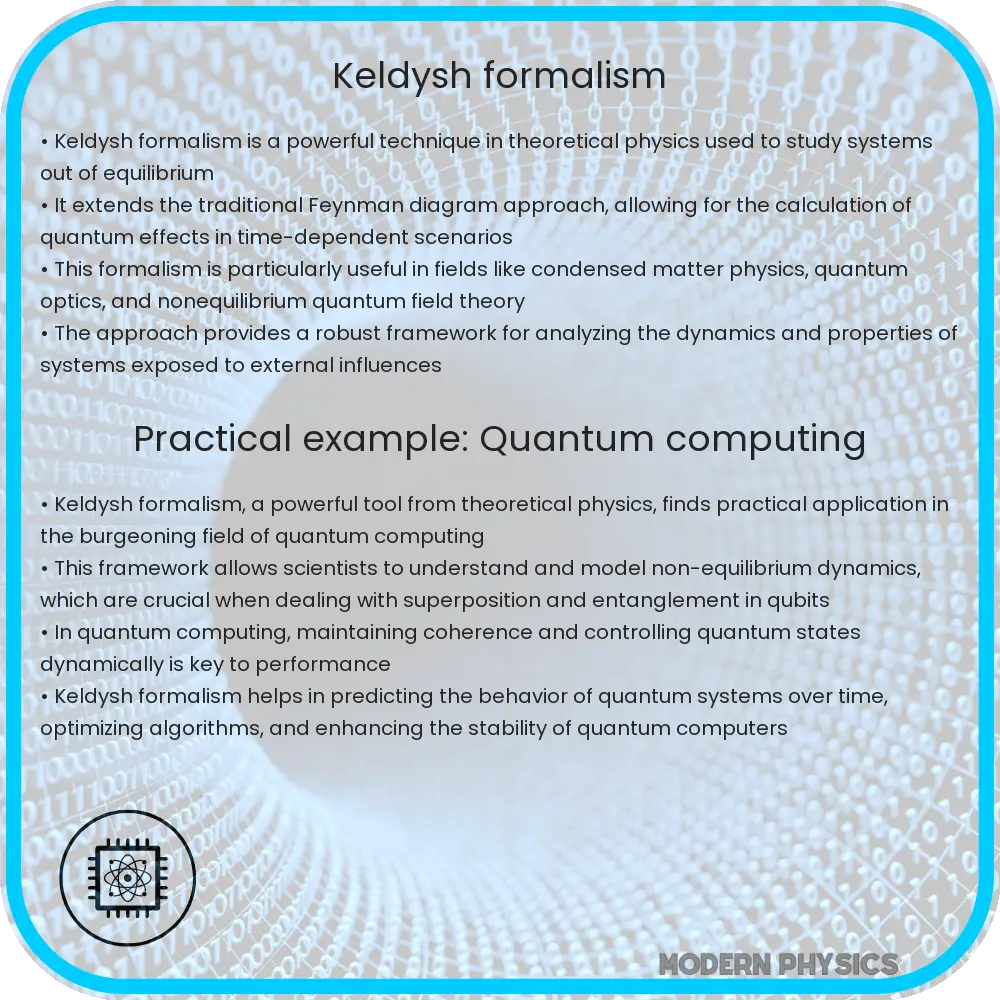
The Keldysh Formalism, a powerful tool in theoretical physics, provides deep insights into the behavior of quantum systems far from equilibrium. Developed by Russian physicist Leonid Keldysh in the mid-20th century, this approach has revolutionized our understanding of non-equilibrium dynamics in quantum mechanics, offering a robust framework to tackle complex phenomena in solid-state physics, quantum optics, and condensed matter physics.
Understanding the Core Concepts
At its core, Keldysh Formalism is a non-equilibrium version of the well-known Green’s function technique used in many-body quantum physics. Unlike traditional methods that deal with systems in a steady state, Keldysh’s approach allows for the exploration of time-dependent processes in quantum systems. This is essential for understanding the dynamic behavior of electrons in semiconductors, superconductors, and other materials under external influences like electric fields or laser pulses.
Application in Modern Physics
The methodology has found extensive applications in various domains of physics. One prominent example is in quantum transport theory, where it provides a framework to study the flow of particles, such as electrons, in a non-equilibrium setting. This is crucial for the development of nanoscale devices and quantum computing elements, where understanding electron dynamics is key to improving efficiency and performance.
The Mathematical Framework
The mathematical structure of Keldysh Formalism is built on the concept of the contour-ordered Green’s function. This function takes into account the time evolution of quantum states along a complex time contour. This contour runs forward and then backward in time, elegantly encompassing both the equilibrium and non-equilibrium aspects of the system. The beauty of this approach lies in its ability to reduce to the familiar equilibrium formalisms in the appropriate limit, thus providing a unified view of quantum dynamics.
Another significant aspect is its role in the study of quantum field theory in curved spacetime, where it helps to understand phenomena like Hawking radiation and particle creation in an expanding universe. In these scenarios, Keldysh Formalism offers a unique perspective on how quantum fields behave in non-traditional settings, shedding light on some of the most enigmatic aspects of the cosmos.
In conclusion, Keldysh Formalism is a cornerstone of modern quantum theory, providing a versatile and profound framework for exploring the intricate dynamics of quantum systems in non-equilibrium states. Its applications range from condensed matter physics to cosmology, making it an indispensable tool in the theoretical physicist’s toolkit.
Stay tuned for the second part, where we delve deeper into the practical applications and recent advancements in the field, driven by Keldysh Formalism.
Practical Applications and Advancements in Keldysh Formalism
The utility of Keldysh Formalism extends beyond theoretical constructs into practical applications, particularly in nanotechnology and quantum computing. A notable application is in the realm of quantum dots and nanowires, where understanding electron transport at the quantum level is crucial. Here, Keldysh Formalism helps in analyzing the quantum states and their evolution, enabling advancements in the design of quantum circuits and nanoscale electronic devices.
Additionally, in the field of quantum optics, Keldysh Formalism is instrumental in studying light-matter interactions under non-equilibrium conditions. This has profound implications in the development of high-precision lasers and photonic devices, which are pivotal in various technological and scientific applications.
Recent Advancements and Future Prospects
Recent advancements in computational physics have allowed for more sophisticated applications of Keldysh Formalism. Complex numerical simulations, which incorporate this formalism, have led to new insights in high-temperature superconductivity and topologically non-trivial materials. These materials exhibit exotic properties and hold promise for revolutionary applications in electronics and quantum information science.
The integration of Keldysh Formalism with other quantum mechanical frameworks and numerical methods is another area of active research. This synergy has the potential to unravel new quantum phenomena and foster innovative approaches to understanding and manipulating quantum systems.
Conclusion: The Impact and Future of Keldysh Formalism
In conclusion, Keldysh Formalism stands as a pillar in the understanding of non-equilibrium quantum dynamics. Its versatility and depth have made it an essential tool in both theoretical and applied physics. The formalism’s ability to model complex time-dependent quantum systems has opened new avenues in numerous fields, ranging from condensed matter physics to quantum computing.
As we venture further into the quantum realm, the insights provided by Keldysh Formalism will undoubtedly continue to play a critical role. Its ongoing development and integration with other theoretical frameworks and computational techniques promise to deepen our understanding of the quantum world and pave the way for groundbreaking technological advancements. Thus, Keldysh Formalism not only enriches our current understanding but also lights the path towards future discoveries in the quantum universe.
This article provides a glimpse into the fascinating world of Keldysh Formalism and its profound impact on our understanding of quantum theory. As we continue to explore the depths of quantum mechanics, the relevance and application of this formalism are bound to expand, unlocking further mysteries of the universe.